
The Subatomic Foundation of Electrical Charge
In the realm of electrical fundamentals, we routinely calculate current as the macroscopic flow of electrons through a conductor, such as a copper wire. However, to truly master electrical physics and instrumentation, one must understand the behavior of charge carriers at the subatomic level, particularly when they are liberated not by a voltage potential, but by nuclear decay. When analyzing the electric charge of beta particle emissions, engineers and physicists must bridge the gap between standard circuit theory and nuclear physics. This comparison guide explores the fundamental properties of beta particles, contrasting them with alpha and gamma radiation, and examines how their specific electrical charges dictate their behavior in electromagnetic fields and solid-state electronics.
Defining the Electric Charge of Beta Particle Emissions
Unlike standard conduction electrons that drift through a wire at millimeters per second, beta particles are high-energy, high-speed electrons or positrons ejected from the nucleus of a radioactive atom during beta decay. The exact electric charge of beta particle variants depends entirely on the type of decay occurring:
Beta-Minus ($\beta^-$) Decay
In $\beta^-$ decay, a neutron in an unstable nucleus transforms into a proton, emitting an electron (the beta-minus particle) and an electron antineutrino. The electric charge of this beta particle is exactly $-1e$, which translates to $-1.602176634 \times 10^{-19}$ Coulombs. This is the exact same fundamental charge magnitude as the electrons flowing through your household wiring, though the beta particle possesses vastly higher kinetic energy (often in the MeV range).
Beta-Plus ($\beta^+$) Decay
In $\beta^+$ decay, a proton converts into a neutron, emitting a positron (the beta-plus particle) and an electron neutrino. A positron is the antimatter counterpart of the electron. Consequently, the electric charge of this beta particle is $+1e$, or $+1.602176634 \times 10^{-19}$ Coulombs. Since the 2019 redefinition of the SI base units by the National Institute of Standards and Technology (NIST), this elementary charge value is an exact, fixed constant.
Comparative Analysis: Beta vs. Alpha vs. Gamma
To contextualize the electrical properties of beta emissions, we must compare them against other common forms of nuclear radiation. The charge of the particle directly dictates its Linear Energy Transfer (LET)—the amount of energy it deposits into surrounding materials per unit of distance.
| Radiation Type | Identity | Relative Charge (e) | Charge (Coulombs) | Ionization Density (LET) |
|---|---|---|---|---|
| Alpha ($\alpha$) | Helium Nucleus | +2 | $+3.204 \times 10^{-19}$ | Very High |
| Beta-Minus ($\beta^-$) | Electron | -1 | $-1.602 \times 10^{-19}$ | Moderate / Low |
| Beta-Plus ($\beta^+$) | Positron | +1 | $+1.602 \times 10^{-19}$ | Moderate / Low |
| Gamma ($\gamma$) | Photon | 0 | 0 | Very Low (Indirect) |
Key Takeaway: While an alpha particle carries twice the positive charge of a beta-plus particle, its mass is roughly 7,300 times greater. This massive difference means the electric charge of beta particle emissions results in vastly deeper penetration depths but lower localized ionization compared to alpha particles. For a deeper dive into nuclear decay mechanics, refer to the HyperPhysics beta decay database.
Behavior in Electromagnetic Fields (Lorentz Force)
Because beta particles carry a net electrical charge, their trajectories are heavily influenced by external electric and magnetic fields. This behavior is governed by the Lorentz force equation:
$\vec{F} = q(\vec{E} + \vec{v} \times \vec{B})$
Where q is the electric charge of the beta particle, E is the electric field, v is the velocity, and B is the magnetic field.
- Magnetic Deflection: When a mixed beam of alpha, beta, and gamma radiation passes through a magnetic field, gamma rays (charge 0) pass straight through. Alpha particles (+2 charge) curve slightly in one direction. Beta particles (-1 or +1 charge) curve sharply in the opposite direction due to their minuscule mass and opposite charge polarity.
- Electric Field Acceleration: In an electric field, $\beta^-$ particles are accelerated toward the positive anode, while $\beta^+$ particles accelerate toward the negative cathode. This principle is heavily utilized in particle accelerators and mass spectrometers.
Engineering Implications: Shielding and Bremsstrahlung
Understanding the electric charge of beta particle emissions is critical for electrical engineers designing instrumentation for aerospace, nuclear, or high-altitude environments. A common and dangerous misconception is that heavy metals like lead are the best shield for all radiation.
The Bremsstrahlung Effect
When a high-velocity beta-minus particle (negative charge) approaches the nucleus of a high-Z (high atomic number) material like lead, the intense positive electric field of the lead nucleus violently decelerates the beta particle. According to classical electrodynamics, a decelerating charge emits electromagnetic radiation. This generates Bremsstrahlung (braking radiation), which manifests as highly penetrating X-rays.
Practical Shielding Protocol:
- Primary Layer (Low-Z): Use materials with low atomic numbers and low nuclear charge, such as polycarbonate, acrylic, or aluminum. These materials decelerate the beta particles gradually, minimizing X-ray generation while absorbing the kinetic energy via ionization.
- Secondary Layer (High-Z): If secondary Bremsstrahlung X-rays or gamma rays are present, a secondary layer of lead or tungsten is added behind the low-Z material to absorb the photons.
Semiconductor Degradation and Single Event Upsets (SEUs)
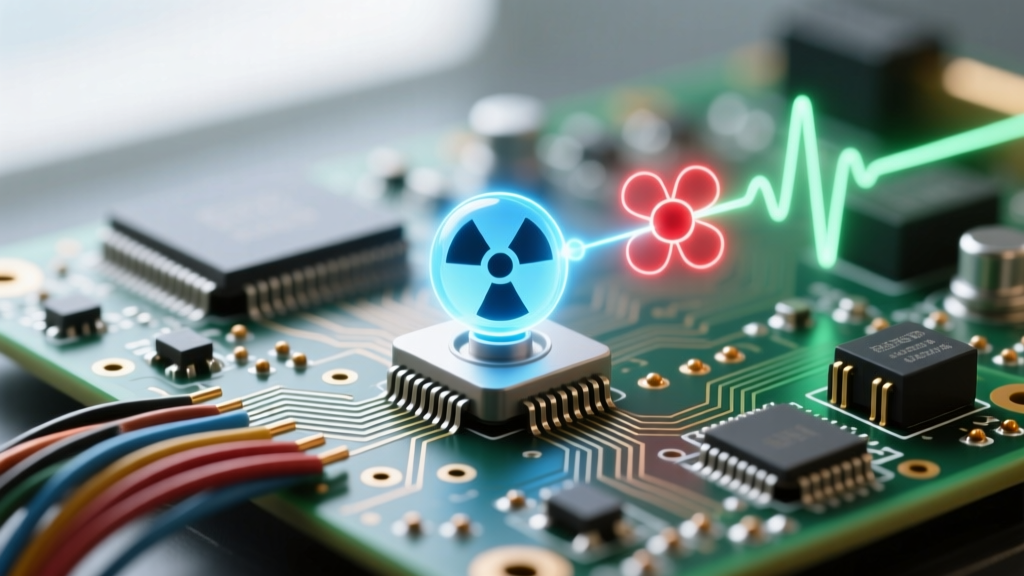
In modern microcontrollers and solid-state relays, the miniaturization of transistor gates makes them highly susceptible to ionizing radiation. When the electric charge of beta particle emissions passes through a silicon substrate, it knocks valence electrons out of their covalent bonds, creating electron-hole pairs.
- Total Ionizing Dose (TID): Over time, the accumulation of trapped charges in the gate oxide of a MOSFET shifts the threshold voltage, leading to increased leakage currents and eventual component failure.
- Single Event Upsets (SEU): A single high-energy beta particle passing through a memory cell can deposit enough charge to flip a binary 0 to a 1, causing data corruption in SRAM or FPGA arrays. Engineers mitigate this by using Triple Modular Redundancy (TMR) and error-correcting code (ECC) memory in radiation-prone environments.
Measurement and Detection Instruments
Detecting the presence and energy of beta particles relies directly on their electrical charge. Instruments like Geiger-Müller (GM) tubes operate by filling a chamber with an inert gas (like argon) and applying a high voltage potential across an anode and cathode. When a beta particle enters the tube, its charge ionizes the gas atoms. The freed electrons cascade toward the anode, creating a measurable current pulse that the instrument registers as a "click" or count.
Conversely, because gamma rays lack an electric charge, they are far less likely to interact with the gas directly, making standard GM tubes highly efficient at detecting beta radiation compared to gamma radiation. The Environmental Protection Agency (EPA) provides extensive guidelines on how these detection principles are applied in environmental safety and dosimetry.
Summary: Why Fundamental Charge Matters
Whether you are sizing a 12 AWG ground wire for a residential panel or designing a radiation-hardened circuit board for a satellite, the fundamental unit of charge remains the cornerstone of electrical engineering. The electric charge of beta particle emissions—whether negative or positive—dictates how these subatomic projectiles interact with magnetic fields, shielding materials, and semiconductor lattices. By comparing beta particles to their alpha and gamma counterparts, engineers can accurately predict ionization densities, prevent catastrophic Bremsstrahlung X-ray generation, and design robust electronic systems capable of surviving extreme environments.