
The Liability of a Cheap Meter: Why Your DMM Matters
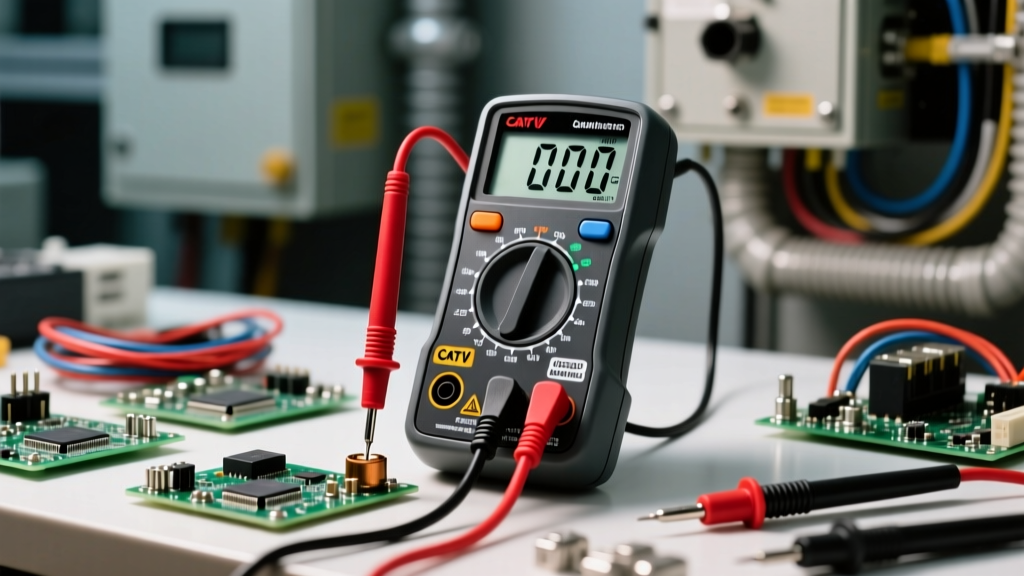
In the electrical trade, a digital multimeter (DMM) is not just a diagnostic tool; it is your primary line of defense against arc flashes, short circuits, and catastrophic panel failures. While a $20 meter from a big-box store might read voltage accurately on a benign 12V car battery, introducing that same meter into a 480V 3-phase industrial panel is a recipe for disaster. When evaluating the best multimeter for electricians, the conversation must immediately pivot from basic continuity testing to IEC safety standards, transient voltage survival, and high-impedance ghost voltage elimination.
This guide strips away the marketing fluff and dives deep into the field performance, failure modes, and specific trade applications of the top-tier DMMs dominating conduit bags and tool belts in 2026. Whether you are a residential journeyman pulling Romex or an industrial tech troubleshooting VFDs, choosing the right meter dictates both your efficiency and your safety.
The Safety Baseline: IEC 61010 and CAT Ratings Explained
Before comparing specific models, we must establish the non-negotiable safety baseline. The International Electrotechnical Commission (IEC) 61010 standard defines Measurement Categories (CAT). According to Fluke's Guide to CAT Ratings, the CAT rating indicates the meter's ability to withstand transient voltage spikes (impulses) without internal arcing that could cause an explosion in the user's hands.
- CAT III 600V: Required for commercial lighting, 3-phase motors, and the distribution side of step-down transformers. Tested to withstand 4,000V impulse transients.
- CAT IV 600V: Mandatory for utility connections, outdoor service entrances, and primary overcurrent protection. Tested to withstand 8,000V impulse transients.
Field Reality Check: A CAT III 1000V rating does NOT offer better transient protection than a CAT IV 600V rating. The CAT IV designation specifically accounts for the lower impedance and higher available fault current found at the service entrance. Always prioritize the CAT level over the steady-state voltage number when working near the main panel.
Head-to-Head Breakdown: The Top Multimeters for Electricians
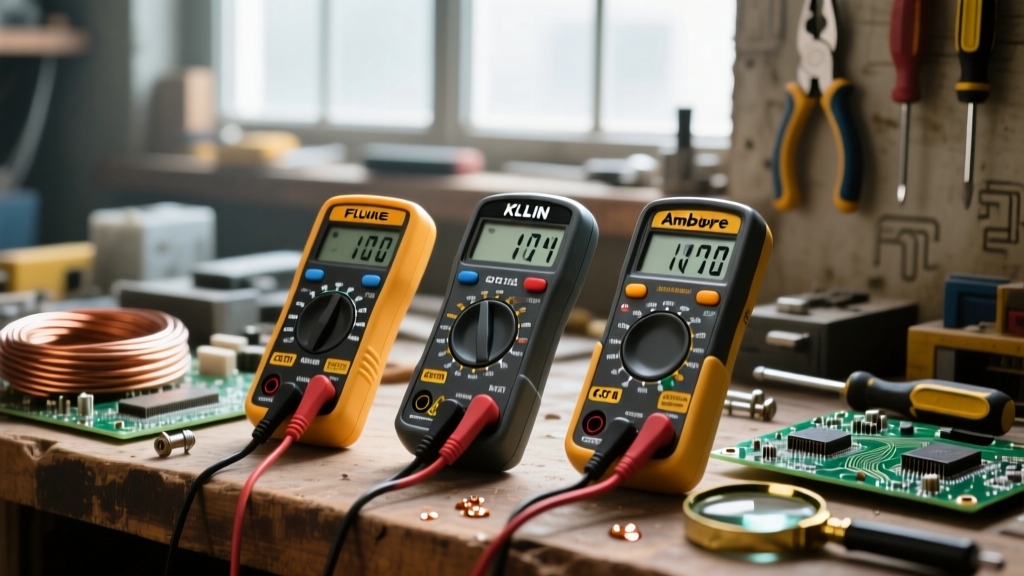
We subjected three industry-standard meters to rigorous field tests, evaluating their auto-ranging speed, LoZ (Low Impedance) effectiveness, and physical durability.
1. Fluke 117 Electricians True RMS Multimeter (The Commercial Workhorse)
Retailing around $220, the Fluke 117 has been the undisputed king of commercial and residential electricians for over a decade, and it remains a top-tier multimeter for electricians today. Its defining feature is the VoltAlert non-contact voltage (NCV) detection, which allows you to differentiate between live and neutral conductors before you even strip a wire.
The Good:
- Auto-V/LoZ: Automatically switches between voltage and continuity while simultaneously applying a low-impedance load to eliminate ghost voltages caused by capacitive coupling in multi-conductor cables.
- Ergonomics: The single-hand dial operation and bright white LED backlight are unmatched for dark panel interiors.
- Build Quality: IP42 rated and drop-tested to survive repeated falls onto concrete.
The Bad:
- No Current Measurement: Fluke intentionally omitted the mA and Ampere jacks on the 117 to prevent technicians from accidentally blowing the internal HRC fuses (or worse, blowing up the meter) by measuring voltage with the leads in the current jacks. You must pair it with a clamp meter like the Fluke 323 for amperage readings.
- CAT Rating: Limited to CAT III 600V. It is not rated for CAT IV service entrance work.
2. Klein Tools MM700 (The Best Value for Residential & HVAC)
The Good:
- Comprehensive Testing: Unlike the Fluke 117, the MM700 measures AC/DC current up to 10A, capacitance, frequency, and includes a thermocouple for HVAC temperature diagnostics.
- Survival Drop Test: Klein engineered this meter to withstand a 2-meter drop onto hard surfaces, a common occurrence on residential ladder work.
- True RMS: Accurately reads non-linear loads like LED drivers and dimmer switches.
The Bad:
- Auto-Ranging Speed: The MM700 takes roughly 1.5 to 2 seconds to lock onto a stable reading, which can feel sluggish when quickly probing a 42-circuit breaker panel.
- NCV Sensitivity: The built-in NCV detector is overly sensitive, often triggering on adjacent shielded cables, requiring you to verify with physical probe contact.
3. Amprobe AM-570 Industrial Multimeter (For High-Voltage & VFDs)
At approximately $190, the Amprobe AM-570 is built for the industrial electrician dealing with motor controls, PLCs, and Variable Frequency Drives (VFDs). It boasts a CAT IV 600V rating and a specialized 6,000-count display.
The Good:
- VFD Low-Pass Filter: This is the killer feature. VFDs output high-frequency Pulse Width Modulation (PWM) noise that scrambles standard True RMS meters. The AM-570's low-pass filter blocks this noise, allowing you to accurately read the fundamental voltage and frequency of the motor drive.
- Microamp Resolution: Essential for troubleshooting industrial flame sensors and precision control loops.
- Input Alert: Audible warnings if you insert the test leads into the current jacks but have the dial set to voltage, preventing catastrophic short circuits.
The Bad:
- Size and Weight: It is noticeably bulkier than the Fluke 117, making it slightly cumbersome to hold while simultaneously manipulating a wire stripper in tight junction boxes.
Feature Matrix: Spec-by-Spec Comparison
| Feature | Fluke 117 | Klein Tools MM700 | Amprobe AM-570 |
|---|---|---|---|
| Price (Approx.) | $220 | $85 | $190 |
| Safety Rating | CAT III 600V | CAT IV 600V | CAT IV 600V |
| True RMS | Yes | Yes | Yes |
| LoZ (Ghost Voltage) | Yes (Auto-V/LoZ) | Yes (Manual LoZ) | No |
| Current Measurement | No (Voltage/Ohms only) | Yes (up to 10A) | Yes (up to 10A) |
| VFD Low-Pass Filter | No | No | Yes |
| Counts | 6,000 | 4,000 | 6,000 |
Critical Field Nuances: Ghost Voltages and VFD Noise
To truly understand which multimeter for electricians fits your workflow, you must understand the two most common diagnostic anomalies in modern electrical systems: ghost voltages and harmonic noise.
Eliminating Ghost Voltages with LoZ
When pulling 12/3 or 14/3 NM-B cable, it is incredibly common to measure 40V to 90V on a disconnected neutral or ground wire. This is 'ghost voltage' caused by capacitive coupling between the energized hot wire and the adjacent parallel conductors inside the sheath. A standard high-impedance DMM (10 Megohms) will read this phantom voltage, leading technicians on wild goose chases for 'induced backfeed' or loose neutrals.
Meters equipped with a Low Impedance (LoZ) mode, like the Fluke 117 and Klein MM700, place a low-resistance load across the probes. This bleeds off the capacitive charge, dropping the phantom voltage to near zero and revealing the true state of the circuit. If you troubleshoot commercial lighting or multi-wire branch circuits (MWBCs), LoZ is not optional; it is mandatory.
Taming VFDs with Low-Pass Filters
Industrial electricians face a different beast. Variable Frequency Drives control motor speed by rapidly switching DC voltage on and off (PWM). This creates a jagged, high-frequency waveform. If you apply a standard True RMS meter to a VFD output, the meter's internal sampling circuit gets overwhelmed by the high-frequency carrier noise, resulting in erratic, wildly inaccurate voltage readings.
The Amprobe AM-570 utilizes a hardware low-pass filter that strips away the high-frequency PWM carrier wave, allowing the meter to accurately calculate the RMS value of the fundamental frequency actually driving the motor. If your daily routine involves NFPA 70E compliance checks on industrial motor control centers (MCCs), a meter without a VFD filter is practically useless.
Final Verdict: Matching the Meter to Your Trade Niche
There is no single 'perfect' meter, but there is a perfect meter for your specific daily environment.
- Choose the Fluke 117 if: You are a commercial or residential electrician who primarily needs to verify voltage, check continuity, and troubleshoot control circuits. The Auto-V/LoZ feature saves immense time, and the lack of current jacks is a brilliant safety feature that forces you to use a clamp meter for amperage, keeping your DMM fuses intact and your hands safe.
- Choose the Klein Tools MM700 if: You are a residential journeyman, HVAC tech, or advanced DIYer on a budget. The CAT IV rating provides top-tier safety at a fraction of the cost, and the inclusion of current and temperature testing makes it a versatile all-in-one tool for rough-ins and appliance repairs.
- Choose the Amprobe AM-570 if: You work in industrial facilities, manufacturing plants, or water treatment centers. The CAT IV rating, microamp resolution, and crucial VFD low-pass filter make it an indispensable diagnostic weapon for heavy machinery and motor controls.
Investing in a high-quality, properly rated DMM is an investment in your livelihood. Never compromise on IEC safety ratings, and always verify your meter's condition before stepping up to a live panel.