
Upgrading your electrical toolkit is a rite of passage for any serious DIYer or apprentice. When you start tackling 200-amp panel upgrades, smart home integrations, or HVAC diagnostics, the $20 bargain-bin meter from the hardware store becomes a liability. This brings us to the industry gold standard: Fluke. But with price tags ranging from $170 to over $500, finding the best Fluke multimeter for electricians requires matching the tool's specific architecture to your actual project needs.
In this guide, we strip away the marketing jargon and break down the technical realities of the Fluke 115, 117, and 87V. We will explore real-world failure modes, the physics of ghost voltages, and the critical safety components that justify the premium price tag.
The Core Contenders: Decoding the Fluke Lineup
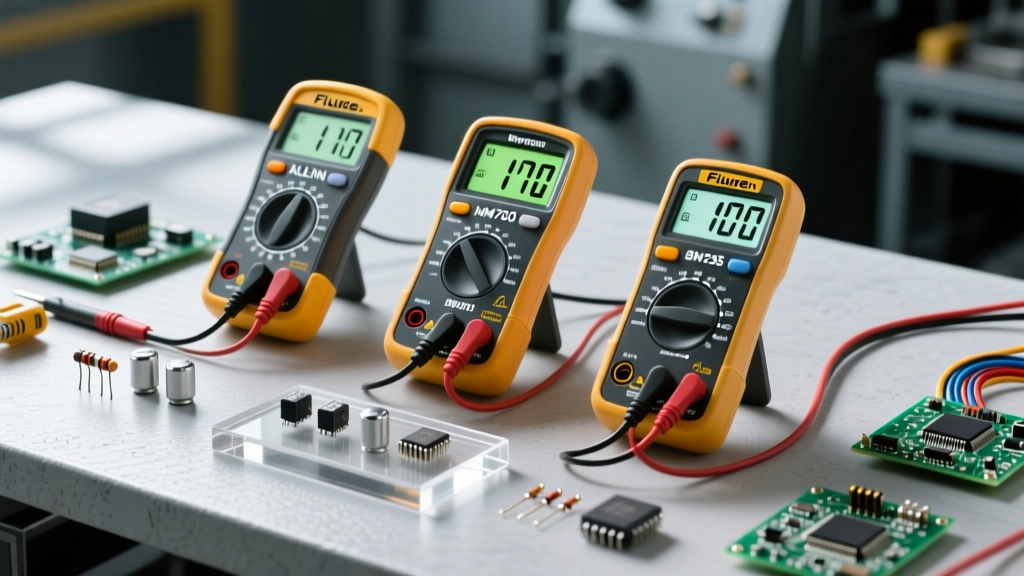
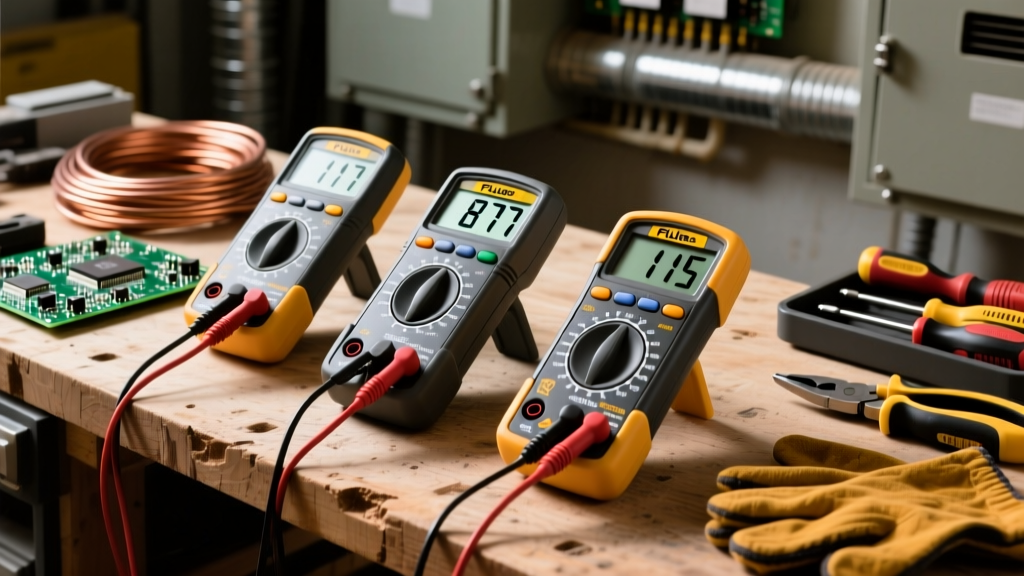
Fluke's portfolio is vast, but for general electrical and advanced DIY projects, three True-RMS models dominate the landscape. Understanding their baseline differences is crucial before making an investment.
- Fluke 115: The entry-level True-RMS workhorse. Excellent for basic continuity, voltage, and current checks, but lacks non-contact voltage (NCV) and low-impedance modes.
- Fluke 117: The commercial and residential electrician's standard. Adds VoltAlert (NCV) and Auto/Manual ranging, plus a specialized Low Impedance (LoZ) mode.
- Fluke 87V: The industrial powerhouse. Built for high-precision diagnostics, variable frequency drives (VFDs), and extreme environments. It features a 10,000-count display and a removable protective holster.
Project-Based Selection: Matching the Meter to the Task
Rather than just reading a spec sheet, let us look at how these meters perform during specific, high-stakes DIY and prosumer projects.
Scenario A: Residential Panel Upgrades & Ghost Voltage (Fluke 117)
When pulling new 12/2 or 14/2 NM-B (Romex) cables through crowded studs, you will frequently encounter 'ghost voltages.' Because the hot and neutral wires run parallel for long distances, capacitive coupling can induce a phantom voltage of 40V to 90V on a disconnected neutral or ground wire. A standard high-impedance meter (10 Megohms) will read this ghost voltage, leading you to believe a circuit is live when it is not.
The Fluke 117 solves this with its LoZ (Low Impedance) mode. By dropping the input impedance to roughly 3kΩ, the meter creates a small load that bleeds off the capacitive phantom charge, dropping the display to a true 0.0V. For any DIYer wiring sub-panels, adding smart switches, or troubleshooting multi-way circuits, the 117's LoZ and integrated VoltAlert NCV sensor make it the undisputed champion of residential wiring.
Scenario B: HVAC Capacitor & Motor Drive Troubleshooting (Fluke 87V)
If your projects extend into heavy appliances, HVAC systems, or workshop machinery with Variable Frequency Drives (VFDs), the 117 will struggle. VFDs use Pulse Width Modulation (PWM) to control motor speed, creating high-frequency harmonic noise that scrambles standard multimeter readings.
The Fluke 87V features a dedicated low-pass filter. When engaged, this filter cuts off high-frequency noise, allowing the meter to accurately measure the fundamental composite RMS voltage and frequency of the motor drive. Furthermore, the 87V offers a capacitance testing range up to 10,000 µF, which is essential for diagnosing failing HVAC run and start capacitors without needing a dedicated capacitance meter.
Specification Matrix: What You Are Actually Paying For
Here is a technical breakdown of the specifications that directly impact your diagnostic capabilities in the field.
| Feature | Fluke 115 | Fluke 117 | Fluke 87V |
|---|---|---|---|
| Target Audience | Basic DIY / Maintenance | Residential / Commercial | Industrial / HVAC |
| DC Accuracy | 0.5% | 0.5% | 0.05% |
| Display Count | 6,000 | 6,000 | 10,000 (with hi-res mode) |
| LoZ (Ghost Voltage) | No | Yes | No (Uses standard 10MΩ) |
| Low-Pass Filter | No | No | Yes (For VFDs) |
| Temperature Probe | No | No | Yes (Type K included) |
| Typical Street Price | ~$175 | ~$215 | ~$480 |
The Hidden Cost of Ownership: HRC Fuses and Safety
One of the most common mistakes advanced DIYers make is blowing the internal fuse of their new Fluke and attempting to replace it with a cheap, generic glass fuse from an online marketplace. Never do this.
'Using a standard glass fuse in a CAT III or CAT IV environment turns your multimeter into a potential pipe bomb. High Rupturing Capacity (HRC) fuses are engineered with ceramic bodies and sand fillers to quench the explosive plasma arc that occurs during a high-energy fault.' - Fluke's official safety guide
Fluke meters utilize specialized HRC fuses. For example, the high-amp terminal on the 117 and 87V requires an 11A, 1000V HRC fuse (Fluke part number 803293 or 448593 depending on the exact chassis revision). These fuses cost between $10 and $15 each. When calculating the total cost of ownership, factor in the reality that a single mistake on a high-amp circuit will require a factory-grade replacement component to maintain the meter's safety rating.
Safety Ratings Demystified: CAT III vs CAT IV
According to the NFPA 70 National Electrical Code and IEC 61010 standards, measurement categories define the transient voltage spikes a meter can survive. It is not just about maximum voltage; it is about energy and impedance.
- CAT III (1000V): Covers fixed installations, distribution panels, and heavy commercial lighting. The Fluke 117 is rated CAT III 600V / CAT IV 300V, making it perfectly safe for 99% of residential and light commercial panel work.
- CAT IV (1000V): Covers the origin of the installation, utility meters, and primary overcurrent protection. The Fluke 87V boasts a CAT III 1000V / CAT IV 600V rating, providing the necessary dielectric withstand capability for working directly on main service entrances and industrial switchgear.
For the DIYer working on a standard 120/240V split-phase residential home, CAT III 600V is more than adequate. You only need to step up to the 87V's CAT IV rating if you are working on the line side of a commercial main breaker or utility transformer.
Final Verdict for the Advanced DIYer
Choosing the best Fluke multimeter for electricians ultimately comes down to the physics of your projects. If your focus is on residential wiring, smart home retrofits, and sub-panel installations, the Fluke 117 is the undisputed winner. Its LoZ mode and integrated VoltAlert will save you hours of chasing phantom voltages, and its price point leaves room in the budget for quality wire strippers and torque screwdrivers.
However, if your DIY ambitions lean toward building automated workshop machinery, repairing HVAC systems, or diagnosing 3-phase motor drives, the Fluke 87V is a non-negotiable investment. Its low-pass filtering, high-resolution display, and extreme safety margins provide the precision required for complex electronic and electromechanical troubleshooting. Buy for the work you do today, but ensure the safety rating covers the panels you will open tomorrow.