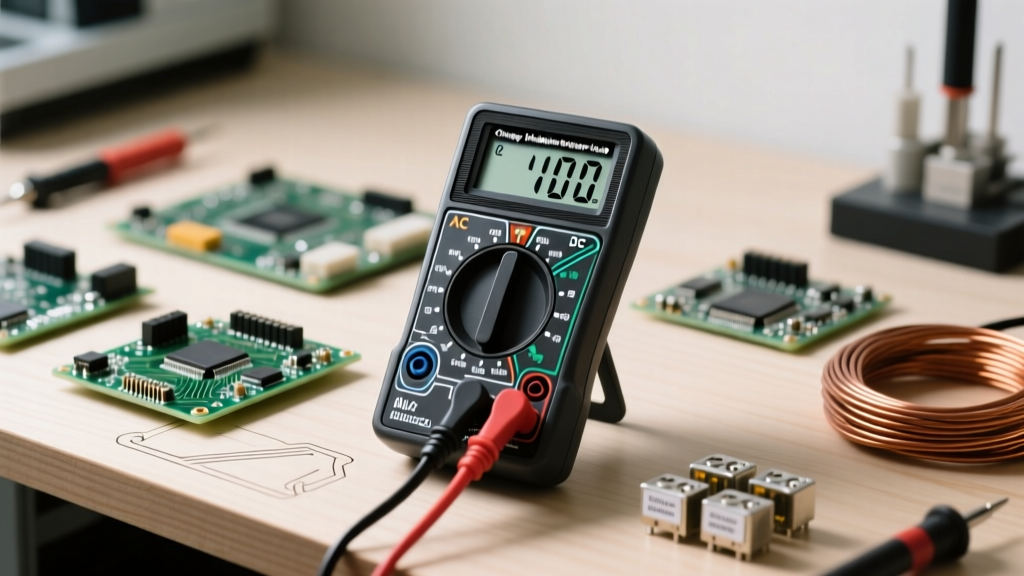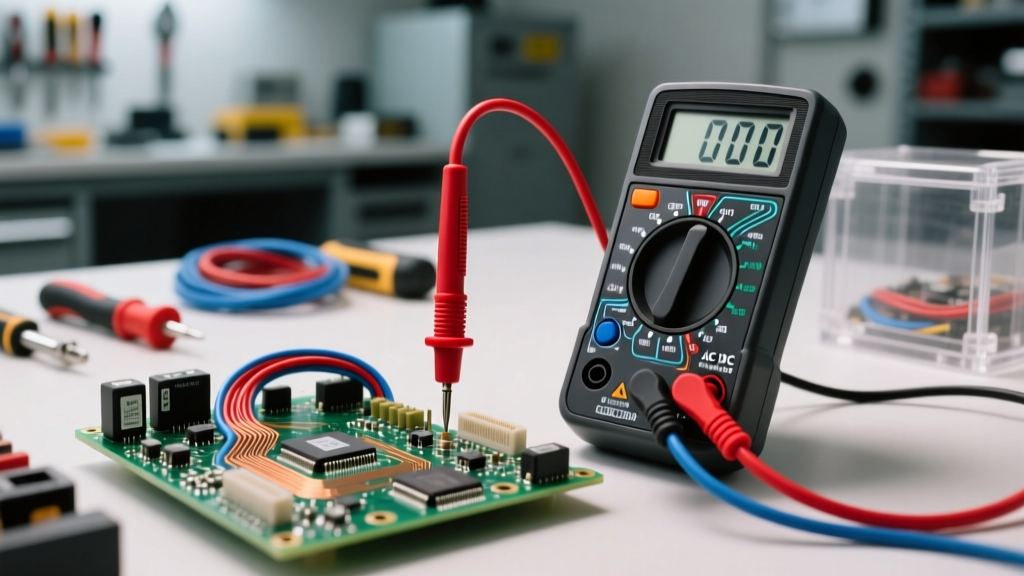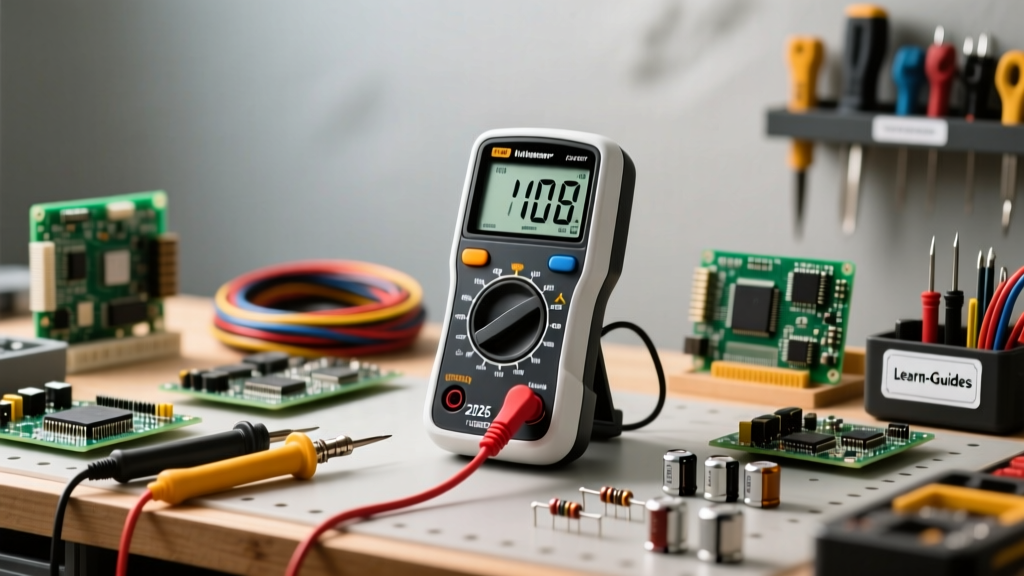

Purchasing your first digital multimeter (DMM) is a rite of passage for any DIY enthusiast, electronics hobbyist, or apprentice electrician. However, simply owning the tool is only half the battle. When beginners search for a multimeter tester how to use tutorial, they often get overwhelmed by cryptic symbols, safety warnings, and varying price points. This comprehensive 2026 guide bridges the gap between buying the right equipment and mastering its real-world applications, ensuring you work safely and accurately.
Decoding the Dial: Multimeter Tester How to Use Basics
Before you touch a live circuit, you must understand the anatomy of the dial and the input jacks. According to SparkFun's comprehensive multimeter tutorial, the most common point of failure for beginners is plugging the test leads into the wrong ports.
- COM (Common): The black probe always goes here. It serves as the ground or reference point for your measurements.
- VΩmA (Voltage/Ohms/Milliamps): The red probe goes here for 99% of tasks, including measuring AC/DC voltage, resistance, and continuity.
- 10A (High Current): The red probe moves here only when measuring high current (usually above 200mA). Leaving the probe here while testing voltage will create a dead short, instantly blowing the internal fuse or destroying the meter.
Understanding the Symbols
The dial features universal electrical symbols. V~ represents Alternating Current (AC) voltage, used for mains electricity and wall outlets. V⎓ (a solid line over a dashed line) represents Direct Current (DC) voltage, used for batteries, solar panels, and microcontroller logic. Ω denotes resistance, while the soundwave symbol indicates the continuity test, which emits an audible beep when a complete circuit path is detected.
Real-World Testing Scenarios
Theory is useless without practical application. Here is how to apply your DMM in three common scenarios.
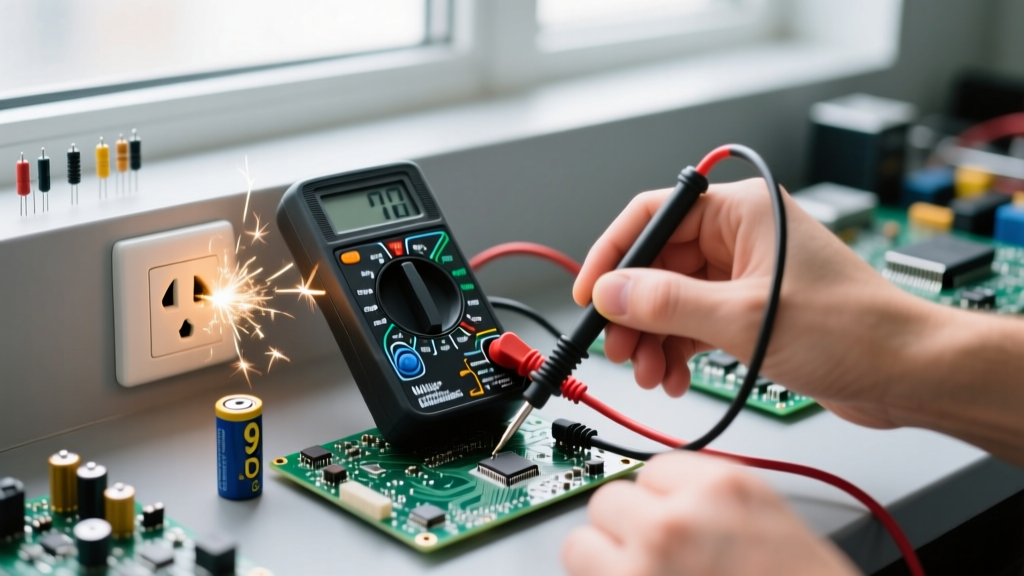
Scenario 1: Testing a Standard 120V AC Wall Outlet
- Turn the dial to V~ (AC Voltage). If your meter is not auto-ranging, set it to the 200V or 600V range.
- Insert the black probe into the neutral slot (the longer vertical slot) and the red probe into the hot slot (the shorter vertical slot).
- A healthy US residential outlet should read between 115V and 125V. If you read 0V, check the breaker panel. If you read significantly higher, you may have a loose neutral connection at the transformer.
Scenario 2: Checking an Automotive Blade Fuse (Continuity)
- Remove the fuse from the vehicle's fuse box. Never test continuity on a live circuit.
- Set the dial to the continuity (soundwave) mode.
- Touch the probes to the two metal prongs of the fuse. A continuous beep and a near-zero resistance reading (e.g., 0.5Ω) means the fuse is good. No beep and an 'OL' (Over Limit) display means the internal filament is broken.
Scenario 3: Measuring a 9V Battery (DC Voltage)
- Set the dial to V⎓ (DC Voltage).
- Touch the red probe to the positive terminal and the black probe to the negative terminal.
- A brand-new alkaline 9V battery will often read around 9.4V. If it reads below 8.0V under no load, it is effectively dead for high-drain applications.
2026 Buyer’s Matrix: Top Multimeters Compared
Choosing the right meter depends on your budget and the environments you work in. Below is a comparison of three industry-standard models dominating the market in 2026.
| Model | Target User | True RMS | CAT Rating | Counts | Approx. Price |
|---|---|---|---|---|---|
| Fluke 117 | Pro Electricians | Yes | CAT III 600V | 6000 | $215 |
| Brymen BM235 | HVAC / Advanced DIY | Yes | CAT III 600V | 6000 | $140 |
| Klein Tools MM400 | Beginners / Auto | No | CAT III 300V | 4000 | $55 |
What are 'Counts'? A 6000-count meter can display values up to 5999 before switching to the next range. This provides higher resolution on lower measurements compared to a 4000-count meter. True RMS is essential for measuring non-linear loads (like LED drivers or variable frequency drives); average-responding meters like the MM400 will yield inaccurate readings on distorted AC waveforms.
The Hidden Danger: Safety Categories and HRC Fuses
When researching multimeters, you will see 'CAT' ratings. According to Fluke's official guide on measurement categories, CAT ratings define the meter's ability to withstand transient voltage spikes (surges) without arcing internally.
- CAT II: Single-phase receptacle plugged-in loads (appliances, TVs).
- CAT III: Three-phase distribution, including single-phase commercial lighting and hardwired equipment.
- CAT IV: Three-phase at utility connection, outdoor service entrances, and main breaker panels.
Critical Safety Warning: Never trust a cheap, unbranded multimeter for mains electrical work. Professional meters use High Rupturing Capacity (HRC) ceramic fuses filled with sand to quench arc flashes. Cheap meters use standard glass fuses. If you accidentally test voltage with the leads in the current (Amps) jacks on a CAT III circuit, a glass fuse will vaporize and explode inside the meter, potentially causing severe burns or blindness. Always adhere to OSHA's electrical safety standards by verifying your meter's internal fusing and CAT rating before working on live panels.
Advanced Troubleshooting: Ghost Voltage and LoZ
One of the most frustrating experiences for electricians is 'ghost voltage.' This occurs when you measure a disconnected wire running parallel to a live wire in the same conduit. Capacitive coupling induces a phantom voltage (often 40V to 90V) on the dead wire, leading to misdiagnosis.
To solve this, premium meters like the Fluke 117 feature a LoZ (Low Impedance) mode. Standard DMMs have an input impedance of 10 Megohms, which is high enough to detect these phantom capacitive charges. LoZ drops the impedance to roughly 3 kilo-ohms, providing a path for the ghost voltage to bleed off, resulting in a true 0.0V reading on dead wires. If you frequently troubleshoot residential wiring or HVAC control boards, a meter with LoZ or a built-in solenoid voltage tester is a mandatory investment.
Final Verdict: Matching the Tool to the Task
If you are strictly building Arduino projects, testing AA batteries, and diagnosing low-voltage DC automotive circuits, the Klein Tools MM400 offers unbeatable value for beginners. However, if you plan to open breaker panels, install smart thermostats, or troubleshoot 240V appliances, the Brymen BM235 provides professional True RMS accuracy and robust safety features at a mid-tier price. For daily commercial and residential electricians, the Fluke 117 remains the undisputed king of reliability, offering non-contact voltage detection (VoltAlert) and LoZ to eliminate ghost voltages instantly.
Mastering your multimeter starts with respecting its safety limits and understanding the physics behind the dial. Practice on known, safe DC sources before moving to live AC circuits, and always verify your meter on a known live source before and after testing a dead circuit to ensure the internal fuses haven't failed silently.