
When a circuit fails, the amateur reaches for a replacement part; the professional reaches for a multimeter and their foundational knowledge. In the world of electrical diagnostics, guessing is not a strategy. It is a fast track to blown components, tripped breakers, and potentially lethal arc flashes. This is where basic electricity training transitions from abstract classroom theory into a vital, real-world survival skill. Whether you are debugging a 12V DC off-grid solar array, troubleshooting a 240V AC compressor, or tracing a fault in a custom microcontroller PCB, the underlying physics remain identical.
Comprehensive basic electricity training equips you with the mental models required to visualize electron flow, potential difference, and resistance. By applying Ohm's Law and Kirchhoff's Circuit Laws systematically, you can isolate faults with surgical precision. This guide bridges the gap between fundamental electrical theory and advanced field troubleshooting, providing actionable frameworks to diagnose open circuits, short circuits, and the notoriously elusive voltage drop.
The Diagnostic Mindset: Moving Beyond Swap-and-Pray
The 'swap-and-pray' method—randomly replacing fuses, relays, and switches until the system powers on—is expensive and dangerous. True troubleshooting relies on the scientific method. Basic electricity training teaches us that every electrical fault falls into one of three primary categories: an unintended break in the path (open), an unintended bypass of the load (short), or an unintended restriction of current (high resistance). Before touching a probe to a terminal, a trained technician formulates a hypothesis based on the system's symptoms and verifies it through sequential voltage and resistance testing.
Core Faults and How Basic Electricity Training Solves Them
1. The Open Circuit (The Infinite Resistance Trap)
An open circuit occurs when the conductive path is broken, stopping current flow entirely. In a DC system, this might be a corroded battery terminal; in AC, it could be a tripped breaker or a severed neutral wire. The defining characteristic of an open circuit is infinite resistance.
Troubleshooting Approach: Beginners often rely on continuity testing to find opens. However, continuity testing requires the circuit to be de-energized, which isn't always practical. Basic electricity training emphasizes voltage drop testing across switches and connections while the circuit is live. If you measure full source voltage across a closed switch, you have found your open fault (the switch is internally broken). A healthy closed switch should read 0.00V to 0.05V under load.
2. The Short Circuit (The Path of Least Resistance)
A short circuit creates a low-resistance path that bypasses the intended load, causing a massive, instantaneous spike in current. According to Ohm's Law (I = V/R), as resistance approaches zero, current approaches infinity. This is what trips breakers and melts wire insulation.
Troubleshooting Approach: Never use a continuity tester on a live circuit to find a short; you will destroy your multimeter. Instead, use the 'divide and conquer' method. Disconnect the circuit at the main distribution point. Measure resistance from the hot/live conductor to ground. If it reads near 0.0 ohms, a short exists. Systematically reconnect downstream branches until the resistance drops to zero, isolating the exact branch harboring the fault.
3. Voltage Drop (The Silent Component Killer)
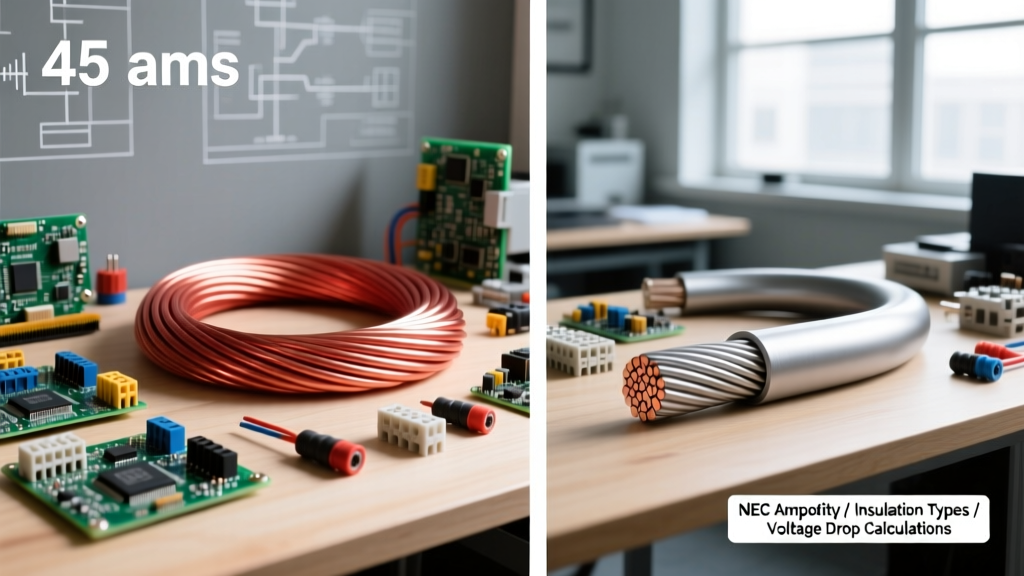
Voltage drop is the most misunderstood fault in basic electricity training. It occurs when excessive resistance in the wiring or connections consumes electrical potential before it reaches the load. The NEC (National Electrical Code) recommends a maximum 3% voltage drop for branch circuits and 5% for feeders. Exceeding this causes motors to overheat, lights to dim, and digital logic boards to reset unpredictably.
As highlighted in Fluke's technical guide on voltage drop, measuring voltage at the source is useless if you don't measure it at the load while the load is operating. A loose neutral wire might show 120V with no load, but drop to 95V the moment a 15A space heater is turned on.
Real-World Scenario: The 12V DC Water Pump Failure
Consider a common DIY scenario: an off-grid 12V DC water pump rated for 10A. The pump is mounted 50 feet from the battery bank, wired with 14 AWG copper. The user reports the pump 'clicks' but fails to spin, assuming the pump motor is dead.
Applying basic electricity training, we calculate the circular mils and voltage drop. A 100-foot total round-trip of 14 AWG wire carrying 10A will drop approximately 2.5V. The pump receives only 9.5V. The internal solenoid engages (the click), but the motor lacks the torque to start under low voltage, drawing locked-rotor current and overheating. The troubleshooting fix isn't a new pump; it is upsizing the wire to 10 AWG or 8 AWG to reduce the resistance and restore the necessary operating voltage.
Troubleshooting Matrix: Symptom to Root Cause
Use this diagnostic matrix to quickly correlate field symptoms with foundational electrical principles.
| Fault Type | Multimeter Setting | Expected Reading (Fault State) | Expected Reading (Normal State) | Primary Root Cause |
|---|---|---|---|---|
| Open Circuit | Continuity / Ohms | OL (Over Limit) | < 1.0 Ω | Broken wire, blown fuse, failed relay coil. |
| Short to Ground | Ohms (Power OFF) | 0.0 Ω - 0.5 Ω | > 1 MΩ | Melted insulation, pinched cable, moisture ingress. |
| High Resistance | Voltage (Under Load) | Significant Drop (> 5%) | < 3% Drop | Corroded terminals, loose lug, undersized wire. |
| Phantom Voltage | AC Volts (High Z) | 40V - 100V (No load capacity) | 0.0 V or Nominal Line V | Capacitive coupling in parallel unshielded cables. |
Essential Tools for the Electrically Trained Troubleshooter
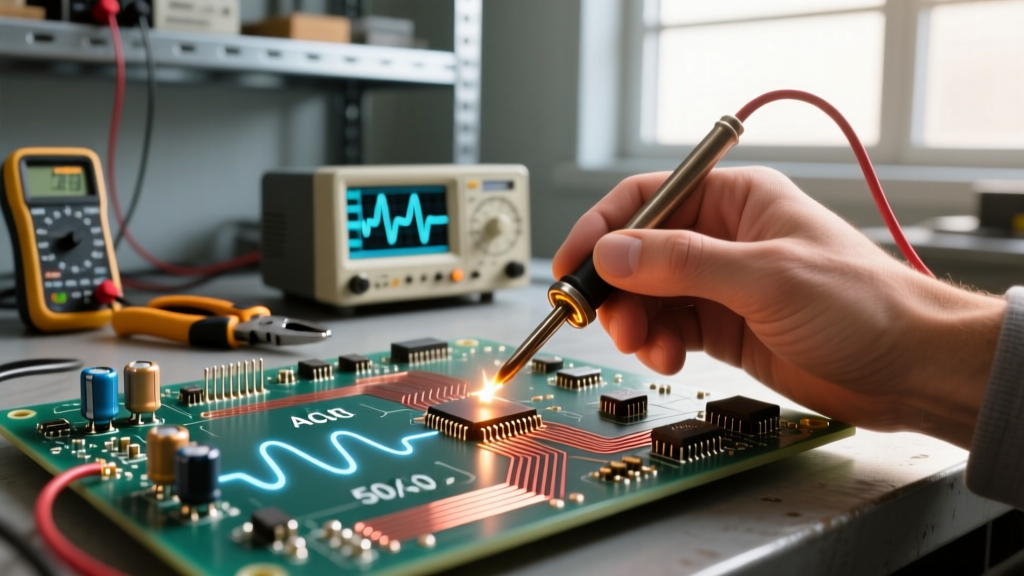
Your diagnostic accuracy is capped by the quality of your test equipment. Basic electricity training must include familiarization with modern digital multimeters (DMMs).
- True-RMS vs. Average-Responding: If you are troubleshooting circuits with non-linear loads like Variable Frequency Drives (VFDs), LED drivers, or switching power supplies, an average-responding meter will give you wildly inaccurate readings. You must use a True-RMS meter to accurately measure the heating effect of distorted waveforms.
- Low-Impedance (LoZ) Mode: Digital meters have high input impedance (often 10 Megohms), making them susceptible to 'phantom voltage' caused by electromagnetic induction from adjacent live wires. Using the LoZ setting places a low-impedance load on the circuit, bleeding off phantom voltages and revealing the true state of the conductor.
- Non-Contact Voltage Testers (NCVT): While useful for a quick initial check, NCVTs only detect the presence of an electric field, not actual voltage potential or current capacity. They should never be used as the sole verification for a dead circuit before making physical contact.
Safety Protocols: The Foundation of Any Basic Electricity Training
No troubleshooting exercise is successful if it results in injury. The principles of electrical safety are just as critical as Ohm's Law. According to OSHA's electrical safety standards, working on or near exposed energized parts requires strict adherence to Lockout/Tagout (LOTO) procedures and the use of appropriate Personal Protective Equipment (PPE).
Expert Insight: Whenever possible, perform voltage testing rather than continuity testing. Continuity testing requires de-energizing the panel, removing components, and re-energizing to verify the fix. Voltage drop testing allows you to diagnose high-resistance faults while the system is operating under normal load conditions, keeping panel covers in place and minimizing arc flash exposure.
Furthermore, ensure your multimeter is rated for the environment you are testing. A CAT II meter is sufficient for testing household appliances, but troubleshooting a main distribution panel or outdoor service entrance requires a CAT III or CAT IV rated meter with the proper HRC (High Rupturing Capacity) fuses installed. For a deeper dive into the physics governing these safety thresholds, resources like All About Circuits provide excellent foundational theory on electron flow and insulation breakdown limits.
Conclusion: Theory Meets Practice
Troubleshooting is not an innate talent; it is the disciplined application of basic electricity training to physical systems. By understanding how voltage, current, and resistance interact in real-time, you stop viewing circuits as mysterious black boxes and start seeing them as predictable, measurable pathways. Master your multimeter, respect the physics, and always prioritize safety. The next time a breaker trips or a motor stalls, you won't just guess the fix—you'll prove it.