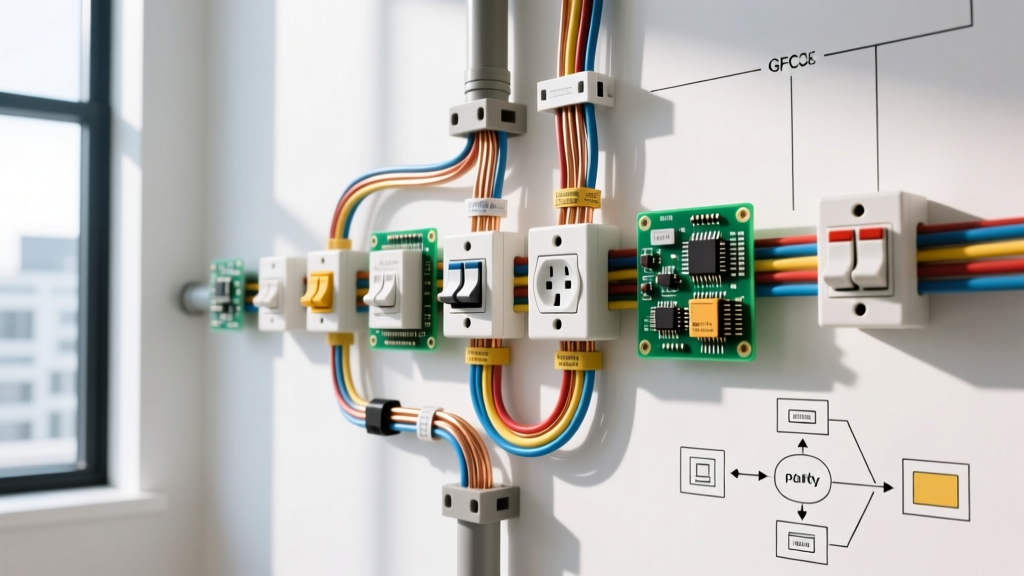
A subpanel electrico (electrical subpanel) is a secondary breaker enclosure that distributes power to a specific zone or outbuilding, fed by a dedicated double-pole breaker from your main service panel. In a real installation, it changes a single high-capacity feeder circuit into multiple localized branch circuits, saving hundreds of feet of wire and providing a local disconnect. People most commonly confuse it with a main service panel, but the critical difference is that a subpanel never bonds the neutral and ground buses together.
The Core Mechanics of a Subpanel Eléctrico
To understand how this equipment functions, you have to look at the busbar architecture. A main panel receives power directly from the utility transformer and contains the main service disconnect. It is the single point in your electrical system where the neutral (grounded conductor) and the ground (equipment grounding conductor) are physically bonded together.
When you install a subpanel electrico, you are essentially creating a localized distribution node. The main panel sends power via a 4-wire feeder (two hot legs, one neutral, one ground). Inside the subpanel, the neutral bar must be physically isolated from the metal enclosure using plastic standoffs or isolation screws, while the ground bar remains bonded directly to the enclosure. This separation ensures that under normal operation, neutral return current never travels along the equipment grounding path, which prevents stray voltage and shock hazards.
Worked Numeric Example: Sizing a 100A Garage Feeder
Let's look at a real-world scenario: you are wiring a detached garage workshop located 150 feet from your main house panel. You need to run an EV charger (40A continuous), an air compressor (20A), and general lighting/receptacles (20A). Your calculated load is roughly 80A, so you select a 100A double-pole breaker for the feeder.
Step 1: Ampacity and the 75°C Column
Even if you buy 90°C rated THHN wire, standard residential load centers and breakers are typically rated for 75°C terminations. Therefore, we must use the 75°C column in NEC Table 310.16.
- Copper: 3 AWG copper is rated for 100A at 75°C.
- Aluminum: 1 AWG aluminum (XHHW-2) is rated for 100A at 75°C.
Step 2: Voltage Drop Calculation
Because the run is 150 feet, we must check voltage drop to ensure your compressor motor doesn't brownout on startup. The NEC recommends a maximum of 3% voltage drop on feeders. We use the formula: VD = (2 × K × I × L) / CM.
| Wire Type | K Factor | Current (I) | Length (L) | Circular Mils (CM) | Calculated VD | Percentage (of 240V) |
|---|---|---|---|---|---|---|
| 3 AWG Copper | 12.9 | 80A | 150 ft | 52,620 | 5.88V | 2.45% (Pass) |
| 1 AWG Aluminum | 21.2 | 80A | 150 ft | 83,690 | 6.08V | 2.53% (Pass) |
Both wire sizes keep the voltage drop under the 3% threshold. However, because aluminum is significantly cheaper and lighter, most electricians will pull 1 AWG aluminum XHHW-2 in PVC conduit for this exact run, saving hundreds of dollars on material costs compared to copper.
Where You Meet This in Practice
You will encounter the need for a subpanel electrico in several specific residential and light-commercial scenarios:
- Detached Structures: Garages, barns, and ADUs (Accessory Dwelling Units). Under NEC Article 250.32, a detached structure with a subpanel also requires its own local grounding electrode system (typically two ground rods driven 6 feet apart) in addition to the equipment grounding conductor run with the feeder.
- Interior Finish-Outs: Basement home theaters or large kitchen islands. Running six individual 12/2 NM-B cables back to a main panel on the other side of the house is a nightmare; running a single 6/3 NM-B feeder to a 60A interior subpanel keeps the wiring clean and manageable.
- Renewable Energy Integration: Solar inverter combiner boxes and battery backup systems (like a Tesla Powerwall) often feed into a dedicated 'critical loads' subpanel, allowing the inverter to power only essential circuits during a grid outage.
Main Service Panel vs. Subpanel Comparison
Buying the right enclosure saves time on the bench. While you can buy a 'main breaker' panel and use it as a subpanel, buying a dedicated 'main lug' subpanel is usually cheaper and purpose-built for the task.
| Feature | Main Service Panel | Subpanel Eléctrico |
|---|---|---|
| Power Source | Utility transformer (Service entrance conductors) | Feeder breaker from the main panel |
| Main Disconnect | Yes (Required by NEC 230.70) | Optional (Required for detached buildings per 250.32) |
| Neutral/Ground Bond | Bonded (Green screw or strap installed) | Separated (Bonding strap must be removed) |
| Typical Enclosure Type | Main Breaker (MB) | Main Lug (ML) |
Frequently Asked Questions
Do I need a main disconnect breaker in my subpanel electrico?
If the subpanel is located inside the same building as the main panel (like a basement addition), you do not need a main disconnect breaker; a 'main lug' panel is perfectly fine because you can walk to the main panel to shut off the feeder. However, if the subpanel is in a detached structure (like a separate garage), NEC 250.32 requires a local disconnecting means. This can be achieved by installing a panel with a main breaker, or by placing a standalone disconnect switch outside the building.
Why are the neutral and ground separated in a subpanel?
If you bond the neutral and ground in a subpanel, you create a parallel path for normal neutral return current to flow back to the main panel along the bare copper ground wire and the metal conduit. This energizes the grounding system, meaning the metal casing of your tools, the garage door tracks, and the panel enclosure itself could carry a mild voltage, creating a severe shock hazard and defeating the purpose of the safety ground. The neutral bar must remain floating (isolated) in all downstream panels.
How many wires are required to feed a subpanel electrico?
Modern NEC code strictly requires a 4-wire feed for all subpanels: two ungrounded 'hot' conductors (X and Y phases), one grounded 'neutral' conductor (white or gray), and one equipment 'grounding' conductor (bare or green). Older codes allowed a 3-wire feed to detached structures, but this was eliminated due to the safety risks of lost neutrals energizing grounding paths. Always pull four wires.
Can I use a main breaker panel as a subpanel?
Yes, you can absolutely use a main breaker panel as a subpanel, and it is often done when main lug panels are out of stock at the local supplier. If you do this, you must remove the green bonding screw or bonding strap that connects the neutral busbar to the metal enclosure. The main breaker in this setup simply acts as a local disconnect switch and an additional overcurrent protection point; it does not change the panel's fundamental wiring rules.