A plug-in space heater is a high-wattage resistive load that draws continuous current, pushing standard 15A branch circuits to their absolute thermal limits. Are plug in heaters safe? Yes, but only when plugged directly into a properly rated, dedicated 20A circuit; they become severe fire hazards when used on shared 15A circuits, daisy-chained through power strips, or run on undersized extension cords.
The Physics of Receptacle Heating (What It Changes in a Circuit)
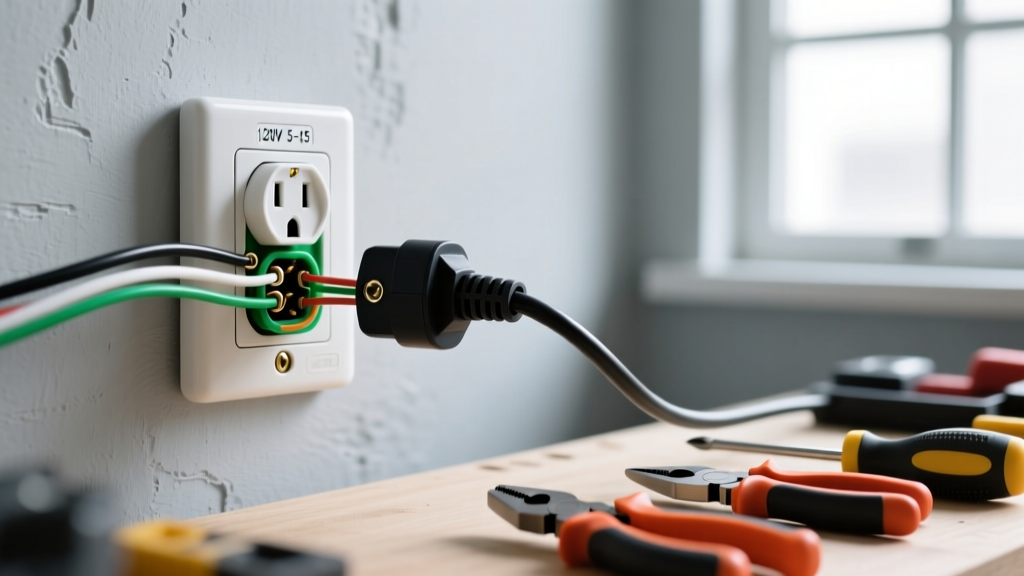
When you plug in a 1500W heater, you fundamentally change the thermal profile of the entire branch circuit. Standard 15A duplex receptacles rely on spring-tensioned brass wipers inside the plastic housing to grip the male plug blades. Over years of use, or if a cheaper builder-grade receptacle was installed, these wipers lose tension. This loss of mechanical pressure increases the electrical contact resistance.
According to Joule's first law, power dissipated as heat is calculated as P = I²R. If a degraded receptacle has a contact resistance of just 0.02 ohms, and your heater draws 12.5 amps, the heat generated at that single connection point is:
12.5² × 0.02 = 3.125 Watts of localized heat per contact.
While 3.125W sounds small, it is concentrated on a tiny brass surface area enclosed in a thermoplastic housing with zero airflow. Over a 4-hour burn, this localized heat softens the nylon or PVC face of the receptacle, causing the plug to sag, further reducing contact pressure, increasing resistance, and initiating a thermal runaway loop that melts the plastic and exposes live conductors.
Worked Numeric Example: The 1500W Continuous Load Problem
The core issue with plug-in heaters isn't just the raw amperage; it is the duration of the draw. The National Electrical Code (NEC) Article 100 defines a continuous load as any load where the maximum current is expected to continue for 3 hours or more. In a cold bedroom or drafty garage, a space heater will easily run for 3+ hours straight.
- Heater Wattage: 1500W
- Nominal Voltage: 120V
- Current Draw (I = P/V): 1500 / 120 = 12.5 Amps
NEC 210.20(A) dictates that branch circuit overcurrent protection must be rated at no less than 125% of the continuous load.
12.5A × 1.25 = 15.625 Amps.
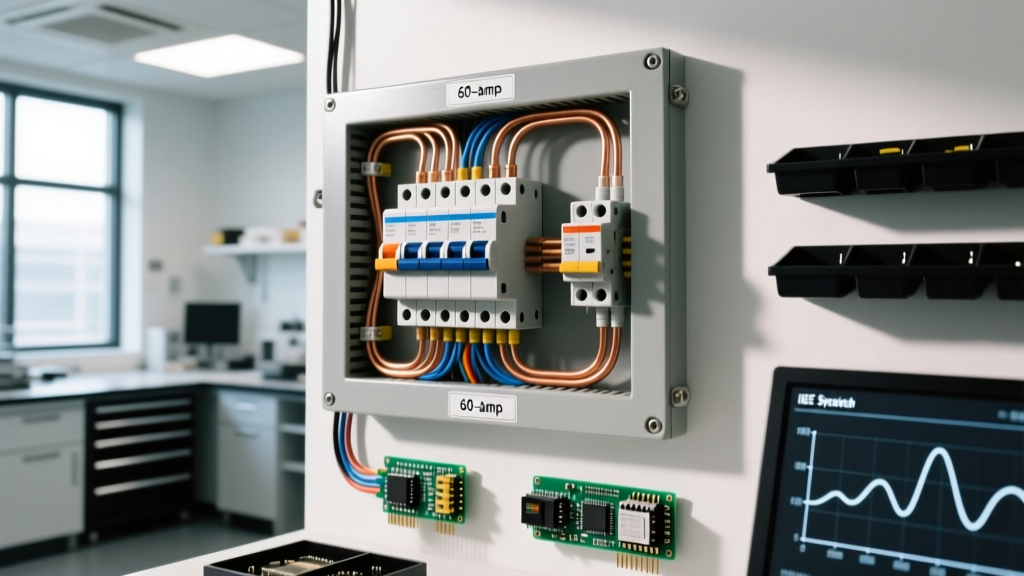
A standard 15A breaker is mathematically undersized for a continuous 1500W load. While a thermal-magnetic breaker might not trip instantly at 15.6A, the bimetallic strip inside will slowly heat up. Eventually, it will nuisance-trip, or worse, the ambient heat in a crowded panel will cause the breaker to fail to protect the 14 AWG wire hidden inside your drywall.
Where You Meet This in Practice
If you work on residential circuits or troubleshoot home electrical issues, you will see the fallout of misunderstood heater loads in three specific ways:
- The Melted Receptacle Face: You pull a 15A receptacle from a bedroom wall and find the black (hot) wire insulation is brittle and cracked, and the plastic around the hot slot is warped. This is the classic signature of a 1500W heater on a 15A builder-grade receptacle.
- Extension Cord Failures: Homeowners plug heaters into 16 AWG "zip cord" extension cords. 16 AWG wire is typically rated for 10A to 13A depending on the insulation. Pushing 12.5A continuously through 50 feet of undersized copper causes severe voltage drop and turns the cord into a literal heating element, melting the outer jacket.
- Shared Circuit Brownouts: A bedroom circuit is wired with 14 AWG and a 15A breaker, sharing power with LED lights, a TV, and a vacuum. Plugging in the heater drops the voltage at the receptacle to 112V. The lights dim, and the vacuum motor runs hot because it is drawing higher amperage to compensate for the low voltage.
Decision Tree: Sizing Your Heater Circuit Safely
Stop guessing if your wall outlet can handle the load. Use this decision path to determine exactly how to wire your space for high-wattage heating.
| Scenario | Circuit Condition | Action Required | Concrete Pick / Specification |
|---|---|---|---|
| Using a 1500W heater in a room with existing 15A / 14 AWG shared circuit | Undersized for continuous load; shared with lights/outlets | Do not use the plug-in heater. Upgrade the circuit or switch to hardwired. | Install a 240V hardwired baseboard heater (e.g., Cadet F252T4) on a dedicated 2-pole 15A breaker. |
| Using a 1500W heater on an existing 20A / 12 AWG shared circuit | Legally compliant (12.5A < 16A continuous limit), but voltage drop may occur if other loads run. | Acceptable for temporary use. Ensure no other high-draw appliances are on the same leg. | Verify receptacle is a 20A rated model (Leviton 5362) with tight blade tension. |
| Building a new dedicated circuit specifically for a 1500W plug-in heater | Ideal scenario; eliminates shared-load thermal risks. | Run a new dedicated 20A branch circuit directly from the panel. | Default Pick: 20A breaker (Eaton BR220), 12/2 NM-B cable, terminated on a Leviton 5362 20A commercial-grade receptacle. |
Common Confusions: Appliance Safety vs. Circuit Safety
The most dangerous misconception about plug-in heaters is conflating the appliance's internal safety features with the building's electrical safety.
Modern heaters are equipped with tip-over switches, overheat thermal fuses, and cool-touch housings. According to the National Fire Protection Association (NFPA), these features are highly effective at preventing the heater itself from igniting nearby curtains or furniture. However, none of these features monitor the wall wiring.
If the plug blades are loose in the receptacle, the wall wiring will melt and catch fire inside the stud bay long before the heater's internal thermal fuse ever trips. The heater thinks it is operating perfectly; it has no way of knowing the branch circuit is failing upstream. Furthermore, many users assume that because a heater has a "low" setting (usually 900W / 7.5A), it is safe for any extension cord. While 7.5A won't melt a 16 AWG cord instantly, running it for 6 hours while the cord is buried under a rug traps the heat, degrading the insulation over time.
Frequently Asked Questions
Can I use a heavy-duty 12 AWG extension cord for my space heater?
NEC 400.8 strictly forbids using flexible cords as a substitute for the fixed wiring of a structure. While a 12 AWG, 15-amp rated extension cord (like a US Wire 515SW) can physically handle the 12.5A load without melting, using it for a space heater is a code violation and a trip hazard. If you must use one temporarily for a two-hour garage project, ensure the cord is fully unspooled to prevent inductive heat buildup, but never leave it unattended.
Why does my space heater trip my AFCI breaker?
Arc-Fault Circuit Interrupters (AFCIs) look for high-frequency electrical signatures that mimic arcing. When a space heater's internal blower motor kicks on, or if the plug blades are slightly loose in an old receptacle, the micro-arcing can mimic a dangerous parallel arc fault, causing the breaker to trip. The fix is not to remove the AFCI; the fix is to replace the worn receptacle and ensure the plug blades are clean and tight.
Are 240V plug-in heaters safer than 120V?
Electrically, yes. A 1500W heater running on 240V only draws 6.25 Amps (1500 / 240 = 6.25A). This drastically reduces I²R heating at the receptacle contacts and allows for smaller wire gauges. However, this requires a dedicated 240V circuit and a specific receptacle configuration, such as a NEMA 6-15R. You cannot simply plug a 240V heater into a standard 120V NEMA 5-15R household outlet.
For more on selecting efficient heating alternatives that bypass branch-circuit limits entirely, review the Department of Energy's guide on energy-efficient space heaters and consider hardwired 240V mini-split heat pumps for whole-room solutions.