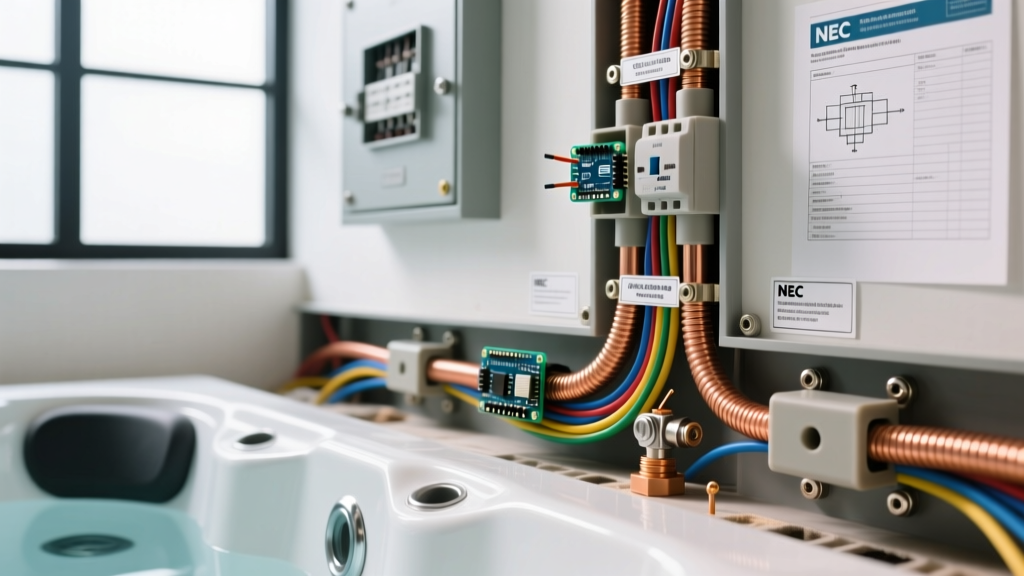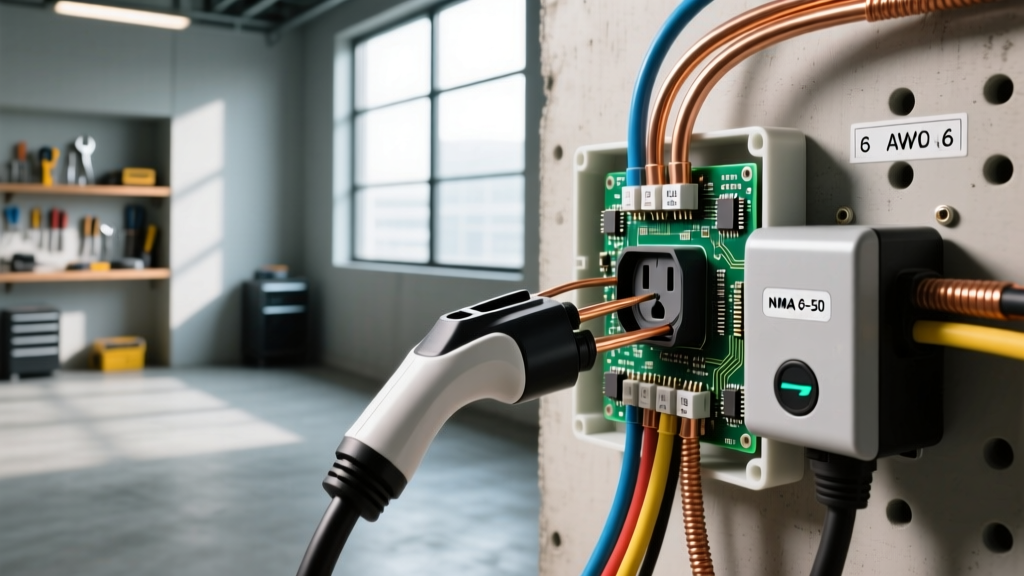

Wire ratings amps (technically called ampacity) is the maximum continuous electrical current a specific wire gauge and insulation type can safely carry without exceeding its temperature rating. When you change a wire's ampacity in a real installation, you directly dictate the physical size of the copper and the maximum breaker size allowed, which prevents insulation meltdown and structural fires. The most common confusion among DIYers is mixing up the wire's ampacity with the breaker's trip rating, or blindly using the 90°C column on an ampacity chart without checking the temperature rating of the panel lugs.
The Core Mechanism: Heat, Resistance, and Insulation Limits
Every conductor has electrical resistance. When current flows through that resistance, it generates heat. Think of wire gauge like a pipe diameter and current like water flow; if you force too much flow through a narrow pipe, the friction generates heat that the pipe cannot dissipate. In electrical terms, if the heat generated exceeds the thermal limit of the wire's insulation (like PVC or nylon), the jacket softens, melts, and eventually exposes bare copper, leading to arc faults or fires.
The National Electrical Code (NEC) addresses this in Article 310, specifically Table 310.16. This table doesn't just give you one number for a wire size; it gives you three, based on temperature columns: 60°C, 75°C, and 90°C. The ampacity of your wire is strictly limited by the lowest temperature rating of any connected component in the circuit. If your wire insulation is rated for 90°C, but the breaker terminal is only rated for 75°C, your legal wire ratings amps are capped at the 75°C column.
Worked Example: Sizing for a 40A Continuous EV Charger
Let's look at a real-world scenario: installing a hardwired Level 2 Electric Vehicle (EV) charger that draws a continuous 40A load. Because it is a continuous load (running for 3 hours or more), NEC Article 210.20(A) requires us to multiply the load by 125% to find our minimum circuit ampacity.
Now, we consult the copper ampacity tables for 50A:
- Scenario A (NM-B Romex in a wall): NM-B cable is legally restricted to the 60°C column regardless of its actual insulation rating. Looking at the 60°C column, 8 AWG is only good for 40A. We must step up to 6 AWG, which is rated for 55A.
- Scenario B (THHN in conduit): THHN wire is rated for 90°C, but standard residential breaker lugs are rated for 75°C. Therefore, we use the 75°C column. Looking at the 75°C column, 8 AWG is rated for exactly 50A.
By understanding wire ratings amps across different insulation types, you save money and conduit space by using 8 AWG THHN instead of pulling bulky 6 AWG NM-B, while remaining perfectly code-compliant.
Where You Meet Wire Ratings Amps in Practice
You will encounter ampacity limitations in three primary areas on a jobsite or in a home workshop:
1. Panelboard and Disconnect Lugs
Almost all standard residential breakers and panel lugs (like those in a Square D Homeline or Siemens EQ load center) are rated for 75°C. Even if you pull 90°C XHHW-2 wire, you must terminate your ampacity calculations at the 75°C column. The only time you use the 60°C column for terminations is on older equipment or specific small-breaker frames (typically 100A and below manufactured before the 75°C standard became ubiquitous, though modern 15A-20A breakers are often dual-rated 60/75°C).
2. Nonmetallic Sheathed Cable (NM-B)
NEC Article 334.80 explicitly states that the ampacity of NM-B cable must be determined using the 60°C column. It doesn't matter that the individual THHN conductors inside the yellow or white jacket are technically 90°C rated. The bundled assembly cannot dissipate heat as efficiently, so the 60°C limit is a hard rule.
3. Flexible Cords and Fixture Wire
When wiring a desk lamp, a DIY workbench light, or an appliance pigtail, you aren't using building wire. You are using flexible cord (like SJTW or SOOW). These cords have entirely different ampacity tables (NEC Table 402.5) and are generally rated much lower than solid building wire of the same gauge due to stranded construction and thinner insulation.
Decision Tree: Picking the Right Wire and Breaker
Use this decision framework to select your wire and breaker for standard copper branch circuits. Follow the path down to your concrete pick.
| Condition / Constraint | Then Select This Column | Concrete Pick for 20A Circuit | Concrete Pick for 30A Circuit |
|---|---|---|---|
| Using NM-B (Romex) in walls/ceilings | 60°C Column | 12 AWG NM-B | 10 AWG NM-B |
| Using THHN/THWN in conduit, standard lugs | 75°C Column | 12 AWG THHN | 10 AWG THHN |
| Using THHN, 75°C lugs, AND 4+ current-carrying conductors in one conduit | 75°C Column, then apply 80% derating factor | 10 AWG THHN (derated to 28A) | 8 AWG THHN (derated to 40A) |
| Terminating to a 60°C rated device (e.g., specific old timers/motors) | 60°C Column | 12 AWG (Any insulation) | 10 AWG (Any insulation) |
Common Mistakes That Bypass Wire Ampacity
Even experienced DIYers make errors when calculating wire ratings amps. Watch out for these specific failure modes:
- The 90°C Column Myth: Many builders see that 12 AWG THHN is rated for 30A in the 90°C column and attempt to put it on a 30A breaker. This is a severe fire hazard. Because the breaker lug is 75°C (rating 25A for 12 AWG) and NEC 240.4(D) strictly limits 12 AWG to a 20A breaker regardless of insulation, this setup will result in a failed inspection or a melted lug.
- Ignoring Bundling Derating: NEC 310.15(C)(1) requires you to derate wire ampacity when you bundle more than three current-carrying conductors in a single raceway. If you pull four 10 AWG THHN wires (two hots, one neutral, one ground) through a conduit for a multi-wire branch circuit, the neutral carries current. You now have four current-carrying conductors. You must multiply the 75°C ampacity (35A) by 80%, dropping it to 28A.
- Mixing Aluminum and Copper Ampacity: Aluminum wire has higher resistance than copper. A 6 AWG copper wire might handle 65A at 75°C, but a 6 AWG aluminum wire (like SER cable) is only rated for 50A. Always verify the material column on the ampacity chart.
FAQ: Wire Ratings Amps
Can I use a larger breaker if my wire ampacity is higher than the load?
No. NEC 240.4 requires the overcurrent protective device (breaker) to protect the wire. If you have 10 AWG wire (30A ampacity), you cannot use a 40A breaker just because your actual load is only 15A. The breaker must be sized to protect the wire's weakest link, not just the load.
Does the ground wire count toward ampacity derating?
No. According to NEC 310.15(C)(1), equipment grounding conductors (bare copper or green) do not carry current under normal operation and are not counted as current-carrying conductors when calculating bundling derating.
What happens if I exceed the wire ratings amps temporarily?
Wire has a thermal mass, meaning it takes time to heat up. A brief inrush current (like a motor starting) that exceeds ampacity for a few seconds will not melt the insulation. This is why breakers have magnetic trip curves for instantaneous shorts and thermal trip curves for sustained overloads. However, continuous operation above ampacity will degrade the insulation's dielectric strength over time.
The Default Recommendation: Stop guessing and standardize your shop stock. For all branch circuits over 20A in conduit, default to 75°C copper THHN/THWN-2 and size your breaker strictly to the 75°C column of NEC Table 310.16. For in-wall residential branch circuits, default to 60°C NM-B and never exceed the 60°C column limits. Match the breaker to the lowest rated component in the circuit, and you will never fail an inspection or start a fire.