When sizing a ground wire—officially known as the Equipment Grounding Conductor (EGC)—the most common and dangerous mistake DIYers make is sizing it based on the expected load current. This is incorrect. According to NEC Article 250.122, the minimum size of your ground wire is dictated entirely by the rating of the overcurrent protective device (the breaker or fuse) protecting the circuit, not the ampacity of the load.
For a standard 15A or 20A branch circuit, the absolute minimum is 14 AWG copper. For a 30A circuit, it is 10 AWG copper. While these are the baseline national standards, always treat NEC-style guidance as a baseline; your local Authority Having Jurisdiction (AHJ) or electrical inspector has the final legal authority on code compliance in your specific municipality.
The Hazard: What Happens When You Undersize an Equipment Grounding Conductor?
To understand why we size the EGC based on the breaker, you have to understand the physics of a ground fault. The EGC does not carry current during normal operation. Its sole purpose is to provide a low-impedance (low-resistance) path back to the panel in the event that a hot wire shorts to a metal appliance chassis or junction box.
If you undersize the ground wire, you introduce a fatal bottleneck. Imagine a 120V hot wire breaks loose inside a metal table saw and touches the chassis. The fault current rushes back to the panel through the EGC to trip the breaker. If you incorrectly used a skinny 16 AWG ground wire on a 20A breaker, the fault current might only reach 40 amps due to the high resistance of the thin wire. A standard 20A thermal-magnetic breaker can take several seconds to trip at 40A. During those seconds, the 16 AWG ground wire will overheat, melt its insulation, and potentially start a fire inside your wall cavity—all while the breaker remains closed and the saw chassis sits at a lethal 120V potential waiting for you to touch it.
By sizing the ground wire to the breaker (e.g., 12 AWG for a 20A breaker), you guarantee the wire can safely carry a massive, instantaneous short-circuit current (often thousands of amps) long enough for the breaker's magnetic trip mechanism to snap open in milliseconds, clearing the fault safely.
Ground vs. Neutral vs. Bond: Clearing Up the Terminology
Misusing these terms leads to miswired panels and shocked homeowners. Here is the precise distinction:
- Ground (Grounding Electrode Conductor): The wire that connects your electrical system to the physical earth (dirt) via ground rods, a Ufer ground, or a metal water pipe. It stabilizes system voltage and dissipates lightning strikes. It does not clear standard appliance faults.
- Bond (Equipment Bonding Jumper): The physical connection that ties all non-current-carrying metal parts (boxes, panels, appliance chassis) together to ensure they are at the same electrical potential. The EGC acts as a bonding path back to the source.
- Neutral (Grounded Conductor): The normal, intentional current-carrying return path for 120V circuits. It is tied to ground only at the main service disconnect. Never use a ground wire as a neutral, and never tie neutral and ground together at a subpanel or receptacle.
How to Size a Ground Wire: The NEC 250.122 Decision Tree
Use the table below to find your minimum copper or aluminum EGC size based on the breaker rating. Note that these are minimums; using a larger ground wire is always legally and physically acceptable, provided it fits in the terminal lugs.
| Overcurrent Device Rating (Breaker/Fuse) | Minimum Copper EGC (AWG) | Minimum Aluminum EGC (AWG) |
|---|---|---|
| 15 Amps | 14 | 12 |
| 20 Amps | 12 | 10 |
| 30 Amps | 10 | 8 |
| 40 Amps | 10 | 8 |
| 60 Amps | 10 | 8 |
| 100 Amps | 8 | 6 |
| 200 Amps | 6 | 4 |
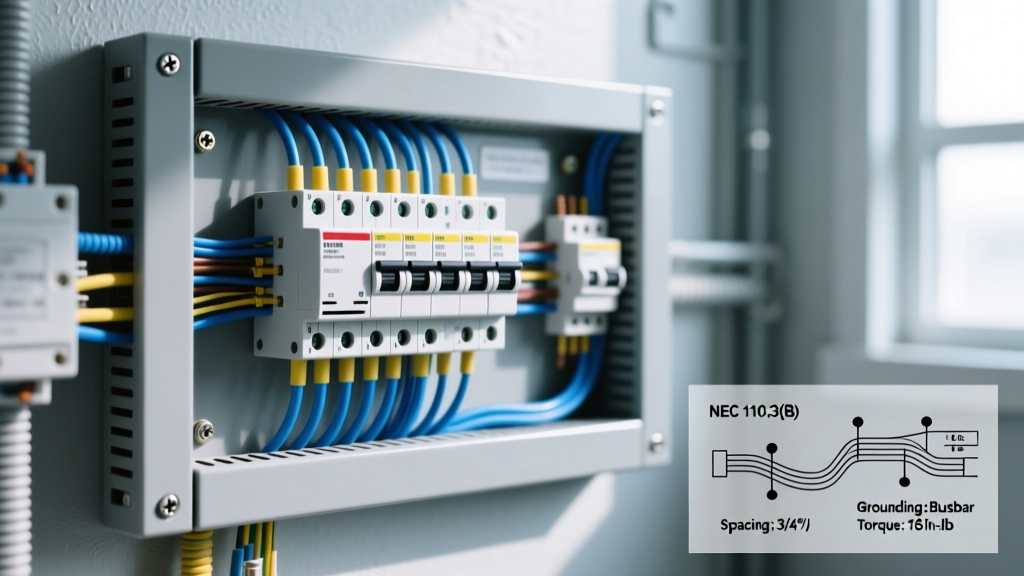
The Voltage Drop Trap: Proportional Sizing (NEC 250.122(B))
Here is a detail that trips up many apprentices and DIYers. If you have a long circuit run (like a 50A RV outlet 150 feet from the panel) and you upsize your ungrounded (hot) conductors from 6 AWG to 4 AWG to mitigate voltage drop, you must proportionately upsize your ground wire. You cannot leave the ground at 10 AWG. If the hot wires increase in cross-sectional area by one size, the EGC must also increase by one size (moving from 10 AWG to 8 AWG copper). This ensures the ground-fault loop impedance remains low enough to trip the breaker instantly at the far end of the circuit.
Step-by-Step: Verifying Your Ground Path with a Tester
Once your circuit is wired and energized, you must verify the ground path exists and has low impedance. Follow this OSHA-aligned testing sequence:
- The Basic Receptacle Test: Plug a standard 3-light receptacle tester into the outlet. Two yellow lights indicate a correctly wired, grounded circuit. If the "Open Ground" light illuminates, your EGC is either disconnected, broken, or never installed.
- The Multimeter Voltage Test (No Load): Set your multimeter to AC Voltage. Measure Hot-to-Neutral (should be ~120V). Measure Hot-to-Ground (should also be ~120V). Measure Neutral-to-Ground (should be 0V to 0.5V). If Hot-to-Ground reads 0V, you have an open ground.
- The Multimeter Voltage Test (Under Load): Plug in a high-draw device (like a hair dryer or space heater) and turn it on. Measure Neutral-to-Ground again. You should see a slight voltage rise (typically 1.0V to 2.5V). This is the voltage drop across the neutral wire under load. If Neutral-to-Ground reads near 120V under load, your neutral and ground are likely bootlegged (illegally jumpered together at the receptacle), which is a severe shock hazard.
When to Call a Licensed Electrician
While replacing a receptacle or sizing branch circuit wires for a new appliance is well within a competent DIYer's scope, certain grounding tasks require a licensed professional. You must call an electrician if you are:
- Upgrading your main service panel or installing a new subpanel.
- Working on the Main Bonding Jumper (the critical link between the neutral bar and the panel enclosure).
- Installing or modifying the Grounding Electrode System (driving ground rods, connecting to a Ufer ground, or bonding metal water pipes).
- Dealing with aluminum branch wiring from the 1960s/70s, which requires specialized CO/ALR connectors and specific torque settings to prevent fires.
Frequently Asked Questions About Sizing a Ground Wire
Can I use a smaller ground wire if my actual load is low?
No. Even if your 20A circuit is only powering a 2-amp LED lighting setup, the ground wire must still be sized to the 20A breaker (minimum 12 AWG copper). The breaker dictates the maximum fault current available to the circuit. If a short occurs, the breaker will allow up to its magnetic trip threshold to flow; the ground wire must be robust enough to survive that surge, regardless of what the normal operating load is.
Do I need to upsize my ground wire if I upsize my ungrounded conductors for voltage drop?
Yes. As mandated by NEC 250.122(B), if you increase the size of your hot wires to compensate for voltage drop over long distances, you must increase the equipment grounding conductor proportionately. This maintains the proper ratio of impedance in the fault loop, ensuring the breaker still trips fast enough at the far end of the run.
Does the ground wire need to be the same material (copper/aluminum) as the circuit wires?
Not necessarily, but you must use the correct column in the NEC 250.122 table. Aluminum has higher resistance than copper, so an aluminum EGC must be two AWG sizes larger than the equivalent copper EGC for the same breaker size. However, be highly cautious of galvanic corrosion if you terminate a copper ground wire onto an aluminum lug or busbar without proper anti-oxidant compound (like Noalox) and bimetallic-rated lugs. When in doubt, match the materials.
Can I use the metal conduit (EMT/Rigid) as my ground wire instead of pulling a separate wire?
Yes, NEC 250.118 allows properly installed metal raceways like EMT, rigid metal conduit, and intermediate metal conduit to serve as the EGC, provided all fittings are tightly threaded or securely tightened with proper set-screws to ensure electrical continuity. However, many modern electricians and local AHJs still prefer or require a separate, dedicated copper EGC pulled inside the conduit as a failsafe against loose fittings vibrating loose over decades of use.