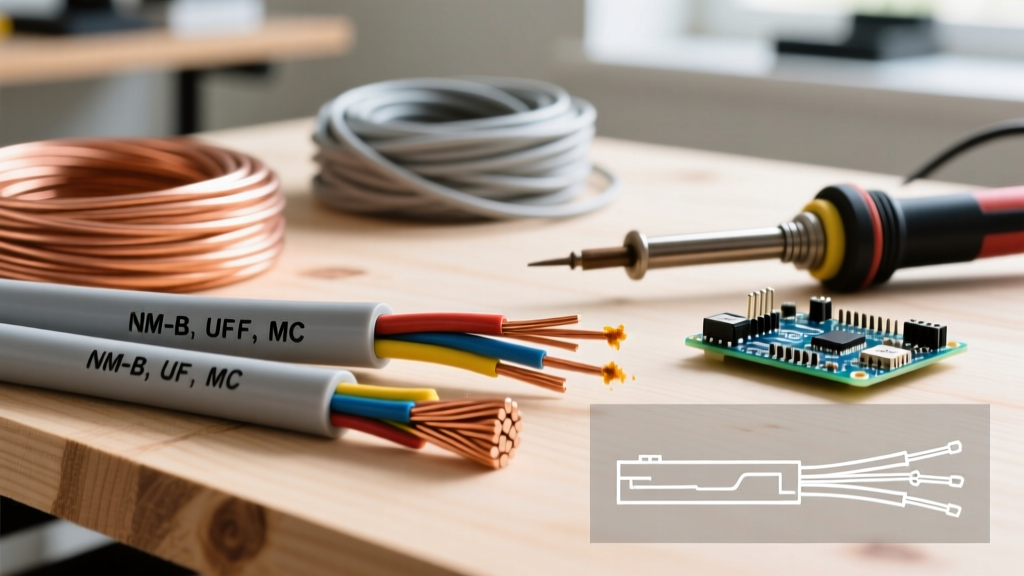

Navigating the Types of Electrical Wiring for Homes
Selecting the correct cable assembly is the foundational decision in any residential rough-in or remodel. The National Electrical Code (NEC) strictly dictates which materials can be used based on environmental exposure, physical protection needs, and amperage requirements. As of the 2026 building cycle, local jurisdictions enforcing the 2023 and 2026 NEC updates have tightened regulations around Arc-Fault Circuit Interrupter (AFCI) protection and cable jacket fire ratings, making material selection more critical than ever.
This guide breaks down the primary types of electrical wiring for homes, providing specific product recommendations, real-world pricing, and the exact tools required for professional-grade installation.
Residential Cable Comparison Matrix
Before purchasing spools or coils, review this matrix to match your specific application with the correct NEC-approved cable type. Prices reflect average 2026 retail costs for 250-foot spools of 12 AWG, 2-conductor with ground (12/2).
| Cable Type | NEC Article | Best Application | Jacket Material | Avg. Cost (250ft 12/2) |
|---|---|---|---|---|
| NM-B (Romex) | Art. 334 | Interior dry walls, ceilings, floors | PVC (Polyvinyl Chloride) | $115 - $135 |
| UF-B | Art. 339 | Direct burial, outdoor sheds, damp areas | Gray UV-resistant PVC | $145 - $170 |
| MC (Metal Clad) | Art. 330 | Commercial, exposed basements, high-end custom | Interlocked Aluminum/Steel | $210 - $245 |
| AC (Armored) | Art. 320 | Retrofits, exposed runs requiring flexibility | Galvanized Steel w/ Bonding Strip | $190 - $220 |
| THHN/THWN | Art. 310 | Pulled through EMT/PVC conduit (garages, shops) | Nylon/PVC (Individual wires) | $85 - $105 (per color) |
Deep Dive: NM-B (Non-Metallic Sheathed Cable)
NM-B, commonly referred to by the trademarked name Romex, is the undisputed standard for interior residential wiring. It consists of two or more insulated conductors wrapped in a paper slip-sheet and encased in a moisture-resistant, flame-retardant PVC jacket.
Material Specifics & Pricing
For standard 20-amp receptacle circuits, you will use 12/2 NM-B. The Southwire SIMpull Romex line features a proprietary NoLubeX jacket that reduces pulling friction by up to 30%, a massive time-saver when fishing wires through existing walls during remodels. Expect to pay approximately $125 for a 250-foot coil of 12/2 SIMpull at major distributors in 2026. For 15-amp lighting circuits, 14/2 NM-B drops the cost to roughly $85 per 250-foot coil.
Code Constraints & Edge Cases
Under NEC Article 334, NM-B cannot be used in wet or damp locations, embedded in concrete, or exposed in unfinished basements where it is subject to physical damage. A common failure mode in DIY projects is running NM-B directly down a basement wall to a workbench without conduit protection; this is an immediate code violation and a fire hazard.
UF-B: Underground Feeder for Exterior Runs
When your circuit needs to leave the conditioned envelope of the home, UF-B is the required material. Unlike NM-B, the conductors in UF-B are individually encased in solid PVC, making the cable completely waterproof and resistant to soil chemicals.
Installation Depths and Transitions
The NEC mandates specific burial depths for UF-B to prevent accidental severing during landscaping. Direct-buried UF-B must be trenched to a minimum depth of 24 inches. If you route the UF-B through Schedule 40 PVC conduit underground, the depth requirement drops to 18 inches.
Pro Tip: Never transition from NM-B to UF-B inside a buried junction box. The transition must occur inside a weatherproof, accessible exterior junction box or within the interior panel where the dry environment begins.
MC and AC Cable: Metal-Clad and Armored Solutions
While NM-B dominates standard tract housing, high-end custom builds, luxury renovations, and areas requiring extreme physical protection rely on Metal Clad (MC) or Armored Cable (AC).
MC vs. AC: The Grounding Distinction
Electricians often confuse MC and AC, but the NEC treats them differently. MC Cable contains a dedicated bare or green insulated grounding wire inside the armor. AC Cable (often called BX) does not have a dedicated ground wire; instead, it relies on the metal armor itself and an internal aluminum bonding strip to provide the ground path. Because of the superior reliability of a dedicated ground wire, MC has largely replaced AC in new construction.
AFCI Compliance
When using MC cable in dwelling units, ensure your terminations utilize listed anti-short bushings (red heads) and proper MC connectors. Furthermore, the 2023/2026 NEC expansion of AFCI protection means that even if you use metal armor for physical protection in a bedroom or living room, the breaker feeding that MC cable must still be an AFCI type to protect against downstream arc faults.
THHN/THWN in Conduit: The Exposed Run Standard
In garages, detached workshops, and unfinished utility rooms, cables cannot be left exposed where they might be crushed by vehicles or tools. Here, individual THHN/THWN wires pulled through EMT (Electrical Metallic Tubing) or PVC conduit is the correct approach.
- Wire Sizing: THHN is rated for 90°C in dry locations, but terminations are generally rated for 60°C or 75°C. Always size the breaker based on the 60°C/75°C ampacity column in NEC Table 310.16.
- Conduit Fill: Do not exceed the 40% conduit fill capacity outlined in NEC Chapter 9, Table 1. For 3/4-inch EMT, the maximum number of 12 AWG THHN wires is 16.
Essential Tools for Residential Wiring Materials
Using the wrong tools damages cable jackets, exposes conductors, and creates arc-fault risks. Equip your pouch with these specific, industry-standard tools:
1. Cable Rippers and Strippers
Avoid using utility knives to slit NM-B jackets; nicking the copper conductor creates a hot spot that will fail under load. Use the Klein Tools 1412 Cable Ripper or the Southwire ROMEX Splitter. These tools hook under the jacket and safely slice it lengthwise without touching the internal wire insulation.
2. MC/AC Cable Cutters
Cutting metal-clad cable with standard lineman pliers leaves jagged, dangerous edges. The Klein Tools 86552 MC/AC Cable Cutter is designed to score and snap the interlocked armor cleanly, leaving a flush edge that won't pierce the internal conductor insulation during termination.
3. Stapling and Support
NEC Article 334.30 requires NM-B to be secured within 8 inches of every electrical box and at intervals not exceeding 4.5 feet. The Gardner Bender GSTB-402 Professional Cable Stapler drives insulated 1/2-inch staples perfectly flush. Over-driving staples crushes the cable jacket and alters the dielectric properties of the insulation, a common inspector fail point.
Safety and Code Verification
Electrical wiring is unforgiving of shortcuts. Always verify your local municipality's specific amendments to the NEC, as some regions mandate MC cable for all vertical wall runs to protect against drywall screw punctures. For comprehensive safety guidelines and worker protection standards when handling these materials, refer to the OSHA Electrical Safety standards.
By matching the exact environmental conditions of your project to the correct cable type—and utilizing the precise tools designed for those materials—you ensure a safe, code-compliant, and long-lasting electrical system.