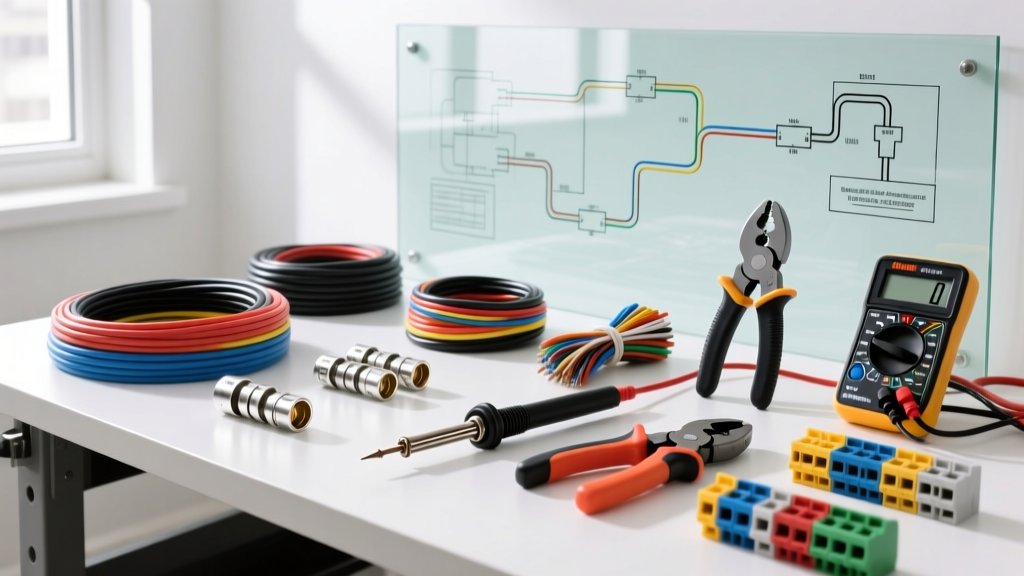

The Foundation of Reliable Light Electrical Wiring
Executing flawless light electrical wiring requires more than just twisting wires together; it demands a precise understanding of material science, current load dynamics, and modern code compliance. As residential and commercial lighting shifts heavily toward LED arrays, smart home integrations, and low-voltage PoE (Power over Ethernet) systems, the materials and tools required for a professional installation have evolved significantly. This comprehensive guide breaks down the exact cables, connectors, and diagnostic tools you need for modern lighting circuits, backed by 2026 industry standards and National Electrical Code (NEC) requirements.
Core Wiring Materials: Selecting the Right NM-B Cable
For standard 120V residential lighting circuits, Non-Metallic Sheathed Cable (NM-B), commonly referred to by the brand name Romex, remains the undisputed standard. However, choosing between 14 AWG and 12 AWG is a critical decision that impacts both safety and future-proofing.
14/2 NM-B vs. 12/2 NM-B: The Voltage Drop Factor
While NEC Article 210.3 permits 14 AWG copper wire on 15-ampere circuits (which is standard for lighting), many master electricians exclusively pull 12/2 NM-B for all general lighting circuits. The primary reason is voltage drop over long runs. A standard LED recessed can light draws roughly 12 watts (0.1 amps at 120V). While the amperage is negligible, a long run from the panel to the farthest switch loop can exceed 75 feet. Upgrading to 12 AWG reduces resistance, ensuring smart switches and LED drivers receive clean, stable voltage without flickering.
Pro Tip: In 2026, a 250-foot coil of Southwire SIMpull 14/2 NM-B costs approximately $115, while the 12/2 equivalent costs around $145. The $30 premium per coil is heavily offset by the elimination of voltage drop issues and the ability to upgrade the breaker to 20A in the future without rewiring.
Wire Gauge and Breaker Sizing Matrix
| Cable Type | AWG Size | Max Breaker | Max Run (3% Drop at 15A) | Best Application |
|---|---|---|---|---|
| NM-B | 14/2 with Ground | 15 Amp | 50 feet | Short bedroom/bathroom lighting loops |
| NM-B | 12/2 with Ground | 20 Amp | 75 feet | Long runs, kitchens, smart lighting hubs |
| UF-B | 12/2 with Ground | 20 Amp | 65 feet | Outdoor landscape lighting, wet locations |
For detailed manufacturer specifications on jacket slip and conductor purity, refer to the Southwire Building Wire catalog.
Termination and Connectors: Moving Beyond Wire Nuts
The days of relying solely on twisted plastic wire nuts for light electrical wiring are over. While traditional twist-on connectors are still code-compliant, modern push-in and lever-nut connectors offer vastly superior pull-out resistance and installation speed.
Wago 221 Lever-Nuts vs. Ideal Twist-On Connectors
- Wago 221 Series (Lever-Nuts): The Wago 221-413 (3-port) and 221-415 (5-port) lever connectors are UL-listed for solid, stranded, and fine-stranded wires from 24 to 12 AWG. They feature a transparent housing for visual inspection and a built-in test port for multimeter probes. Independent pull-tests show they withstand over 150 lbs of tensile force before failure.
- Ideal 33/34 Wire-Nuts: The classic orange (33) and yellow (34) twist-on connectors require precise pre-stripping lengths (usually 3/4 inch) and rely on the internal steel coil for grip. They are cheaper (roughly $0.08 per unit vs $0.50 for a Wago) but take three times longer to install and verify.
- Push-In In-Line Connectors: Ideal 30 PushWire connectors are excellent for solid wire junction boxes where space is at a premium, but they cannot be used with stranded wire, limiting their use in modern flexible fixture whips.
The Professional Tool Arsenal for Lighting Circuits
Proper light electrical wiring demands precision tools that prevent conductor nicking and ensure accurate voltage diagnostics. Below is the essential toolkit for any serious electrical installation.
Wire Strippers and Cutters
Nicking a 14 AWG copper conductor during stripping reduces its cross-sectional area, creating a localized hot spot that can trip AFCI breakers or cause a fire. The Klein Tools 11055 wire stripper is the industry standard, featuring precision-machined stripping holes that cleanly remove insulation without scoring the copper. For cutting and bending ground pigtails, the Milwaukee 48-22-6100 high-leverage diagonal cutting pliers provide flush cuts essential for fitting wires into tight junction boxes. You can view the full lineup of professional stripping tools at the Klein Tools Wire Strippers Catalog.
Diagnostic and Testing Equipment
Before terminating a single light fixture, verifying the absence of voltage is a non-negotiable safety step. The Fluke 117 True-RMS Multimeter features VoltAlert non-contact voltage detection and a low-impedance (LoZ) mode that prevents false readings caused by ghost voltage in parallel switch loops. For mapping circuits in existing walls, the Greenlee 5030 steel fish tape combined with a Milwaukee 48-22-7108 15-foot glow rod set allows for frictionless wire pulling through insulated cavities.
Tool Comparison Matrix: Pro vs. Budget
| Tool Category | Professional Grade Model | Estimated Price (2026) | Budget Alternative | Estimated Price |
|---|---|---|---|---|
| Wire Stripper | Klein 11055 (10-inch) | $32.00 | Irwin VISE-GRIP 2078300 | $14.00 |
| Multimeter | Fluke 117 True-RMS | $225.00 | Klein MM400 | $45.00 |
| Fish Tape | Greenlee 5030 (30ft Steel) | $48.00 | Generic Fiberglass 33ft | $18.00 |
| NCV Tester | Fluke 2AC VoltAlert | $35.00 | Sperry STK001 | $15.00 |
Smart Lighting and NEC Code Compliance
Modern light electrical wiring is heavily influenced by smart home technology and updated safety codes. Failing to plan for these requirements during the rough-in phase will result in costly tear-outs.
The Neutral Wire Mandate (NEC 404.2(C))
Historically, switch loops were wired using only a hot and a switched-hot wire, omitting the neutral conductor to save material. However, modern smart switches (like the Leviton Decora Smart Wi-Fi series) require a constant 120V power supply to operate their internal radios, necessitating a neutral wire. NEC Article 404.2(C) now mandates that a neutral conductor be present at every switch box location. Always pull 12/2 or 14/2 NM-B cable to your switch boxes, ensuring the white neutral wire is capped and available for smart devices. If you are using a system like Lutron Caseta, which utilizes proprietary Clear Connect RF technology and does not require a neutral on the switch itself, you are exempt from this specific hardware requirement, but pulling the neutral is still best practice for future-proofing.
AFCI Protection for Lighting Outlets
According to the National Fire Protection Association (NFPA) and NEC Article 210.12(A), all 120-volt, single-phase, 15- and 20-ampere branch circuits supplying lighting outlets in dwelling unit bedrooms, living rooms, and hallways must be protected by an Arc-Fault Circuit Interrupter (AFCI). This means your lighting panel breakers must be Combination-Type AFCI breakers (such as the Eaton BR215AFC or Square D HOM115AFIC), which typically cost between $35 and $55 each. Ensure your wire runs are kept away from sharp metal framing edges to prevent insulation degradation, which can cause nuisance AFCI tripping.
Junction Box Fill Calculations (NEC 314.16)
Overcrowding a junction box with lighting wires generates excess heat and makes device installation nearly impossible. NEC 314.16 dictates strict box fill calculations. To calculate your required box volume:
- Count the conductors: Each hot, neutral, or switched-hot wire entering and terminating in the box counts as one volume allowance.
- Count the clamps and devices: Internal cable clamps count as one allowance based on the largest wire. Each switch or receptacle counts as two allowances.
- Ground wires: All equipment grounding conductors combined count as a single allowance.
- Multiply by the volume factor: For 14 AWG wire, multiply the total count by 2.0 cubic inches. For 12 AWG, multiply by 2.25 cubic inches.
For example, a standard 3-way switch box containing two 12/2 cables, one 12/3 cable, and one dimmer switch requires a box with a minimum volume of 24.75 cubic inches. Always use deep 2.5-inch or 3-inch gang boxes for lighting switch locations to accommodate the bulky heat-sinks found on modern LED dimmers.
Final Thoughts on Material Selection
Successful light electrical wiring is a balance of code compliance, material quality, and ergonomic tool usage. By investing in 12/2 NM-B cable for long runs, utilizing Wago lever-nuts for secure terminations, and equipping yourself with True-RMS diagnostic tools, you ensure a lighting infrastructure that is safe, flicker-free, and ready for the next generation of smart home technology.