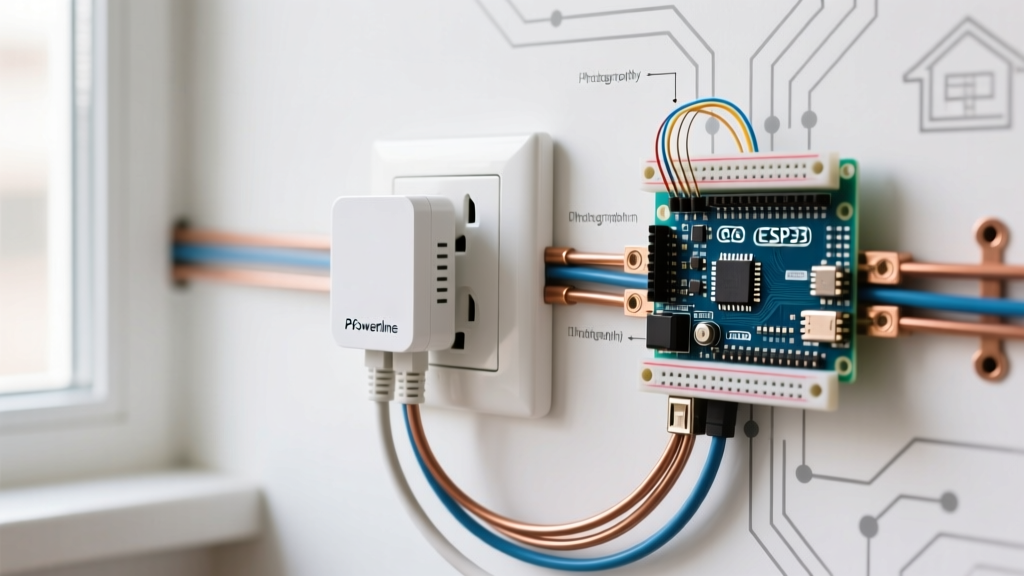

The Renovation Dilemma: Network Backbones Without Tearing Open Walls
When planning a major home remodel or retrofitting a historic property, low-voltage wiring often becomes the primary bottleneck. Pulling Cat6a or fiber optic cable through finished walls, lathe-and-plaster, or multi-story masonry can cost between $150 and $300 per drop, not including the $50 to $75 per linear foot required for drywall repair and repainting. For renovators asking which technology uses existing electrical wiring to bypass these destructive and expensive construction hurdles, the definitive answer is Powerline Communication (PLC).
PLC technology modulates high-frequency data signals over the standard 120V/240V alternating current (AC) wiring already present in your walls. In 2026, modern PLC has evolved far beyond the unreliable, low-speed adapters of the past. Today, leveraging the ITU-T G.hn Wave 2 and Wave 3 standards, powerline networking delivers gigabit-class throughput, making it a highly viable backbone for mesh Wi-Fi nodes, IP security cameras, and smart home hubs in renovation scenarios where running new Ethernet is structurally or financially unfeasible.
How PLC Works: The Physics of Data Over Power
To understand how to plan your renovation around PLC, you must understand the underlying physics. PLC adapters utilize Frequency Division Multiplexing (FDM) to separate the 60Hz electrical power from the data signal, which operates in the 2 MHz to 86 MHz frequency spectrum.
Modern high-end adapters utilize MIMO (Multiple Input Multiple Output) technology. Instead of just transmitting data between the Line and Neutral wires, MIMO PLC adapters also utilize the Ground wire, creating three distinct transmission paths. This spatial diversity drastically reduces signal degradation caused by noisy appliances and allows the signal to navigate complex breaker panel topologies.
Authoritative Standards Governing PLC
When specifying equipment for a high-end renovation, ensure the hardware complies with modern regulatory and performance standards:
- ITU-T G.9960 (G.hn): The global standard for unified home networking over powerlines, coax, and phone lines. The HomeGrid Forum certifies devices that meet these rigorous throughput and latency requirements.
- FCC Part 15: In the United States, PLC devices must comply with FCC Title 47 Part 15 regulations to ensure they do not cause harmful interference to amateur radio or emergency communication bands.
- HomePlug AV2: The legacy but still widely deployed standard that introduced MIMO and beamforming to powerline networks.
Top Powerline Networking Kits for 2026 Renovations
Not all PLC adapters are created equal. For a renovation project where reliability is paramount, avoid entry-level AV600 kits. Below is a comparison matrix of the top-tier adapters suited for demanding remodels.
| Model | Standard | Max PHY Rate | Est. Cost (2026) | Best Renovation Use Case |
|---|---|---|---|---|
| Devolo Magic 2 WiFi 6 | G.hn Wave 2 | 2400 Mbps | $189 | Adding Wi-Fi 6 mesh nodes in detached garages or basements without Ethernet drops. |
| TP-Link TL-PA9025P V3 | HomePlug AV2 (MIMO) | 2000 Mbps | $99 | Hardwiring IP security cameras or smart TV backbones in finished living rooms. |
| Netgear PLP2000 | HomePlug AV2 (MIMO) | 2000 Mbps | $129 | Providing stable backhaul for home office setups where Wi-Fi interference is high. |
Beyond Ethernet: Smart Home Automation via Powerline
While networking is the most common use case, renovators integrating high-end lighting control should also investigate powerline-based smart home protocols. If your renovation involves updating lighting but your switch boxes lack neutral wires (a common issue in pre-1980s homes), specific PLC protocols offer a lifeline.
UPB (Universal Powerline Bus)
UPB operates at a much lower frequency (4 kHz to 300 kHz) than networking PLC, making it incredibly robust against high-frequency noise. It requires no neutral wire at the switch location because it leaks a tiny amount of current through the load (the lightbulb) to power the switch's internal receiver. Brands like PCS Lighting utilize UPB for whole-home lighting scenes without requiring a single new low-voltage wire.
Insteon Dual-Mesh
Insteon utilizes a dual-mesh topology that simultaneously sends signals over both the existing electrical wiring (PLC) and Radio Frequency (RF). If a signal is blocked by a noisy appliance on the powerline, the RF mesh catches it. This redundancy makes it highly favored by CEDIA integrators for retrofitting smart switches in sprawling, multi-story estates where pure RF signals struggle to penetrate floor joists and HVAC ducting.
The Electrician's Reality Check: Edge Cases and Failure Modes
PLC is not magic; it is bound by the laws of physics and the National Electrical Code (NEC). When planning your renovation, you must account for the following edge cases that will degrade or kill a powerline signal.
1. The AFCI/GFCI Breaker Problem
Modern electrical codes require Arc Fault Circuit Interrupter (AFCI) and Ground Fault Circuit Interrupter (GFCI) breakers in almost every room of a newly renovated home. The internal filtering capacitors in these breakers are designed to strip out high-frequency noise—which is exactly what PLC data signals are. The Fix: Ensure your PLC adapters are plugged directly into wall receptacles, never into power strips or surge protectors, which contain similar filtering components. If a signal must cross an AFCI breaker, expect a 20% to 40% drop in throughput.
2. Multi-Phase Panel Topologies
Residential electrical panels in North America feature two 120V legs (phases) that combine to form 240V. A PLC signal injected into an outlet on Phase A will struggle to reach an adapter on Phase B, as the signal must travel all the way to the utility transformer and back to cross phases. The Fix: Install a Passive Phase Coupler (such as the SignaLinc) directly into a 240V dryer or oven receptacle. This device bridges the two phases at the panel, allowing high-frequency data signals to cross seamlessly with zero signal loss.
3. Noisy Switching Power Supplies
Cheap LED drivers, solar micro-inverters, and variable-speed pool pumps inject massive amounts of electromagnetic interference (EMI) into the 2-86 MHz spectrum. The Fix: Identify the noisy appliance and install an inline noise filter (e.g., Insteon FilterLinc 1626-10) directly at the appliance's plug or hardwired junction to choke the noise before it enters the home's wiring.
Renovation Pro-Tip: Before closing up drywall, map your circuits meticulously. PLC adapters perform best when both units are on the same 120V circuit breaker. If your router is in the basement on Circuit 4, and your home office is on the second floor on Circuit 12, you are relying on the breaker panel's bus bars to bridge the connection, which introduces impedance. Plan your outlet placements accordingly.
Renovation Decision Framework: PLC vs. Pulling New Cat6a
When should you use PLC, and when should you bite the bullet and pull new cable? Use this framework during your planning phase:
- Choose Cat6a / Fiber if: You are doing a full gut renovation down to the studs, you require guaranteed 10 Gbps symmetrical speeds for a NAS or video editing suite, or you are wiring for PoE++ (Power over Ethernet) security cameras.
- Choose PLC (G.hn/AV2) if: The drywall is already finished, you are retrofitting a historic home with plaster walls, you need to connect a detached garage where burying conduit is cost-prohibitive, or you simply need a stable backhaul for a mesh Wi-Fi node in a dead zone.
Final Thoughts for the 2026 Remodeler
Understanding which technology uses existing electrical wiring empowers renovators to make cost-effective, non-destructive choices. By selecting G.hn Wave 2 MIMO adapters, accounting for AFCI filtering, and utilizing phase couplers where necessary, you can achieve near-Ethernet reliability without the dust, debris, and expense of running new low-voltage cables. Plan your circuit topology carefully, and let your home's existing copper do the heavy lifting.