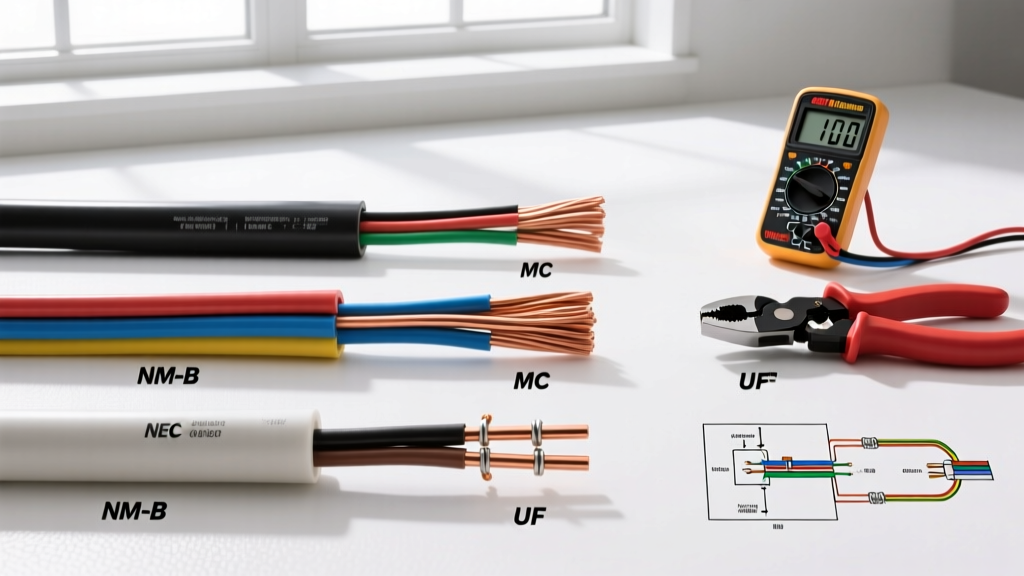

Selecting the correct cable for a residential or light-commercial project is the foundation of a safe, code-compliant electrical system. When evaluating the different types of house electrical wiring, electricians and advanced DIYers must look beyond basic amperage. You must consider the installation environment, physical protection requirements, and the specific tools needed to terminate the conductors without damaging the insulation. In 2026, with copper prices stabilizing but still historically high, minimizing waste through proper tool selection and understanding exact material specifications is more critical than ever.
Decoding NM-B (Romex): The Indoor Standard
Non-Metallic Sheathed Cable, universally known by the brand name Romex and formally designated as NM-B by the National Fire Protection Association (NFPA), is the undisputed workhorse of modern indoor residential wiring. The 'B' designation indicates that the internal THHN conductors are rated for 90°C (194°F), though NEC Article 240.4(D) strictly mandates that overcurrent protection for small conductors (14, 12, and 10 AWG) must be based on the 60°C ampacity column.
Jacket Color Coding and Gauge Specs
Manufacturers like Southwire use distinct jacket colors to help inspectors and electricians instantly identify wire gauge and prevent dangerous over-fusing:
- White Jacket (14 AWG): Rated for 15 Amps. Used almost exclusively for 120V lighting circuits and low-draw receptacles.
- Yellow Jacket (12 AWG): Rated for 20 Amps. The standard for kitchen, bathroom, and general-purpose receptacle circuits.
- Orange Jacket (10 AWG): Rated for 30 Amps. Commonly used for electric water heaters and heavy-duty window AC units.
- Black Jacket (8 AWG and 6 AWG): Rated for 40A and 55A respectively. Used for large appliances like electric ranges, dryers, and sub-panel feeds.
Expert Insight: Modern NM-B cable features advanced lubricated jackets (such as Southwire's SIMpull technology). This reduces pulling friction by up to 40%, allowing you to fish cables through tight stud bays without tearing the outer PVC sheath or stretching the internal copper conductors.
Metal-Clad (MC) and Armored Cable (AC): Heavy-Duty Protection
While NM-B dominates concealed residential walls, exposed areas, garages, and commercial spaces require physical protection. This is where Metal-Clad (MC) and Armored Cable (AC) come into play. Though often incorrectly lumped together as 'BX cable' by older tradesmen, they are fundamentally different under NEC Articles 320 and 330.
The Critical Difference: Grounding Methods
Type AC (Armored Cable): Contains a bare aluminum bonding strip running the length of the cable beneath the interlocked steel armor. The armor itself acts as the equipment grounding conductor (EGC). When terminating AC cable, you must install an anti-short bushing (commonly called a 'redhead') to prevent the sharp metal edges from slicing into the wire insulation.
Type MC (Metal-Clad Cable): Contains a dedicated green insulated or bare copper grounding wire inside the armor. The armor is not listed as a grounding path for standard residential MC. Because of the dedicated ground wire, anti-short bushings are not required by code, though many electricians still use them out of habit.
Underground Feeder (UF-B): Outdoor and Buried Applications
UF-B cable is designed for direct burial and outdoor exposure. Unlike NM-B, where the conductors are loosely wrapped in paper and a hollow PVC sheath, UF-B conductors are completely encased in a solid, moisture-resistant thermoplastic matrix. According to the Southwire Building Wire Specifications, UF-B is rated for 90°C in dry locations and 75°C in wet locations, but again, standard termination limits apply.
Burial Depth and Trenching Requirements
When trenching UF-B, strict adherence to NEC Table 300.5 is mandatory to prevent accidental severing by future landscaping or digging:
- Standard 120V/240V Circuits: Minimum 24 inches of cover.
- 120V, 20A Max (GFCI Protected): Minimum 12 inches of cover.
- Under a 2-inch Concrete Slab: Minimum 18 inches of cover.
Material Comparison Matrix (2026 Pricing & Specs)
| Cable Type | Jacket / Armor | Grounding Path | Primary Application | Avg Cost (250ft, 12/2) |
|---|---|---|---|---|
| NM-B | PVC (Yellow) | Bare Copper Wire | Concealed indoor dry locations | $115 - $135 |
| Type AC | Galvanized Steel | Armor + Bonding Strip | Exposed indoor, retrofit, commercial | $190 - $220 |
| Type MC | Aluminum / Steel | Dedicated Green Wire | Commercial, hospitals, high-end residential | $185 - $215 |
| UF-B | Solid Gray PVC | Bare Copper Wire | Direct burial, outdoor outbuildings | $145 - $170 |
Essential Tools for Stripping and Terminating
Using the wrong tool is the leading cause of nicked conductors, which creates high-resistance hot spots and potential fire hazards. The U.S. Consumer Product Safety Commission (CPSC) frequently cites improper wire stripping and loose terminations as primary factors in residential electrical fires. Equip your pouch with these specific, industry-trusted tools:
1. NM-B Cable Rippers and Strippers
Do not use a utility knife to slit the Romex jacket; you will inevitably score the copper. Use a dedicated cable ripper like the Jonard JIC-3320 or the Milwaukee M18 Cable Ripper. These tools feature a specialized guide that pierces the jacket and rides over the internal ground wire, slitting the sheath perfectly without touching the current-carrying conductors. For stripping the individual THHN insulation, the Klein Tools 11055 Wire Stripper remains the gold standard for 10-20 AWG solid wire, providing clean cuts without reducing the wire diameter.
2. Armored Cable Cutters
Cutting MC or AC cable with standard bolt cutters crushes the armor, making it impossible to insert the conductors into a connector. The Greenlee 1730 Armored Cable Cutter uses a rotating blade mechanism that scores and snaps the interlocked metal armor cleanly, leaving the internal wires completely unharmed and ready for immediate termination.
3. UF-B Skinning Tools
Because the UF-B jacket is solidly extruded around the wires, standard rippers fail. The Ideal 34-098 UF-B Cable Skinning Tool is specifically engineered to slice the gray matrix away from the conductors. Alternatively, many journeymen use a high-quality pair of diagonal cutting pliers (dikes) to carefully 'score and snap' the solid plastic webbing between the wires, though this requires significant practice to avoid nicking the copper.
Advanced Troubleshooting and Edge Cases
Voltage Drop in Long UF-B Runs
A frequent failure mode in outdoor wiring is excessive voltage drop. If you are running a 12 AWG UF-B circuit to a detached garage 150 feet away, the resistance of the copper will cause a voltage drop exceeding the NEC-recommended 3% limit for branch circuits. At 120V, a 15A load on 150ft of 12 AWG wire will drop nearly 6 volts. The Fix: You must upsize to 10 AWG or even 8 AWG UF-B for runs exceeding 100 feet to ensure motors (like sump pumps or air compressors) receive adequate starting voltage and do not burn out.
Thermal Derating in Bundled NM-B
When pulling multiple NM-B cables through a single bored hole in a top plate or fire-block, heat dissipation is severely restricted. Under NEC Article 310.15(C)(1), if you bundle more than three current-carrying conductors together for a continuous run of more than 24 inches, you must apply a derating factor. For example, bundling four 12/2 cables (8 current-carrying conductors) requires an ampacity adjustment factor of 70%. This effectively drops the ampacity of your 12 AWG wire below the standard 20A threshold, requiring you to upsize to 10 AWG or drill separate holes to maintain physical separation.
Final Thoughts on Material Selection
Mastering the different types of house electrical wiring requires matching the physical properties of the cable to the environmental demands of the installation. NM-B offers speed and cost-efficiency for standard framing, MC provides the necessary armor for exposed or commercial applications, and UF-B ensures moisture resistance for exterior runs. By pairing the correct material with specialized stripping and cutting tools, you guarantee a safe, efficient, and inspection-ready electrical system.