
Understanding the Code Landscape for Three-Way Switches
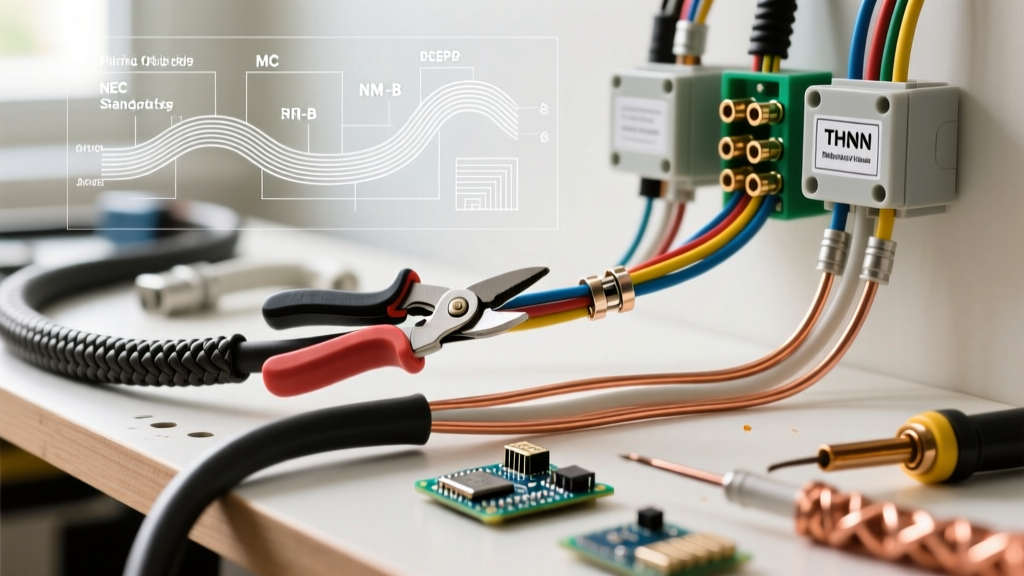
When undertaking an electrical wiring three way switch project, understanding the physical connections is only half the battle. The National Electrical Code (NEC) governs every aspect of the installation, from the cubic inch capacity of your junction boxes to the specific color-coding of traveler wires. As of the 2023 NEC cycle and looking ahead to the 2026 updates, the introduction of smart home technology and advanced arc-fault protection has fundamentally changed how three-way circuits must be roughed in and terminated.
This guide breaks down the critical code requirements, box fill mathematics, and wiring standards you must follow to ensure your three-way switch installation is safe, legal, and inspection-ready.
The Neutral Conductor Mandate: NEC 404.2(C)
Historically, electricians ran a 3-wire cable (e.g., 14/3 Romex) between two three-way switches. This provided a common hot, two travelers, and a ground—but no neutral. This is now a direct code violation in most new construction and major remodels.
Why the Code Changed
Modern electronic switches, smart home hubs, and occupancy sensors require a continuous 120V standby power supply to operate their internal radios and LEDs. Without a neutral, these devices leak current through the load (the light bulb), causing LED flickering or premature ballast failure. Furthermore, the NEC now requires a grounded circuit conductor (neutral) at the switch location to accommodate future energy-control devices without requiring destructive drywall repairs.
How to Comply in the Field
- New Construction: Run a 4-wire cable (14/4 or 12/4) between the switch boxes, or parallel a 14/2 and a 14/3 cable to ensure a dedicated neutral reaches both the line-side and load-side switch boxes.
- Remodels (Grandfather Clause): If opening the walls to run a neutral is structurally impractical, NEC 404.2(C) Exception 2 allows you to omit the neutral only if you install a wireless remote control switch (like the Lutron Caseta PD-5S-DV) that does not require a neutral at the secondary location.
Box Fill Calculations: NEC Article 314.16
Overcrowded junction boxes cause heat buildup and damaged wire insulation. Three-way switch boxes are notorious for box fill violations because they often serve as junction points for both the line voltage and the traveler cables.
Real-World Box Fill Math (14 AWG Circuit)
Let us calculate the required box volume for a standard line-side three-way switch box receiving one 14/2 cable (power source) and one 14/3 cable (travelers and neutral to the second switch).
| Item | Count | Volume Allowance (14 AWG) | Total Cubic Inches |
|---|---|---|---|
| 14/2 Conductors (Hot, Neutral) | 2 | 2.0 cu in each | 4.0 cu in |
| 14/3 Conductors (Black, Red, White) | 3 | 2.0 cu in each | 6.0 cu in |
| Equipment Grounding Wires | 1 (All grounds count as 1) | 2.0 cu in | 2.0 cu in |
| Internal Cable Clamps (Metal Box) | 1 (All clamps count as 1) | 2.0 cu in | 2.0 cu in |
| Three-Way Switch Device | 1 (Counts as 2 volumes) | 4.0 cu in | 4.0 cu in |
| Total Required Volume | 18.0 cu in |
Note: If using a plastic nail-on box, internal clamps are absent, reducing the requirement to 16.0 cu in. However, a standard 18 cu in single-gang box leaves zero margin for error. For 12 AWG circuits (20A), the multiplier is 2.25 cu in, pushing this exact same setup to 20.25 cu in. Always use deep 22 cu in boxes for three-way switches to ensure compliance and ease of termination.
Traveler Wire Identification and Color Coding
Misidentifying wires is a leading cause of failed inspections and dangerous shock hazards. The National Fire Protection Association (NFPA) strictly enforces color-coding rules under NEC Article 200 and Article 210.
NEC Color Code Rules for 3-Way Circuits
- Grounded (Neutral) Conductor: Must be white or gray. It connects to the silver terminal on smart switches or is capped off in the box for standard mechanical switches.
- Grounding Conductor: Must be bare copper or green.
- Ungrounded (Hot/Line) Conductor: Must be black or red. If power enters the switch box via a 14/2 cable, the white wire is acting as an ungrounded hot. NEC 200.7(C)(2) mandates that this white wire must be permanently re-identified with black or red electrical tape or marker at both ends.
- Travelers: The NEC does not mandate a specific color for travelers, but industry standard dictates using the red and black wires in a 14/3 cable. If a white wire is used as a traveler (common in older 3-wire switch loops), it must be re-identified with colored tape at every termination point.
AFCI Protection and Grounding Standards
Under NEC 210.12, nearly all 15A and 20A, 120V branch circuits supplying outlets and switches in dwelling unit living areas, bedrooms, and hallways must be protected by an Arc-Fault Circuit Interrupter (AFCI).
The Bootleg Neutral Trap
When retrofitting a smart three-way switch that requires a neutral, some DIYers mistakenly bond the neutral pigtail to the bare copper ground wire in the box to 'complete' the circuit. This is a severe code violation and a lethal shock hazard. It will also instantly trip an AFCI breaker, as the breaker will detect current returning on the ground path instead of the dedicated neutral. If a neutral is not present, you must pull new cable or use a code-compliant wireless switch alternative.
Proper Grounding and Torque Specs
According to NEC 404.9, all switches must be effectively grounded. If you are using metal junction boxes, the box itself must be grounded via the bare copper wire. The switch yoke must be bonded to the box. While metal yokes on standard switches often make contact via the mounting screws, best practice (and required in many local jurisdictions) is to run a bare copper pigtail from the wire nut bundle directly to the green grounding screw on the switch.
Furthermore, NEC 110.14(D) requires that all terminations be tightened to the manufacturer's specified torque. For standard residential 15A switches (such as the Leviton Decora 5603), the manufacturer specifies a torque of 12 to 14 inch-pounds. Use a calibrated torque screwdriver to prevent loose connections that lead to arcing and thermal failure.
Common Edge Cases and Inspection Failures
'The most common three-way failure I see in the field is the 'switched neutral' wiring method, where the hot is tied directly to the light fixture and the switches break the neutral path. This leaves the light socket energized at 120V even when the light is off, posing a massive shock hazard to anyone changing a bulb. NEC 404.2(B) strictly requires the switching of the ungrounded (hot) conductor only.' - Senior Electrical Inspector, IAEI
Troubleshooting Traveler Cross-Wiring
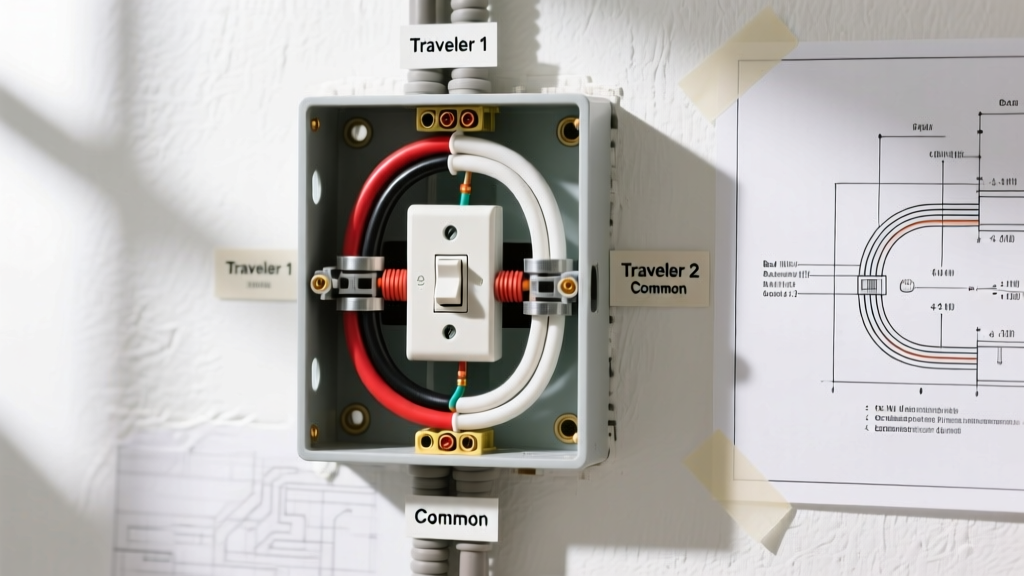
If a three-way circuit requires both switches to be in specific positions for the light to turn on (e.g., Switch A must be UP for Switch B to work), the travelers are miswired. In a compliant installation, the two traveler terminals on Switch 1 must connect directly to the two traveler terminals on Switch 2. The common (dark-colored) screw on Switch 1 receives the line hot, and the common screw on Switch 2 connects to the load (the light fixture). Swapping a traveler with the common wire is the root cause of 90% of three-way operational failures.
Summary of Best Practices for 2026
- Always pull a neutral to both switch boxes, even if using standard mechanical switches today. Future-proofing saves thousands in remodel costs later.
- Use deep junction boxes (minimum 20.25 cubic inches for 14 AWG, 22+ for 12 AWG) to accommodate the extra traveler and neutral wires without violating box fill codes.
- Re-identify white wires used as hots or travelers with black or red tape at both ends.
- Verify torque settings using an inch-pound torque screwdriver to meet NEC 110.14(D) standards.
- Ensure AFCI compatibility by keeping neutrals and grounds strictly isolated downstream of the breaker panel.
For further reading on switch loop requirements and grounding mandates, consult the latest editions of the IAEI Magazine and your local authority having jurisdiction (AHJ), as municipal amendments can sometimes exceed baseline national standards.