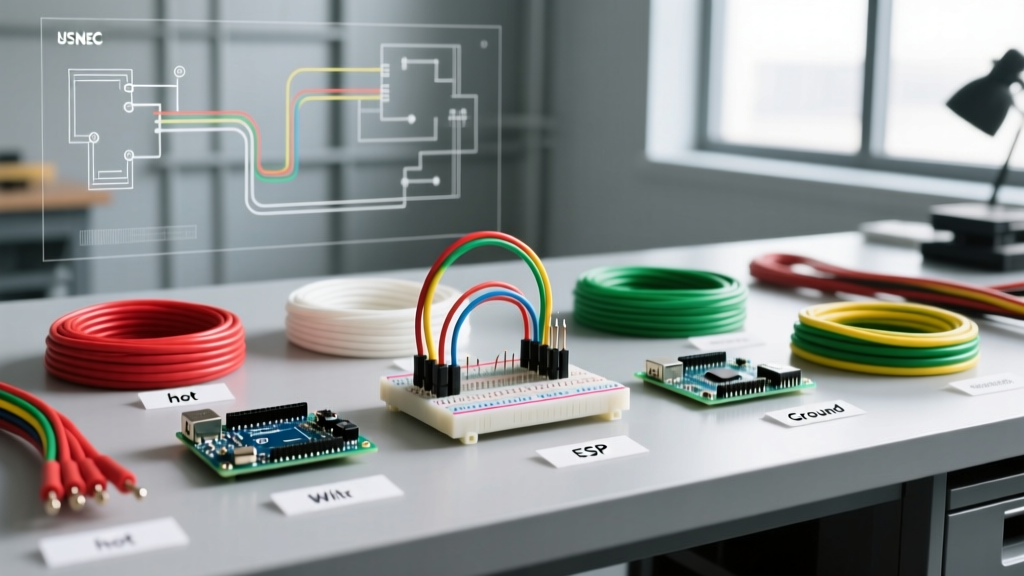

The Critical Role of Electrical Wiring Color Code Standards
Electrical systems are unforgiving. According to the Electrical Safety Foundation International (ESFI), hundreds of fatal electrocutions occur annually in the United States, with a significant percentage linked to improper wiring and misidentified conductors. Adhering to electrical wiring color code standards is not merely an aesthetic preference for neat cable management; it is a fundamental, life-saving protocol mandated by the National Electrical Code (NEC).
As we navigate the widespread adoption of the 2023 NEC and look toward the 2026 code cycle, the emphasis on conductor identification, proper grounding, and arc-fault protection has never been stricter. Whether you are a seasoned journeyman pulling THHN in commercial conduit or a DIYer replacing a 120V receptacle in a residential remodel, misunderstanding wire colors can lead to catastrophic failure modes, including reverse polarity, bootleg grounds, and severe electrical shock.
Core US AC Power Color Codes (Single-Phase 120V/240V)
In the United States, the NEC (specifically Articles 200, 210, and 250) governs the identification of grounded (neutral), ungrounded (hot), and grounding conductors. Below is the definitive matrix for standard residential and light-commercial single-phase wiring.
| Wire Function | Standard Insulation Color | NEC Article Reference | Safety Role & Failure Mode |
|---|---|---|---|
| Ungrounded (Hot) | Black, Red, Blue | 210.4(D), 210.5(C) | Carries current to the load. Failure mode: Shock hazard if exposed or misidentified as neutral. |
| Grounded (Neutral) | White, Gray | 200.2, 200.6 | Provides the return path to the source. Failure mode: Open neutral causes voltage fluctuations and potential shock on appliance chassis. |
| Equipment Ground | Bare Copper, Green, Green/Yellow | 250.118, 250.119 | Provides a low-impedance fault path to trip the breaker. Failure mode: Energized enclosures during a ground fault. |
NM-B Cable vs. THHN Conduit: Contextual Color Applications
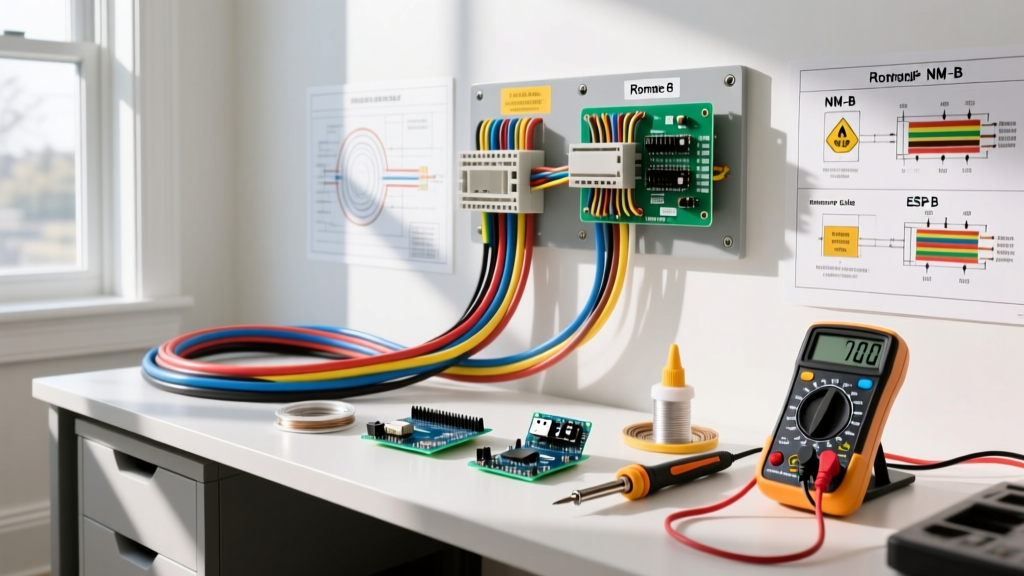
A common point of confusion arises when transitioning between non-metallic sheathed cable (NM-B, commonly known by the brand name Romex) and individual conductors pulled through raceways (THHN/THWN-2).
Residential NM-B (Romex) Configurations
- 14/2 or 12/2 NM-B: Contains one Black (hot), one White (neutral), and one Bare (ground). Used for standard 15A and 20A 120V circuits.
- 14/3 or 12/3 NM-B: Adds a Red conductor. Used for 240V baseboard heaters, split-wired receptacles, and 3-way switch travelers. The White remains strictly neutral.
- 10/3 NM-B: Black, Red, White, Bare. Utilized for 30A 240V loads like electric dryers, where both 120V (for timers/motors) and 240V (for heating elements) are required.
Commercial THHN in Conduit
When pulling individual wires through EMT or PVC conduit, electricians have more flexibility but must follow strict phase-identification rules. For 120/208V 3-phase wye systems, the standard hots are Black, Red, and Blue. The neutral must be White, and the ground Green or Bare. However, for 277/480V systems, the hots shift to Brown, Orange, and Yellow, and the neutral is frequently Gray to prevent dangerous cross-voltage connections.
The High-Leg Delta Hazard: A Commercial Edge Case
One of the most dangerous configurations in older commercial and industrial buildings is the 120/240V High-Leg Delta (also known as a Red-Leg or Wild-Leg) system. This system provides 120V for standard receptacles and 240V for heavy machinery, but it features a center-tapped transformer on only one phase.
CRITICAL SAFETY WARNING: In a High-Leg Delta panel, Phase A to Neutral is 120V, and Phase C to Neutral is 120V. However, Phase B (the High Leg) to Neutral is 208V. The NEC strictly mandates that this high leg be identified with Orange insulation (NEC 215.8). Connecting a standard 120V appliance or lighting ballast to the Orange high leg will instantly destroy the equipment and create a severe fire hazard.
Nuances and Exceptions in the NEC
Rigid adherence to electrical wiring color code standards requires understanding the code's exceptions. Blindly assuming a white wire is always neutral is a fatal mistake in older homes or specific modern switch loops.
The "White Wire as Hot" Exception (NEC 200.7)
In cable assemblies (like NM-B), a white wire can be used as an ungrounded (hot) conductor under specific conditions. Historically, in a "switch loop" where power goes to the light fixture first and a 2-wire cable drops down to the switch, the white wire was used to carry the hot feed down to the switch. The NEC requires this white wire to be permanently re-identified with black tape, paint, or heat shrink at every termination point.
Note on 2026 Perspectives: Modern NEC cycles require a neutral conductor at nearly all switch locations to accommodate smart switches and occupancy sensors. Consequently, electricians now typically pull 14/3 or 12/3 cable to switch boxes, allowing the white wire to remain a true neutral, while the black and red serve as the hot feed and switched leg, vastly improving safety and reducing re-identification errors.
Multimeter Verification Protocol: Trust, But Verify
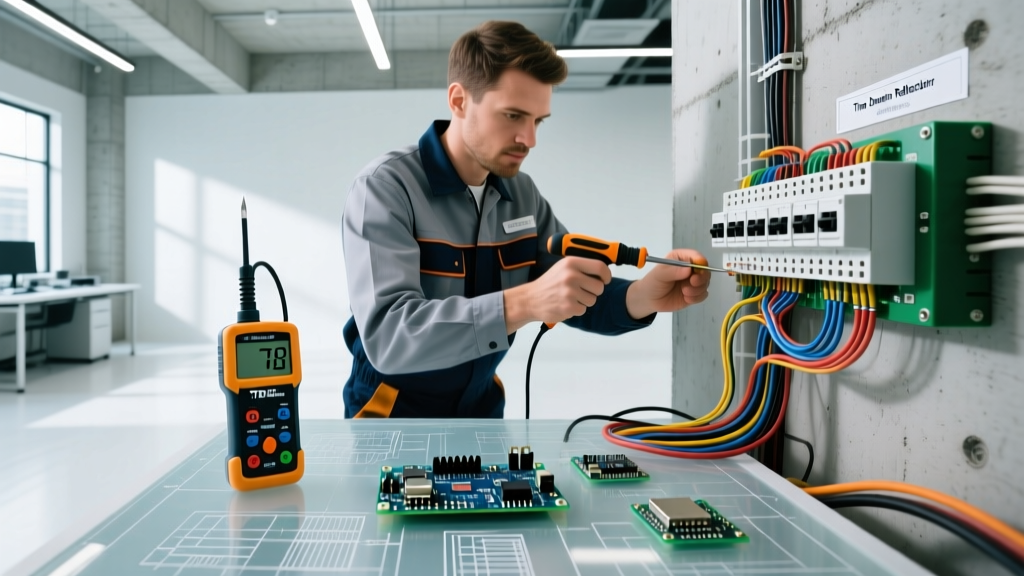
The Occupational Safety and Health Administration (OSHA) emphasizes that visual inspection of wire colors is insufficient for guaranteeing a safe work environment. Previous contractors may have wired circuits incorrectly, used the wrong cable, or failed to re-identify switch legs. Before touching any bare conductor, execute this verification protocol using a CAT III or CAT IV True-RMS multimeter (such as the Fluke 117 or Klein Tools MM700).
- Test Known Source: Verify your multimeter is functioning by testing a known live 120V receptacle.
- Hot to Ground Test: Place the red probe on the suspected hot wire (Black/Red) and the black probe on the equipment ground (Bare/Green). Expect ~120V (or 240V). If you read 0V, the circuit is dead or the ground is open.
- Hot to Neutral Test: Move the black probe to the suspected neutral (White/Gray). Expect ~120V.
- Neutral to Ground Test (The Diagnostic Check): Place probes on Neutral and Ground. You should read less than 2 Volts.
- If you read 0.0V under load: You likely have a bootleg ground (neutral and ground illegally bonded at the receptacle).
- If you read high voltage (e.g., 60V - 120V): You have an open neutral or a severely overloaded circuit experiencing massive voltage drop.
Understanding Neutral-to-Ground Voltage Drop
Many DIYers panic when they measure 1.5V between neutral and ground, assuming a wiring fault. This is actually a demonstration of Ohm's Law. The neutral wire carries the exact same return current as the hot wire. Because copper wire has inherent resistance (e.g., 14 AWG copper has a resistance of roughly 2.52 ohms per 1,000 feet), a 12A load on a 100-foot run of 14 AWG wire will create a voltage drop along the neutral conductor. Since the grounding conductor carries zero current under normal operation, it remains at true zero potential. The multimeter simply reads the potential difference (voltage drop) between the current-carrying neutral and the non-current-carrying ground. Remediation of improperly wired panels that cause excessive voltage drop or unsafe neutral-ground bonds typically costs between $1,500 and $3,500 when performed by a licensed electrical contractor.
International Standards Warning for Imported Equipment
As global supply chains expand, DIYers and technicians frequently encounter imported machinery, HVAC components, or solar inverters wired to IEC (International Electrotechnical Commission) standards. Do not assume US color codes apply to imported equipment.
- IEC Hot (Phase): Brown, Black, Gray (US uses White/Gray for Neutral).
- IEC Neutral: Blue (US uses Blue for Hot in 3-phase or switch travelers).
- IEC Ground: Green/Yellow stripe (Consistent with US, but solid green is rare in IEC).
Always consult the manufacturer's schematic and physically trace the conductors to the terminal block designations (L1, L2, L3, N, PE) rather than relying solely on insulation color when dealing with foreign-manufactured electronics.
Final Safety Directives
Mastering electrical wiring color code standards is the baseline for electrical safety. Always de-energize circuits at the main breaker panel before beginning work, apply a physical lockout/tagout (LOTO) device to prevent accidental re-energization, and verify the absence of voltage with a properly rated meter. For comprehensive code updates and safety training, regularly consult the National Fire Protection Association's NEC resources. When in doubt regarding conductor identification, circuit loading, or panel remediation, hire a licensed electrician to ensure your system meets the latest safety mandates.