
Electrical wiring colors are not mere aesthetic choices or arbitrary suggestions; they are life-saving standards codified in the National Electrical Code (NEC). Misinterpreting a wire's function can lead to catastrophic arc faults, equipment destruction, or fatal shocks. As municipalities across the US continue to adopt the 2023 and upcoming 2026 NEC cycles, understanding the precise color chart for electrical wiring is mandatory for both licensed electricians and advanced DIYers.
This comprehensive guide breaks down the exact NEC color code requirements for residential, commercial, and 3-phase systems, highlighting critical edge cases, common code violations, and the tools required to verify wire identity safely.
The Core NEC Color Chart for Electrical Wiring (120V/240V)
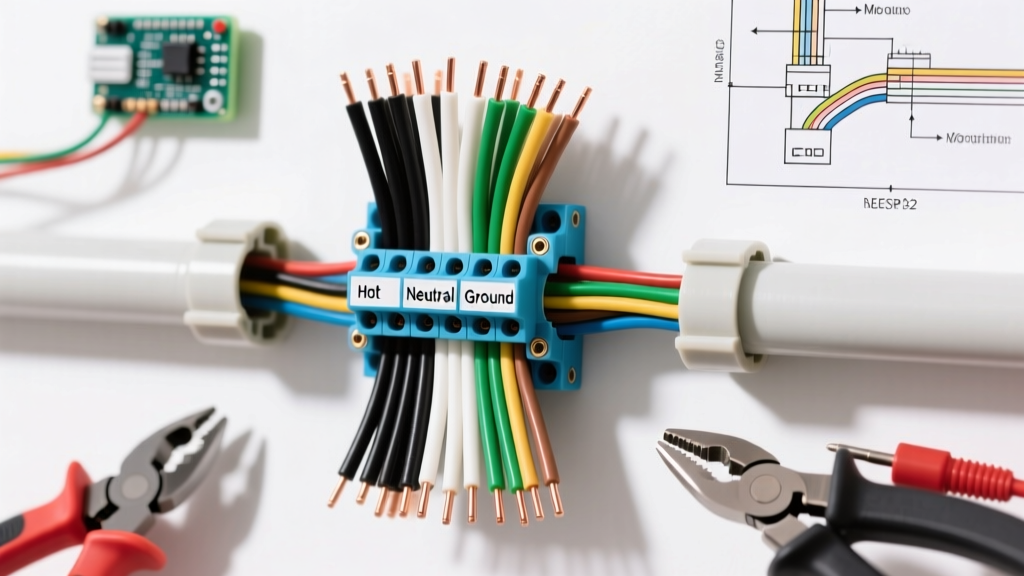
For standard US residential and light-commercial single-phase systems (120V and 240V), the NEC strictly defines the color palette for ungrounded (hot), grounded (neutral), and equipment grounding conductors. These rules are primarily outlined in NEC Articles 200, 210, and 250.
| Wire Function | NEC Designation | Standard Insulation Color | Common AWG Sizes |
|---|---|---|---|
| Hot (Line 1) | Ungrounded Conductor | Black | 14, 12, 10, 8, 6 |
| Hot (Line 2) | Ungrounded Conductor | Red | 14, 12, 10, 8, 6 |
| Neutral | Grounded Conductor | White or Gray | 14, 12, 10, 8, 6 |
| Ground | Equipment Grounding Conductor (EGC) | Bare Copper or Green | 14, 12, 10, 8, 6 |
The 'White Wire as Hot' Exception (NEC 200.7)
One of the most common points of confusion in residential wiring is the switch loop. When wiring a standard light switch, you often use a 12/2 or 14/2 NM-B (Romex) cable to drop power from the ceiling fixture down to the switch. In this scenario, the white wire in the cable is used to carry the hot feed down to the switch, while the black wire carries the switched hot back up to the light.
Commercial & 3-Phase Wiring Color Codes
When stepping into commercial buildings, the color chart for electrical wiring expands to accommodate 3-phase power. NEC Article 210.5(C) and 215.12 mandate specific color coding for branch circuits and feeders to prevent cross-voltage disasters, such as accidentally wiring a 120V receptacle to a 277V lighting circuit.
| System Voltage | Phase A | Phase B | Phase C | Neutral | Ground |
|---|---|---|---|---|---|
| 120/208V (Wye) | Black | Red | Blue | White | Green/Bare |
| 277/480V (Wye) | Brown | Orange | Yellow | Gray | Green/Bare |
The Deadly High-Leg Delta Trap (NEC 110.15)
Older industrial facilities and certain commercial strip malls often utilize a 240V 3-Phase Delta system with a center-tapped neutral to provide both 240V for heavy machinery and 120V for standard outlets. This creates a 'High-Leg' or 'Wild-Leg' delta. The voltage from the high leg to neutral is not 120V—it is approximately 208V.
According to NEC 110.15 and 230.56, the high-leg conductor (always Phase B) must be colored Orange. If an electrician assumes the orange wire in a 277/480V panel is just Phase B of a standard Wye system and terminates it to a 120V breaker, the resulting 208V-to-ground fault will instantly destroy the connected appliance and pose a severe arc-flash hazard.
DC, Low-Voltage, and Control Wiring Standards
While the NEC focuses heavily on AC power, low-voltage and DC systems have their own color conventions, often governed by industry standards rather than strict NEC mandates, though NEC Article 725 covers Class 1, 2, and 3 remote-control and signaling circuits.
- Standard DC Power: Red (Positive), Black (Negative/Ground). Common in solar PV systems and automotive wiring.
- PoE (Power over Ethernet): Follows TIA/EIA-568 standards. Pairs are Blue, Orange, Green, and Brown. DC power is injected over these data pairs.
- Thermostat / HVAC Control (Class 2): Typically uses 18/5 or 18/8 stranded wire. Standard color mapping: Red (24VAC Hot), White (Heat), Yellow (Cooling), Green (Fan), Blue (Common/C).
Top 3 NEC Code Violations to Avoid
Based on data from municipal electrical inspectors and safety organizations like OSHA, the following color-related violations are the most frequently cited during rough-in and final inspections:
- Using Green or Bare for a Current-Carrying Conductor: NEC 250.119 strictly prohibits using green, green with yellow stripes, or bare copper for any wire that carries normal circuit current. These colors are reserved exclusively for equipment grounding.
- Mixing Neutrals and Grounds in Subpanels: In a main service panel, the neutral and ground buses are bonded. However, NEC 250.142 requires them to be completely isolated in all downstream subpanels. White/Gray wires must terminate on the neutral bus (isolated from the enclosure), while Bare/Green wires must terminate on the ground bus (bonded to the enclosure).
- Failing to Maintain Phase Color Consistency: NEC 210.5(C) requires that in a commercial building with multiple voltage systems (e.g., 120/208V and 277/480V), the color coding must be consistent throughout the entire facility. You cannot use Black/Red/Blue for 208V on the first floor and Brown/Orange/Yellow for 208V on the second floor.
Tools for Verifying Wire Identity
A fundamental rule of electrical safety is to never trust the wire color alone. In homes built before 1990, previous DIYers may have used whatever scrap wire was available. Furthermore, imported fixtures and appliances often use IEC (European) color codes, which conflict with US NEC standards.
To verify wire identity, professionals rely on specific diagnostic tools:
| Tool Category | Recommended Model | Approx. Cost (2026) | Primary Use Case |
|---|---|---|---|
| Non-Contact Voltage Tester | Klein Tools NCVT-3 | $35 - $45 | Quickly identifying live hot wires (12V to 1000V AC) before touching conductors. |
| True-RMS Digital Multimeter | Fluke 117 | $215 - $240 | Precise voltage measurement, verifying neutral-to-ground voltage drop (should be < 2V). |
| Circuit Breaker Finder | Amprobe CB-120 | $110 - $130 | Tracing unmarked hot wires back to their specific panel breaker. |
US vs. International Color Codes (NEC vs. IEC)
When working with imported industrial machinery, European vehicles, or international HVAC equipment, you will encounter the IEC 60446 standard. Confusing IEC and NEC wiring is a leading cause of equipment failure in global manufacturing facilities.
IEC Standard (Europe/UK/Australia):
Phase 1: Brown | Phase 2: Black | Phase 3: Gray
Neutral: Blue | Ground: Green with Yellow StripeNote: In the US NEC, Blue is a hot wire (Phase C in 120/208V), and Green/Yellow is strictly ground. Connecting an IEC Blue neutral to a US Blue hot phase will result in a dead short.
Final Thoughts on Code Compliance
Mastering the color chart for electrical wiring is the foundation of safe electrical installation. Whether you are pulling 12/2 NM-B for a residential kitchen remodel or terminating 3/0 AWG THHN in a commercial 480V panel, strict adherence to NEC color standards ensures that the next technician who opens the panel can do so safely. Always consult the latest edition of the National Electrical Code and verify local municipal amendments before beginning any wiring project.