
Navigating the Complexities of Household Electrical Wiring Inspections
When pulling permits for a remodel, addition, or new construction, the phrase household electrical wiring often triggers anxiety for DIYers and seasoned contractors alike. Electrical inspections are not arbitrary bureaucratic hurdles; they are rigorous enforcement mechanisms for the National Electrical Code (NEC), designed to prevent arc faults, thermal overloads, and electrocution. As jurisdictions across the United States fully adopt the 2023 NEC—and begin reviewing and implementing localized 2026 amendments—the compliance landscape for residential wiring has become increasingly stringent. This is particularly true regarding Arc-Fault Circuit Interrupter (AFCI) expansion, energy management systems, and precise torque verification.
Failing an inspection doesn't just mean a delayed project; in 2026, municipal re-inspection fees typically range from $85 to $150 per trip. Worse, failing a rough-in inspection after insulation or drywall has been installed requires destructive remediation. Understanding the exact compliance metrics inspectors use is the only way to ensure your household electrical wiring passes on the first attempt.
The Bifurcated Inspection Process: Rough-In vs. Final
Residential electrical inspections are universally split into two distinct phases. Attempting to schedule a final inspection before the rough-in has been signed off will result in an automatic rejection.
Phase 1: The Rough-In Inspection
This phase occurs after all cables (NM-B, UF-B, MC) are pulled, junction boxes are mounted, and panel knockouts are secured, but before any drywall is hung or insulation is blown. The inspector's primary focus is on the physical routing, securing, and protection of the wiring infrastructure. They are looking for nail plate placement, cable stapling intervals, and box fill calculations.
Phase 2: The Final Inspection
The final inspection takes place after the home is finished. Devices (receptacles, switches, hardwired appliances) are terminated, the panel is dressed, and cover plates are installed. The inspector will verify GFCI/AFCI functionality, proper grounding and bonding, torque on panel lugs, and the accuracy of the panel schedule.
Top 5 NEC Code Violations in Household Electrical Wiring
Based on municipal inspection data and industry reports from the National Fire Protection Association (NFPA), the following five violations account for the vast majority of red-tagged residential projects.
1. NM Cable Proximity to Framing Edges (NEC 300.4)
NEC Article 300.4(A)(1) mandates that nonmetallic-sheathed cables must be kept at least 1.25 inches from the nearest edge of a framing member. If you are boring standard 2x4 studs (which are actually 1.5 inches wide) to run 14/2 or 12/2 Romex, maintaining a 1.25-inch clearance on both sides is mathematically impossible if the hole is centered. Therefore, you must install a steel nail plate (minimum 1/16 inch thick) over the stud to protect the cable from drywall screws and trim nails. Failing to install nail plates is an instant rough-in failure.
2. Missing or Misapplied AFCI Protection (NEC 210.12)
NEC Article 210.12 requires AFCI protection for nearly all 120-volt, single-phase, 15- and 20-ampere branch circuits supplying outlets in dwelling units. This includes kitchens, laundry rooms, bedrooms, and living areas. Using a standard Eaton BR120 breaker (approx. $6) instead of an Eaton BR120CAF AFCI breaker (approx. $45-$55) in a bedroom circuit will result in an immediate fail. Furthermore, dual-function (AFCI/GFCI) breakers are now required in areas where both protections overlap, such as kitchen countertops near sinks.
3. Box Fill Violations (NEC 314.16)
Overcrowding a junction box causes heat buildup and damages wire insulation during device installation. Inspectors calculate box fill based on the volume of the box versus the conductors, clamps, and devices inside. According to the Electrical Safety Foundation International (ESFI), overloaded boxes are a leading cause of residential electrical fires.
| Conductor Size (AWG) | Volume Allowance per Conductor | Device Yoke Allowance |
|---|---|---|
| 14 AWG | 2.0 cubic inches | 4.0 cubic inches (2x vol) |
| 12 AWG | 2.25 cubic inches | 4.5 cubic inches (2x vol) |
| 10 AWG | 2.5 cubic inches | 5.0 cubic inches (2x vol) |
| 8 AWG | 3.0 cubic inches | 6.0 cubic inches (2x vol) |
Note: All equipment grounding conductors combined count as a single volume allowance based on the largest ground wire present.
4. Improper Splicing Outside of Boxes (NEC 300.5 & 110.14)
All splices must be accessible and contained within a listed enclosure. Burying a wire nut splice inside a wall cavity, behind a hardwired vanity mirror, or underground without a listed direct-burial resin splice kit is a severe fire hazard. If a wire is too short, you must install an accessible junction box with a blank cover plate to extend it.
5. Grounding and Bonding Errors (NEC Article 250)
For a 200-amp residential service, the Grounding Electrode Conductor (GEC) must be sized correctly—typically #4 AWG copper or #2 AWG aluminum. A common failure point is the main bonding jumper. In a main service panel, the neutral bar and the ground bar must be bonded together. In a sub-panel, they must remain isolated. Connecting the ground and neutral bars in a sub-panel creates a parallel neutral path, energizing the grounding system and posing a lethal shock hazard.
The 2026 Torque Verification Mandate (NEC 110.14)
One of the most heavily enforced modern code requirements is NEC 110.14(D), which mandates that termination torque be applied using a calibrated torque tool. Hand-tightening lug screws on a 200-amp main breaker or receptacle terminals leads to thermal expansion and contraction cycles that gradually loosen the connection. This micro-movement causes arcing and eventual panel fires. Inspectors are increasingly carrying their own calibrated torque screwdrivers (such as the Wiha 101090) to spot-check panel lugs and breaker terminals. If you cannot produce the torque specifications listed on the panel label and verify them with a tool, you will fail the final inspection.
Inspector's Insight: "The most common reason I fail a final inspection on high-end remodels isn't the complex smart-home wiring; it's the panel schedule. If the typed schedule inside the panel door doesn't exactly match the circuits installed, or if it's handwritten in pencil, it's a red tag. Precision matters."
Comprehensive Pre-Inspection Checklist
Use this actionable checklist before calling your local building department to schedule your inspection.
Rough-In Readiness
- Securing: NM cables are secured within 8 inches of every single-gang box without a cable clamp (NEC 334.30).
- Intervals: Cables are stapled or secured every 4.5 feet maximum.
- Protection: Steel nail plates are installed on all bored studs where cable clearance is less than 1.25 inches.
- Stripping: Wire insulation is stripped no more than 3/4 inch for terminal connections; no exposed copper outside the terminal.
- Firestopping: All holes drilled through top/bottom plates and fire-blocks are sealed with approved firestop caulk or foam.
Final Inspection Readiness
- Panel Dress: All unused breaker knockouts in the panel are sealed with metal knockout seals.
- Device Orientation: Receptacles are installed consistently (e.g., grounding pin down) and are flush with the wall surface.
- Testing: GFCI and AFCI test buttons are physically functional; line and load wires are not reversed.
- Labeling: A typed, accurate, and permanent panel schedule is affixed to the inside of the panel door.
- Clearance000 Btu units require dedicated 240V circuits.
Essential Tools for Compliance Testing
To guarantee your household electrical wiring meets code before the inspector arrives, invest in professional-grade testing equipment. The Consumer Product Safety Commission (CPSC) emphasizes the importance of verified testing in preventing residential electrical hazards.
- Klein Tools ET920 Circuit Breaker Finder: Accurately maps circuits to the panel to ensure your panel schedule is 100% correct.
- Amprobe AT-3500 Advanced Cable Tracer: Essential for tracing hidden wires and verifying circuit integrity before energizing.
- Wiha Insulated Torque Screwdriver Set: Required to meet NEC 110.14(D) torque specifications on terminal lugs.
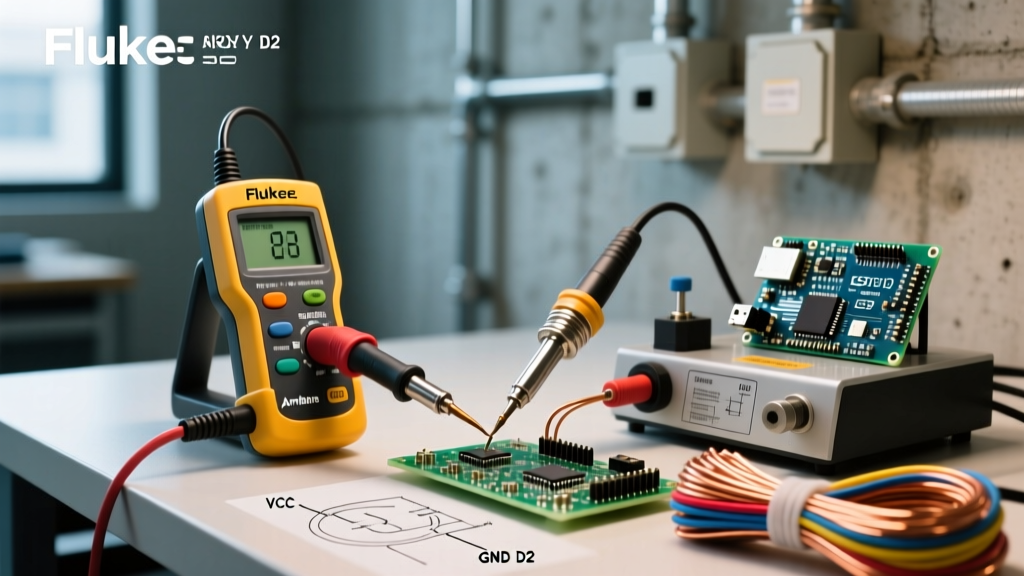
- Fluke 117 True-RMS Digital Multimeter: For verifying exact voltage drops and ensuring neutral-to-ground voltage is under 2 volts at the furthest receptacle.
Conclusion
Passing an electrical inspection requires a meticulous adherence to the National Electrical Code and an understanding of the specific metrics inspectors evaluate. By respecting box fill calculations, enforcing strict cable securing rules, and utilizing calibrated torque tools, you ensure that your household electrical wiring is not only code-compliant but fundamentally safe for decades to come. Always consult your local Authority Having Jurisdiction (AHJ), as local amendments can supersede baseline NEC requirements.