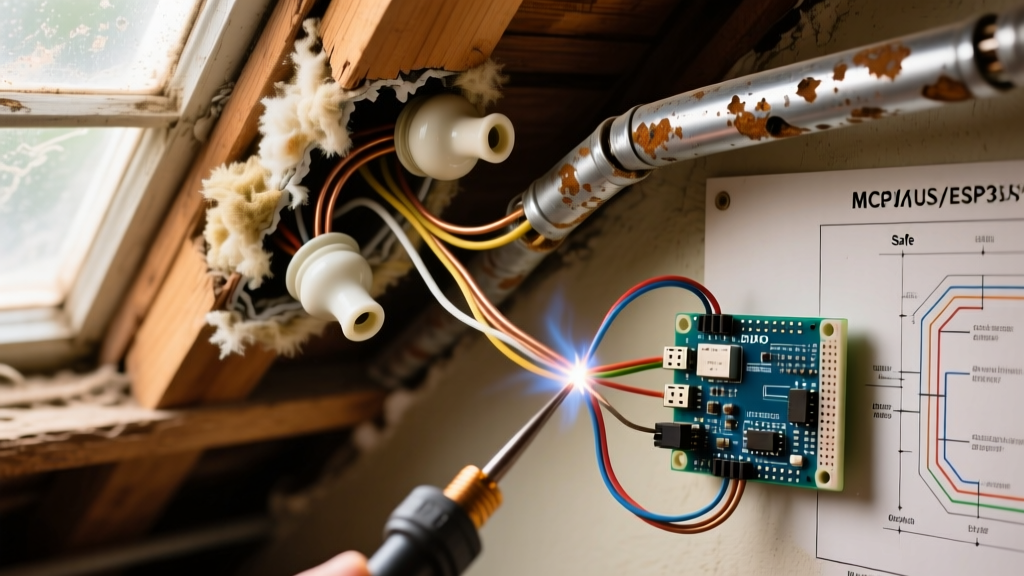

The Hidden Dangers Lurking Behind Pre-1980 Drywall
Owning a historic or mid-century home comes with undeniable architectural charm, but it also conceals severe electrical liabilities. When dealing with old home electrical wiring, the primary threat isn't just outdated aesthetics; it's the fundamental mismatch between legacy infrastructure and modern power demands. A 1950s home was designed to handle a few incandescent bulbs, a radio, and a refrigerator. Today, that same home runs central HVAC, high-wattage kitchen appliances, and dozens of smart home devices.
According to the National Fire Protection Association (NFPA), electrical failures or malfunctions remain a leading cause of U.S. home structure fires, resulting in over $1.3 billion in direct property damage annually. Aging insulation, degraded splices, and improper DIY modifications are the primary culprits. As a homeowner or DIYer in 2026, understanding the exact failure modes of legacy wiring is the first step toward preventing a catastrophic thermal event.
2026 Safety Alert: Never assume a newly painted receptacle implies updated wiring. Always perform a non-contact voltage and wiring sequence test before touching any terminal in a pre-1980 dwelling.
Identifying Legacy Wiring Systems: The Big Three
Before you cut into any wall for a remodel, you must identify the era and type of wiring present. Here are the three most hazardous legacy systems found in North American homes.
1. Knob-and-Tube (K&T) Wiring (1880s–1930s)
K&T wiring features single-strand copper conductors suspended by porcelain knobs and run through porcelain tubes when passing through framing. The wires were insulated with rubberized cloth. The Hazard: K&T lacks an equipment grounding conductor (EGC). Furthermore, the cloth insulation becomes brittle and flakes off over time, exposing bare copper. The most severe fire risk occurs when modern contractors blow cellulose or fiberglass insulation over K&T wires in attics, violating NEC clearance rules and preventing the wires from dissipating heat, leading to thermal runaway.
2. Aluminum Branch Wiring (1965–1972)
During the copper shortage of the late 1960s, builders used AA-1350 aluminum alloy for 15A and 20A branch circuits. The Hazard: This specific alloy suffers from 'cold creep' (expanding and contracting under load, loosening terminal screws) and rapid galvanic oxidation when mated directly to copper or brass terminals. The Consumer Product Safety Commission (CPSC) notes that homes wired with pre-1972 aluminum have a significantly higher risk of outlet fires. Note: Post-1972 AA-8000 series aluminum is safe and still used today for heavy feeder cables (e.g., 2/0 AWG to a subpanel).
3. Ungrounded NM-B 'Romex' (1940s–1960s)
Early non-metallic sheathed cable contained only a black (hot) and white (neutral) wire, wrapped in a tar-impregnated paper sheath. The Hazard: There is no ground wire. While the paper sheath degrades and the outer jacket can crack if bent, the primary safety issue is the reliance on 2-prong receptacles, which offer no path to trip a breaker in the event of a short to a metal appliance chassis.
Essential Diagnostic Tools for Old Home Wiring
Visual inspection is insufficient. You need empirical data to verify the safety of your circuits. Here is the mandatory toolkit for assessing old home electrical wiring in 2026.
| Diagnostic Tool | Target Hazard | Expected Reading / Actionable Insight |
|---|---|---|
| Klein Tools RT250 GFCI Receptacle Tester | Bootleg grounds, open neutrals | Verifies true ground path; standard 3-light testers will falsely pass a 'bootleg' ground. |
| Fluke T+PRO Voltage Tester | Phantom voltages, backfed neutrals | Provides exact voltage drop readings under load; crucial for detecting high-resistance aluminum joints. |
| Schneider Electric Square D Thermal Camera | Loose breaker lugs, overloaded bus bars | Identifies hot spots (>110°F) inside the main panel caused by corroded aluminum feeders. |
High-Risk Failure Modes & Edge Cases
When assessing old home electrical wiring, the wiring itself is often less dangerous than the improper 'fixes' applied by previous owners. Watch for these specific edge cases.
The 'Bootleg Ground' Illusion
Home inspectors frequently flag ungrounded 2-prong outlets. To hide this from inspectors, unethical flippers sometimes install a 3-prong receptacle and jumper the neutral terminal to the ground terminal behind the yoke. This is a bootleg ground. If a hot wire shorts to the appliance chassis, the chassis becomes energized at 120V, and the breaker will not trip until someone touches it and completes the circuit to earth. The Fix: Use the RT250's GFCI test button. A bootleg ground will fail to trip the upstream GFCI breaker because there is no actual path to the panel's ground bus.
Over-Fusing and Edison-Base Tampering
In older fuse boxes, a homeowner might screw a 30-amp fuse into a circuit wired with 14 AWG copper (rated for 15 amps). When the circuit overloads, the wire inside the wall will melt and ignite before the 30A fuse blows. The Fix: If you are retaining a legacy fuse panel, ensure 'Type S' rejection bases are installed. These bases physically prevent the insertion of a fuse with an amperage rating higher than the wire's capacity.
Backstabbed Receptacles on Shared Neutrals
Push-in 'backstab' terminals on 1970s-era receptacles rely on a tiny internal spring clip. Under the continuous 12A-15A load of modern space heaters or window AC units, these clips heat up, lose tension, and arc. In multi-wire branch circuits (MWBC) common in older homes, a loose neutral connection via a backstab can cause 240V to be pushed across 120V appliances, instantly destroying electronics.
2026 Remediation Pathways and Cost Matrix
Rewiring an entire home is the gold standard, but it requires tearing into drywall, plaster repair, and massive capital. Here is a realistic breakdown of 2026 remediation strategies, from targeted fixes to full overhauls.
| Remediation Strategy | Application Scenario | Est. 2026 Cost Range | Code Compliance Note |
|---|---|---|---|
| AlumiConn Lug Pigtailing | Aluminum branch circuits (AA-1350) | $12 - $18 per outlet | Must use King Innovation 95125 connectors torqued to exactly 20 in-lbs. COPALUM is an alternative but requires proprietary tooling. |
| GFCI Receptacle Swap | Ungrounded 2-wire NM circuits | $25 - $40 per outlet | NEC 406.4(D)(2)(c) requires labeling the faceplate 'No Equipment Ground'. Does NOT protect surge suppressors. |
| AFCI Breaker Retrofit | Active Knob-and-Tube or degraded cloth Romex | $65 - $95 per breaker | NEC 210.12 mandates Arc Fault protection. Eaton BR120AFIC or Siemens QAF2 series will detect dangerous series arcs in degrading insulation. |
| Full Copper Rewire (1,500 sq ft) | Complete system failure, major remodel | $14,000 - $24,000+ | Brings home to 2026 NEC standards, including dedicated 20A kitchen/bath circuits and whole-home surge protection (230.95). |
Navigating NEC Code Requirements for Existing Dwellings
When upgrading old home electrical wiring, you are generally permitted to perform 'like-for-like' repairs. However, the moment you alter the circuit, extend a run, or replace a panel, you trigger compliance with the current National Electrical Code (NEC). The NFPA's National Electrical Code outlines strict rules for existing dwellings.
- AFCI Expansion: If you replace a legacy breaker or extend a circuit into a living room, bedroom, or hallway, you must install an Arc Fault Circuit Interrupter (AFCI) breaker. Standard thermal-magnetic breakers will not pass inspection in these zones.
- Tamper-Resistant (TR) Receptacles: Any receptacle replaced in an old home must now be a TR type (NEC 406.12), featuring internal shutters that prevent children from inserting foreign objects.
- AFCI/GFCI Dual Function: If an old home's kitchen or laundry circuit is upgraded, the breaker or first receptacle in the chain must provide both Arc Fault and Ground Fault protection, typically achieved via a Dual Function (DF) breaker.
When to Abandon DIY and Call a Master Electrician
While replacing a light fixture or swapping a receptacle on a known-good copper circuit is a standard DIY task, old home electrical wiring presents compounding variables. You must hire a licensed electrical contractor if you encounter:
- Federal Pacific (Stab-Lok) or Zinsco Panels: These legacy breaker panels have documented failure rates where the internal bus bars melt and breakers fail to trip. They cannot be repaired; the entire panel and breakers must be replaced immediately.
- Active Knob-and-Tube in Insulated Cavities: De-energizing, removing, and rerouting K&T requires tracing circuits through finished walls, often necessitating a professional with specialized fish-tape and borescope equipment.
- Service Mast Upgrades: Upgrading a 60A or 100A overhead service to a modern 200A meter-main combo involves utility coordination, municipal permits, and working with live, un-fused utility drop cables.
Treating old home electrical wiring with the respect and diagnostic rigor it demands is the only way to preserve the history of your home without compromising the safety of your family. Always test twice, torque to manufacturer specifications, and never bypass modern safety devices for the sake of convenience.