
The Critical Link Between Electrical Wiring Names and Safety
Walking into a hardware store or opening an existing junction box can feel like reading a foreign language. Terms like NM-B, THHN, UF-B, and XHHW-2 are not just manufacturer jargon; they are precise electrical wiring names that dictate exactly where and how a cable can be safely installed. Misidentifying these wires or ignoring their specific ratings is one of the leading causes of residential electrical fires and severe shock hazards.
According to the Electrical Safety Foundation International (ESFI), electrical malfunctions cause over 50,000 home fires annually in the United States. A significant percentage of these stem from improper wire selection, overloaded circuits, and degraded insulation caused by using a wire type in an environment it was never named or rated for. In 2026, with the widespread adoption of the latest National Electrical Code (NEC) standards, understanding these names is no longer optional for DIYers and professional electricians alike.
Decoding Non-Metallic (NM) Cable Names and Jacket Colors
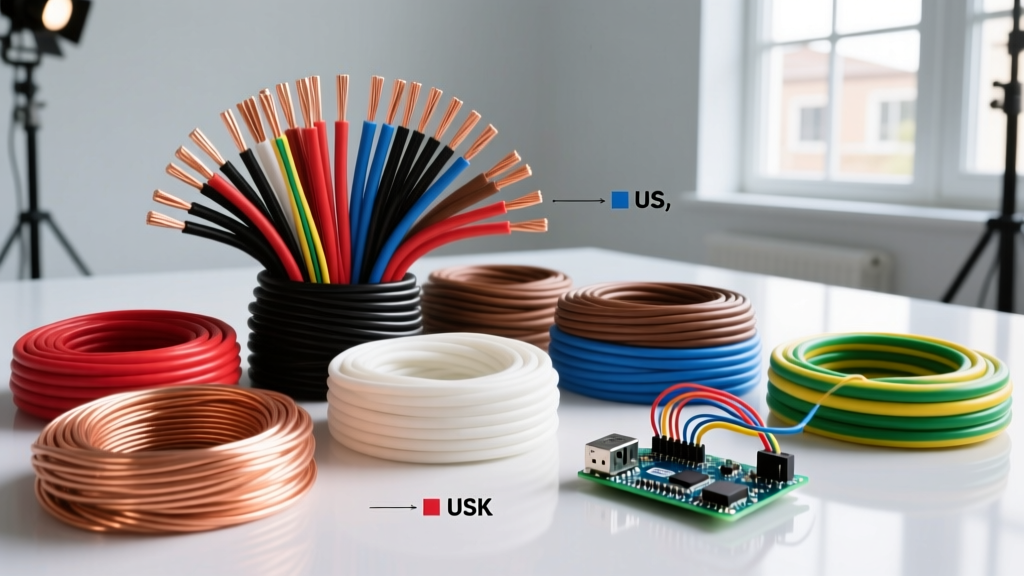
The most common cable found in modern residential dry-wall construction is Non-Metallic sheathed cable, universally referred to by the legacy brand name 'Romex'. The official electrical wiring name for this is NM-B (Non-Metallic, Type B, rated for 90°C). The outer PVC jacket color is a deliberate safety indicator of the wire gauge and ampacity hidden inside.
| Jacket Color | Wire Gauge (AWG) | Max Ampacity | Common Application | Safety Warning |
|---|---|---|---|---|
| White | 14 AWG | 15 Amps | Standard lighting, bedroom outlets | Never use on a 20A breaker; fire risk. |
| Yellow | 12 AWG | 20 Amps | Kitchen small appliances, bathrooms | Required for 20A receptacles (NEC 210.11). |
| Orange | 10 AWG | 30 Amps | Electric water heaters, dryers (120V) | Too thick for standard 15A/20A receptacles. |
| Black | 8 AWG or 6 AWG | 40A - 55A | Electric ranges, HVAC condenser units | Requires specific high-amperage lugs. |
Note: Modern NM-B cables, such as Southwire's Romex® SIMpull®, feature a specialized jacket lubricant that reduces pulling friction by up to 47%, preventing micro-tears in the insulation during rough-in—a major safety upgrade over older, brittle NM cables.
Individual Conductor Names: THHN vs. THWN-2 vs. XHHW-2
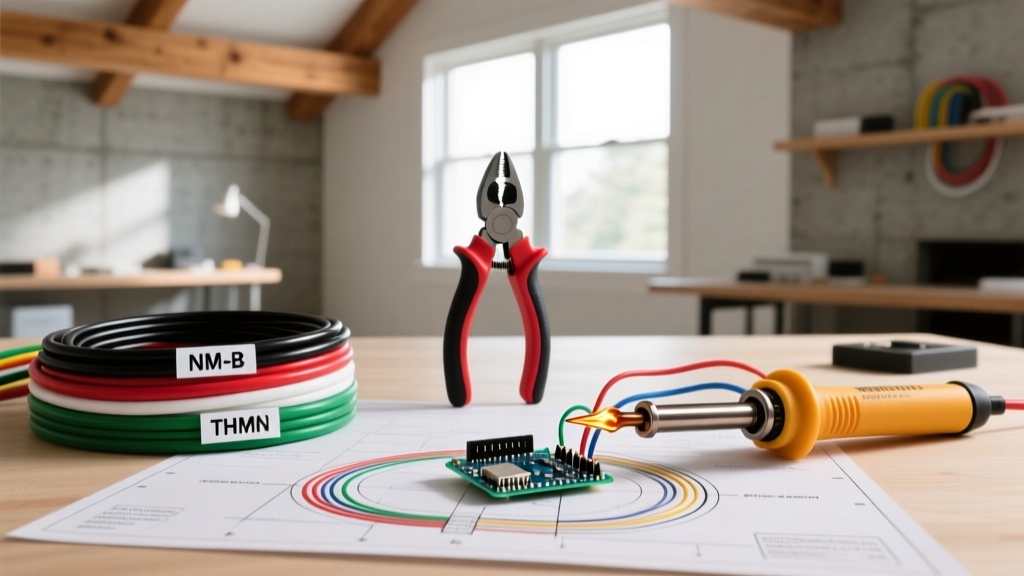
When wiring inside metal or PVC conduit, you will not use sheathed NM-B cable. Instead, you will pull individual conductors. The electrical wiring names for these individual wires are acronyms that describe their chemical insulation and environmental ratings. Confusing these names can lead to catastrophic insulation failure.
THHN (Thermoplastic High Heat-resistant Nylon-coated)
THHN is rated for dry locations only, with a maximum temperature rating of 90°C. The nylon outer coating makes it slick and easy to pull through conduit. Safety Hazard: If you pull THHN wire through underground PVC conduit, condensation will eventually accumulate inside the pipe. Because THHN is not water-rated, the insulation will absorb moisture, degrade, and cause a ground fault or short circuit.
THWN-2 (Thermoplastic Heat and Water-resistant Nylon-coated)
The 'W' stands for Water-resistant. THWN-2 is dual-rated for both wet and dry locations (90°C wet, 90°C dry). This is the standard wire you must use for any conduit run that exits the building or is buried underground.
XHHW-2 (Cross-linked Polyethylene High Heat Water-resistant)
XHHW-2 uses XLPE (cross-linked polyethylene) insulation instead of PVC. It is physically tougher, more resistant to chemical degradation, and handles higher fault currents without melting. For commercial panels or long conduit runs where heat dissipation is a concern, XHHW-2 is the safest, most robust choice.
NEC Code Alert: Under NEC Article 310, conductors in wet locations must be explicitly rated for moisture. Always check the printing on the wire jacket. If it only says 'THHN' and lacks 'THWN-2', it is illegal and unsafe to use in damp basements, outdoor conduits, or underground runs.
The Danger of 'Dead' Whites and Switch Loops
One of the most lethal assumptions in residential wiring is that a white wire is always a neutral. In standard NM-B cable, the white wire is indeed the grounded neutral. However, in older 'switch loop' configurations, electricians used the white wire to carry the 'hot' (line or load) voltage down to a light switch.
If you are working in a home built before 2011, you may encounter a white wire that is actually energized at 120V. The NEC now requires that any white wire used as an ungrounded (hot) conductor must be permanently re-identified with black or red electrical tape, or painted at both ends. If you see a white wire without this re-identification in an older switch box, treat it as a live hazard. Always verify with a non-contact voltage tester before touching any conductor.
Underground and Outdoor Wiring Names: UF-B
For outdoor lighting, detached garages, or landscape features, NM-B is strictly prohibited because its paper filler and PVC jacket will rapidly rot and degrade when exposed to moisture and UV light. The correct electrical wiring name for this application is UF-B (Underground Feeder, Type B).
- Jacket Appearance: Solid gray, with the individual conductors fully encased in solid PVC (no paper filler).
- UV Resistance: Rated for direct sunlight exposure (though burial is preferred).
- Burial Depth (NEC Table 300.5): UF-B must be buried at least 24 inches deep in standard soil. If you run it through rigid metal conduit or PVC, the burial depth requirement drops to 18 inches.
Failure Mode: A common DIY mistake is burying UF-B cable only 6 inches deep beneath a garden bed. A single strike from a shovel or a frost heave can sever the cable, creating an invisible, electrified puddle in the soil—a severe electrocution risk for anyone gardening or walking barefoot.
Essential Tools for Verifying Wire Identity
Never trust electrical wiring names or color codes blindly, especially in older homes where previous owners may have made unpermitted, dangerous modifications. Before cutting, stripping, or terminating any wire, deploy the following tools:
- Non-Contact Voltage Tester (NCVT): A tool like the Klein Tools NCVT-2 (approx. $35) detects AC voltage from 12V to 1000V without requiring bare metal contact. Use this to confirm a circuit is dead at the breaker.
- Digital Multimeter (DMM): An NCVT can give false positives due to 'ghost voltage' in adjacent wires. A true RMS multimeter like the Fluke 117 (approx. $220) allows you to measure exact voltage between the hot and ground, confirming 0V before you touch the wires.
- Wire Stripper/Gauge Checker: Use the precision holes on a Klein Tools 11055 wire stripper to physically verify the AWG size. Do not rely on visual estimation; 14 AWG and 12 AWG look nearly identical to the untrained eye, but mixing them up on a 20A breaker is a fire code violation.
FAQ: Quick Answers on Wire Identification and Safety
Can I use Romex (NM-B) in a wet basement?
No. NM-B is rated for dry, interior locations only. If your basement is subject to dampness, condensation, or potential flooding, the National Electrical Code (NEC) requires you to use individual THWN-2 conductors inside PVC or EMT conduit, or use specifically rated wet-location cables.
What does the '-2' mean in THWN-2 or XHHW-2?
The '-2' designation indicates that the wire is rated for 90°C in both wet and dry locations. Older versions without the '-2' (like standard THWN) were only rated for 75°C in wet environments. Always look for the '-2' for maximum safety and ampacity derating flexibility.
Is it safe to mix copper and aluminum wiring?
Absolutely not, unless you use specialized connectors like the AlumiConn lug or COPALUM crimps. Directly twisting copper and aluminum together with a standard wire nut causes galvanic corrosion. This increases electrical resistance, generates intense heat, and is a leading cause of hidden wall fires in homes built in the 1960s and 70s.
Where can I find the official wiring names and codes?
The definitive source is the National Fire Protection Association (NFPA), which publishes the NEC. Additionally, the Occupational Safety and Health Administration (OSHA) provides excellent, free safety guidelines regarding electrical wiring standards and workplace hazard prevention.