
Defining the 'Double Switch': Double-Pole vs. Double Rocker
When planning an electrical wiring double switch project, homeowners and DIYers frequently encounter a terminology trap. In the electrical trade, the phrase 'double switch' is not a standardized NEC term; instead, it is a colloquialism that refers to one of two entirely different devices. Understanding which one you need is the first step in accurately estimating your 2026 project costs.
- Double-Pole Switch (240V): Used for heavy-duty appliances like baseboard heaters, well pumps, and air compressors. It breaks both ungrounded (hot) conductors simultaneously, completely disconnecting a 240V circuit.
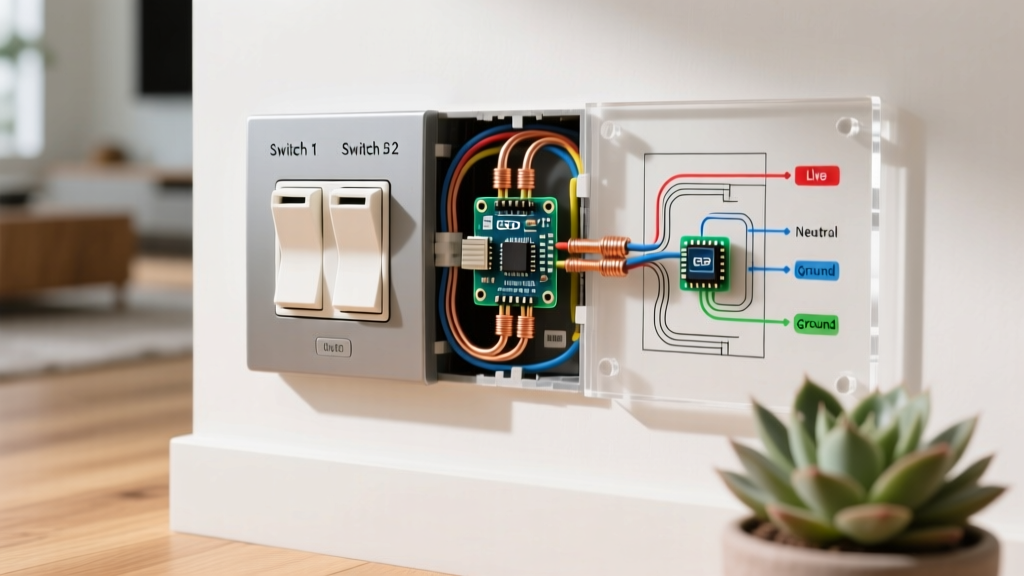
- Double Rocker / Duplex Switch (120V): Two single-pole switches stacked vertically on a single yoke (strap). Used to control two separate 120V lighting or fan circuits from a single gang box, saving wall space.
This comprehensive 2026 cost estimation guide breaks down the material pricing, labor rates, and critical National Fire Protection Association (NFPA) 70 (NEC) code requirements for both configurations.
2026 Cost Breakdown: Materials and Labor Matrix
Copper prices and electrical component manufacturing costs have stabilized in 2026, but licensed electrician labor rates continue to climb due to high demand and a shortage of skilled tradespeople. Below is the current market pricing for a standard residential installation.
| Cost Category | Double-Pole (240V) Estimate | Double Rocker (120V) Estimate |
|---|---|---|
| Switch Device (Standard Grade) | $14.00 - $22.00 | $8.50 - $13.00 |
| Wiring (per foot, NM-B) | $1.15/ft (10/2 AWG) | $0.72/ft (12/2 AWG) |
| Electrical Box (Old Work) | $3.50 - $5.00 (Deep Gang) | $3.00 - $4.50 (Standard Gang) |
| Electrician Hourly Rate | $85 - $135 / hour | $85 - $135 / hour |
| Minimum Service Call Fee | $150 - $225 | $150 - $225 |
| Total Professional Installation | $280 - $450 | $220 - $380 |
Note: According to Angi's 2026 electrical cost database, the national average for standard switch replacement is $185, but specialized double-switch configurations require more complex wiring and higher box-fill capacities, pushing the average up by 20-30%.
Scenario A: Wiring a 240V Double-Pole Switch
Required Materials & Specific Models
For a 240V resistive load (like a 2000W baseboard heater drawing roughly 8.3 Amps), you need a switch rated for the specific voltage and amperage. Do not use a standard 120V toggle.
- Device: Leviton 3030-2 (30A, 120/277V Double-Pole Toggle) - ~$16.50
- Wire: Southwire 12/2 NM-B with ground (for loads under 20A) or 10/2 NM-B (for loads up to 30A).
- Breaker: Eaton BR220 (20A Double-Pole Breaker) - ~$48.00
Wiring Steps & NEC Compliance
Under NEC Article 380.2, switches must only break the ungrounded (hot) conductors. A double-pole switch has four terminal screws (two brass, two black) and a green grounding screw.
- Line Side: Connect the two hot wires (L1 and L2) coming from the double-pole breaker to the top two brass terminals.
- Load Side: Connect the two hot wires running to the appliance to the bottom two black terminals.
- Grounding: Bond the bare copper ground wires together with a wire nut and a pigtail to the green grounding screw on the switch yoke, per NEC 250.146.
Expert Warning: Never use a double-pole switch to control two separate 120V circuits. The internal mechanism ties the two poles together; flipping the switch will simultaneously energize or de-energize both unrelated circuits, creating a severe shock hazard for anyone working on the downstream fixtures.
Scenario B: Wiring a 120V Double Rocker Switch
Space Saving vs. Box Fill Calculations
A double rocker switch (e.g., Leviton 1221 Duplex Toggle) is a favorite for remodels where controlling a ceiling fan and a recessed light from a single gang box is desired. However, this convenience triggers strict NEC box fill rules.
Under NEC 314.16(B), a single gang box must have adequate cubic inch capacity for the conductors, clamps, and devices inside. A double rocker switch counts as two devices for box fill calculations.
- Each 14 AWG wire counts as 2.0 cubic inches.
- Each 12 AWG wire counts as 2.25 cubic inches.
- The double switch (2 devices) based on 12 AWG wire counts as 4.5 cubic inches (2 x 2.25).
If you are running two separate 12/2 cables into the box (Line 1, Load 1, Line 2, Load 2, plus grounds), you will quickly exceed the capacity of a standard 18 cubic inch old-work box. You must upgrade to a 20 or 22 cubic inch deep box (like the Carlon B120R-UPC) to pass inspection and prevent wire insulation damage during device insertion.
The Multi-Wire Branch Circuit (MWBC) Edge Case
The most dangerous edge case in electrical wiring double switch projects occurs when a DIYer wires a double rocker using a Multi-Wire Branch Circuit (a single 12/3 or 14/3 cable sharing a neutral wire between two hot legs).
If you split the red and black hot wires to feed the two separate switches on the double rocker, you must adhere to NEC 210.4(B). This code mandates a simultaneous disconnect for all ungrounded conductors of an MWBC. Because a double rocker operates the switches independently, it violates this rule unless the upstream breakers in the panel are fitted with an approved handle tie or replaced with a single double-pole breaker. Furthermore, the red and black wires must be on opposite phases (L1 and L2) in the panel; if placed on the same phase, the shared neutral will carry the additive current of both circuits, leading to a melted neutral and a potential electrical fire. Always verify phase alignment with a multimeter before terminating an MWBC on a duplex switch.
Hidden Costs & Edge Cases in Older Homes
When budgeting for your project, factor in these common 2026 remediation costs that frequently arise in homes built before 1985:
- Aluminum Wiring Remediation: If your home has pre-1972 solid aluminum branch wiring, standard copper-rated switches will oxidize and cause arcing. You must purchase CO/ALR rated switches (approx. $18 each) or use Alumiconn pigtail connectors ($4.50 per connection) to transition to copper pigtails.
- Missing Ground Wires: Older knob-and-tube or early Romex lacks an equipment ground. The Consumer Product Safety Commission (CPSC) strongly advises against bootleg grounds. The code-compliant fix is installing a GFCI breaker upstream or replacing the switch box with a grounded metal box tied to a verified grounding electrode, adding $150-$300 in labor.
- Plaster Lath Repair: Cutting into plaster and wood lath to install a new old-work box for a double switch often results in crumbling. Budget an extra $100 for a plaster ring adapter or a specialized Madison hanger bracket to secure the box without destroying the wall.
Frequently Asked Questions
Can I replace a single-pole switch with a double rocker myself?
Yes, if you have adequate box depth and understand line/load identification. However, if the box is overcrowded or you discover an MWBC sharing a neutral, hiring a licensed electrician is highly recommended to ensure NEC compliance and fire safety.
Why does my double-pole switch spark when I turn it off?
Switching off a 240V inductive load (like a motor or transformer) can cause a brief arc as the magnetic field collapses. Heavy-duty double-pole switches feature internal arc chutes to suppress this. If you are using a standard toggle switch for a motorized load, upgrade to an AC Horsepower-rated switch (e.g., Hubbell HBL3030) designed to handle inductive kickback.
Do smart double switches exist?
As of 2026, true 240V smart double-pole switches are rare and expensive (often exceeding $85) due to the complex internal relays required to break both hot legs safely. For 120V double rockers, brands like Leviton and Lutron offer stacked smart dimmers, but they require a deep box and a neutral wire, significantly increasing installation complexity.