
The Shock of the Draw: Why Color Codes Matter in Remodels
Peeling back the drywall of a mid-century home often reveals a chaotic history of electrical modifications. For renovation planners and DIY electricians, deciphering legacy electrical wiring color codes is not just a matter of passing municipal inspections—it is a critical life-safety protocol. Misinterpreting a faded white wire that was repurposed as a 240V hot leg in 1985 can lead to catastrophic equipment failure or fatal arc flashes.
When planning a 2026 home renovation, whether you are upgrading a kitchen to accommodate induction ranges or pulling new circuits for a Level 2 EV charger, you must map the existing infrastructure against modern National Electrical Code (NEC) standards. This guide breaks down the exact color matrices, legacy wiring traps, and procurement strategies you need to execute a flawless electrical rough-in.
Modern NEC Standards: The 2026 Baseline
The National Fire Protection Association (NFPA) outlines strict color-coding mandates in the NEC to ensure uniformity across the trade. While local amendments exist, the foundational color rules for Non-Metallic Sheathed Cable (NM-B, commonly known as Romex) and individual THHN conductors in conduit remain consistent.
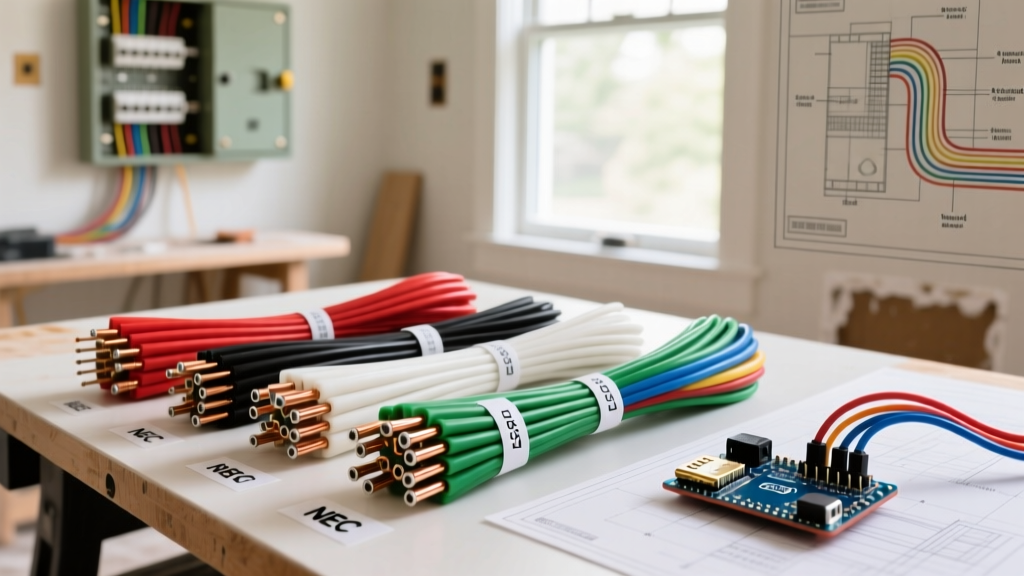
Standard Color Matrix for Residential Wiring
| Wire Type | Insulation Color | Function | Common Voltage Application |
|---|---|---|---|
| NM-B / THHN | Black | Ungrounded Conductor (Hot) | 120V Branch Circuits |
| NM-B / THHN | Red | Secondary Ungrounded (Hot) | 240V Appliances, MWBCs |
| NM-B / THHN | Blue / Yellow | Tertiary Hots (3-Phase or Travelers) | 208V Commercial, 3-Way Switches |
| NM-B / THHN | White / Gray | Grounded Conductor (Neutral) | All Return Paths |
| NM-B | Bare Copper | Equipment Grounding Conductor | Fault Current Path |
| THHN | Green / Green-Yellow | Equipment Grounding Conductor | Fault Current Path |
Legacy Wiring Nightmares: What Lurks Behind 1960s Drywall
Renovating homes built before 1970 requires extreme vigilance. Early cloth-covered rubber wiring and first-generation NM cables often lacked a dedicated equipment ground. Furthermore, the strict adherence to electrical wiring color codes was frequently ignored by handymen of the era.
The 'Switched Hot' Trap
In older switch loops, power was sent to the light fixture first, and a 2-wire cable (Black and White) was dropped down to the switch. By convention, the white wire was used as the permanent hot feed down to the switch, and the black wire carried the switched hot back up to the fixture. While the NEC required the white wire to be re-identified with black tape, this step was skipped in thousands of homes. If you assume a white wire in an older ceiling junction box is a neutral, you will create a dead short the moment you connect it to a grounded fixture.
Multi-Wire Branch Circuits (MWBC) and the Shared Neutral
Open up a 1980s kitchen junction box, and you might find a 12/3 cable containing a black hot, a red hot, and a shared white neutral. This is an MWBC. The black and red wires are on opposite phases of your 240V panel, meaning the neutral only carries the unbalanced load. Renovation Warning: If you are replacing a kitchen counter receptacle and break the neutral pigtail while both hots are energized, you will inadvertently send 240V through your 120V appliances, instantly destroying microwaves and coffee makers. Always use a two-pole breaker or handle-ties for MWBCs, and verify phase alignment with a multimeter before touching the white wire.
NEC Re-Identification Rules: What You Can (and Cannot) Tape
During a remodel, you will inevitably run into a situation where you need to use a white wire as a hot conductor (such as in a modern switch loop where power goes to the switch first). The NEC has strict rules regarding re-identification.
NEC Article 200.6(A) & 310.12: You may re-identify a white or gray wire as an ungrounded (hot) conductor by permanently wrapping it with black or red electrical tape, or heat-shrink tubing, at every point the wire is accessible. However, you can NEVER re-identify a colored wire (black, red, blue) as a neutral. The neutral must always be white or gray.
Using high-quality 3M Super 33+ vinyl electrical tape is mandatory for this. Cheap, off-brand tape dries out, peels off in the heat of a junction box, and leaves future electricians guessing about the wire's true function.
Renovation Planning Matrix: Matching Projects to Wire Colors
When drafting your material list for a 2026 renovation, use this matrix to ensure you are pulling the correct cable assemblies and THHN colors for specific high-demand projects.
| Renovation Project | Required Cable / Wire | Color Configuration | Est. 2026 Cost (per 250ft) |
|---|---|---|---|
| Kitchen Appliance Circuit (20A) | 12/2 NM-B | Black, White, Bare | $115 - $135 |
| EV Level 2 Charger (40A / 50A Breaker) | 6/3 NM-B or 8 AWG THHN | Black, Red, White, Bare/Green | $280 - $360 |
| 3-Way Staircase Lighting | 14/3 or 12/3 NM-B | Black, Red, White, Bare | $140 - $175 |
| Whole-Home Generator Interlock | 10 AWG THHN in Conduit | Black, Red, White, Green | $85 - $110 (per color roll) |
2026 Material Costs & Procurement Strategy
Copper volatility continues to impact electrical budgets in 2026. When planning your renovation, account for a 10-15% buffer in your wire budget. Buying 250-foot coils of Southwire or Cerro Wire NM-B from big-box retailers is generally 20% cheaper than buying 50-foot cut-offs. For THHN runs in EMT conduit, purchasing 500-foot spools of black, red, and white from specialized electrical supply houses (like Graybar or City Electric Supply) will yield the best per-foot pricing. Always verify that the cable jacket is stamped with 'UL Listed' and 'RoHS Compliant' to ensure you are not importing substandard, fire-hazardous wire from unverified online marketplaces.
Trust, But Verify: Testing Before You Touch
According to the U.S. Consumer Product Safety Commission (CPSC), electrocution and electrical fires remain a leading cause of home injury, frequently stemming from assumptions made during DIY renovations. Never trust the color of a wire in an existing home until you have verified it.
The Verification Protocol
- Non-Contact Voltage Test: Use a tool like the Klein Tools NCVT-3 to scan the cable jacket and individual wires. Remember that NCVT testers can give false positives due to phantom voltage in parallel runs.
- Solenoid Voltage Tester or Digital Multimeter: A Fluke T6-1000 or a classic Wiggy solenoid tester is required to confirm true voltage. Measure Hot-to-Neutral (should be ~120V), Hot-to-Ground (~120V), and Neutral-to-Ground (should be < 2V).
- De-Energize and Re-Test: Turn off the breaker, test the tester on a known live source to prove it works, test the target wire to prove it is dead, and test the known live source again. This 'Live-Dead-Live' protocol is an OSHA-mandated standard for commercial work and a vital habit for residential remodels.
Mastering electrical wiring color codes is the bridge between a chaotic demolition phase and a smooth, inspection-ready finish. By respecting the NEC color matrix, identifying legacy anomalies, and rigorously testing every conductor, your renovation will be safe, compliant, and built to last.