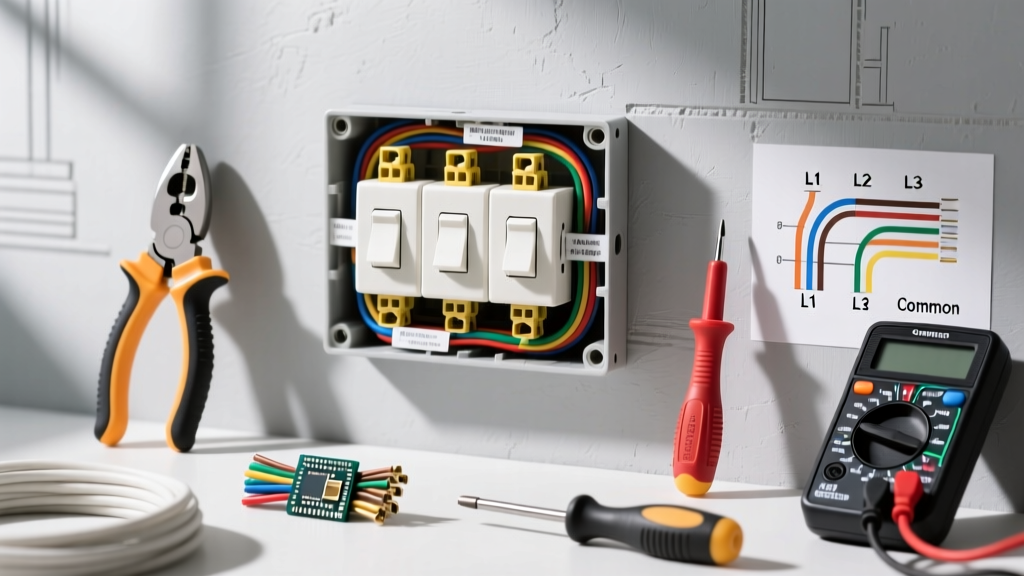

Clarifying the Terminology: Triple Rocker vs. 3-Gang Box
Before purchasing materials for your electrical wiring 3 gang switch project, we must resolve a common terminology conflict that leads to costly material returns. In North American electrical parlance, a '3-gang box' refers to a wall box wide enough to hold three separate standard switches side-by-side. However, when DIYers and international electricians search for a '3 gang switch,' they are frequently referring to a triple rocker switch—a single device yoke that houses three independent switches, designed to fit into a standard single-gang box.
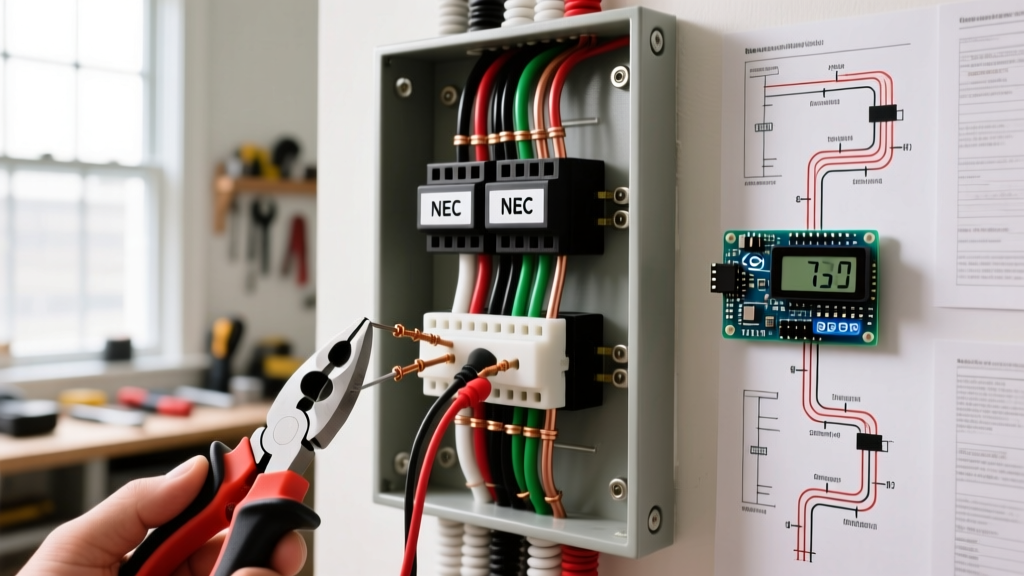
This guide addresses the material and tool requirements for both scenarios, with a heavy emphasis on space-saving materials and National Electrical Code (NEC) compliance. Whether you are retrofitting a single-gang box with a Leviton triple rocker or pulling new 12 AWG THHN into a deep 3-gang steel box, the tools and connector strategies detailed below are optimized for 2026 installation standards.
Core Materials: Wires, Connectors, and Switches
The Wire Gauge Decision: 14 AWG vs. 12 AWG
Your wire gauge is strictly dictated by the breaker protecting the circuit. A 15-amp breaker requires a minimum of 14 AWG copper, while a 20-amp breaker mandates 12 AWG. For multi-switch configurations, 12 AWG is significantly harder to bend and manage inside crowded boxes. If you are planning a new 3-gang box installation with three separate smart switches, strongly consider dedicating a 15-amp circuit with 14 AWG Romex SIMpull to save valuable cubic inches and reduce physical strain on the device yokes.
Connectors: Why Wago 221 Beats Twist-Ons in Crowded Boxes
When wiring three switches to a single hot feed, pigtailing is mandatory. Traditional twist-on wire nuts (like the Ideal Yellow 74B) create bulky, rigid splices that fight you when pushing the devices back into the box. In 2026, professional electricians overwhelmingly prefer Wago 221 Series lever nuts for multi-switch pigtailing.
- Wago 221-415 (5-Port): Perfect for splicing one incoming hot wire to three separate switch pigtails, plus one continuous feed to the next box. The flat profile slides easily behind the switch yoke.
- Wago 221-614 (4-Port, 6mm): Ideal for bundling four 12 AWG neutral wires together without the massive bulk of a blue Ideal wire nut.
Switch Selection: Triple Rocker vs. Individual Gang
If you are constrained to a single-gang box but need to control three separate loads (e.g., a bathroom fan, vanity light, and hallway sconce), the Leviton 5241 Triple Rocker (15A, 120V) is the industry standard. It features three independent internal mechanisms but requires only one hot feed and three separate load wires. If you are wiring a true 3-gang box, consider the Eaton 35W31 or standard Lutron Diva dimmers, ensuring you purchase the deep-wallplate variant to accommodate bulky wire connections.
Essential Tool Loadout for Multi-Switch Wiring
Wiring multiple switches in a confined space requires precision stripping and torque management. Using the wrong tools leads to nicked conductors (a fire hazard) and loose terminal screws (arcing).
| Tool Category | Recommended Model | Specific Purpose in 3-Gang Wiring | Approx. Cost |
|---|---|---|---|
| Wire Strippers | Klein Tools 11055 | Strips 12 & 14 AWG without nicking; includes shearing holes for 6-32 and 8-32 device screws. | $28.00 |
| Voltage Tester | Fluke 1AC-II VoltAlert | Non-contact verification of dead circuits before unboxing; features a built-in LED flashlight for dark boxes. | $35.00 |
| Screwdriver | Klein 32500 Multi-Bit | 1/4-inch nut driver for grounding screws and #2 Phillips for terminal screws; prevents cam-out on brass terminals. | $16.00 |
| Torque Driver | Wiha 28501 (VDE) | Ensures terminal screws are tightened to manufacturer specs (usually 12-14 in-lbs) to prevent arc faults. | $110.00 |
| Wire Puller | Milwaukee 48-22-0300 | Non-conductive fiberglass fish tape for pulling new 3-wire cables through finished walls to a new 3-gang box. | $45.00 |
NEC Box Fill Calculations: Avoiding the Overfill Violation
The most common failure mode in DIY electrical wiring 3 gang switch projects is box overfill. Cramming too many wires and devices into a standard box causes heat buildup and physical damage to wire insulation. According to NFPA 70 (NEC) Article 314.16, you must calculate the cubic inch fill before buying your wall box.
Expert Insight: A standard single-gang 'nail-on' box (like the Carlon B618R) offers only 18 cubic inches. If you are installing a triple rocker switch (counts as 2 device fills) with 12 AWG wire (2.25 cu in per conductor), you will max out the box with just the incoming power and three load wires. Always upgrade to a 22.5 cu in deep box for multi-switch configurations.
Box Fill Allowance Chart (Per NEC Table 314.16(B))
| Item Type | 14 AWG Fill (cu in) | 12 AWG Fill (cu in) |
|---|---|---|
| Each Hot/Neutral Conductor | 2.0 | 2.25 |
| All Equipment Grounds (Combined) | 2.0 | 2.25 |
| Internal Box Clamps | 2.0 | 2.25 |
| Each Device (Switch/Receptacle) | 4.0 (2x2.0) | 4.5 (2x2.25) |
Note: Wago lever connectors do not require additional cubic inch fill calculations beyond the wires entering them, but their physical dimensions still require adequate physical space. Always opt for 'deep' or 'oversized' boxes when using push-in connectors.
Step-by-Step Material Prep & Pigtailing Strategy
When wiring a true 3-gang box with three separate switches, you cannot simply daisy-chain the hot wire through the side terminal screws of the switches. You must create a pigtail splice. Here is the professional method using Wago 221-415 connectors:
- Prepare the Feed: Strip exactly 11mm (7/16 inch) of insulation from the incoming hot wire, the outgoing feed wire (if continuing the circuit), and three 6-inch 12 AWG pigtail wires. Use the strip gauge printed directly on the bottom of the Wago connector.
- Seat the Wires: Lift the orange levers on the 5-port Wago 221-415. Insert one bare wire into each port until it hits the internal stop. Snap the levers down.
- The Pull Test: Give each wire a firm tug. The internal clamping mechanism bites into the copper; if a wire pulls out, it was not stripped far enough.
- Terminate the Switches: Connect the three pigtail wires to the brass (hot) terminal screws on your three switches. Use your Klein 32500 to drive the screws, finishing with a torque driver set to 14 in-lbs to ensure a gas-tight connection.
- Neutral Management: Bundle all incoming and outgoing neutral wires together using a Wago 221-614. Do not attach these to the switches unless you are installing smart switches that explicitly require a neutral connection.
Troubleshooting Common Material Failures
Failure Mode 1: Smart Switch Overheating
If you are upgrading a 3-gang setup to smart switches (like the Lutron Caseta or GE Cync), these devices generate internal heat. Placing three smart switches side-by-side in a standard 3-gang plastic box can trap heat, causing the switches to drop their Wi-Fi/Zigbee connection or fail prematurely. Solution: Use a steel 3-gang box (like the Raco 833) which acts as a passive heat sink, and ensure the wallplate has ventilation slots if available.
Failure Mode 2: Yoke Grounding Shorts
When pushing three metal-yoke switches into a metal 3-gang box, the exposed ground wires can accidentally touch the brass terminal screws, tripping the breaker the moment you turn it on. Solution: Wrap the sides and back of the switch yokes with 3M Temflex electrical tape (leaving the front mounting screws and terminal faces exposed) before folding the wires and pushing the device into the box. This physical barrier prevents accidental short circuits in tight quarters.
Final Procurement Checklist
Before heading to the supply house or ordering online for your electrical wiring 3 gang switch project, verify your cart against this checklist:
- Deep wall boxes (minimum 22.5 cu in for single-gang triple rockers; 54 cu in for 3-gang steel boxes).
- Wago 221-415 (5-port) and 221-614 (4-port) lever nuts.
- 12 AWG or 14 AWG THHN wire in black, white, and green for pigtailing (buying a spool of individual THHN is cheaper and easier to route than cutting up extra Romex).
- Leviton 5241 (Triple Rocker) OR three individual single-pole switches.
- Extra-long 6-32 and 8-32 mounting screws (standard screws often fail to reach the box ears when wires push the switch forward).