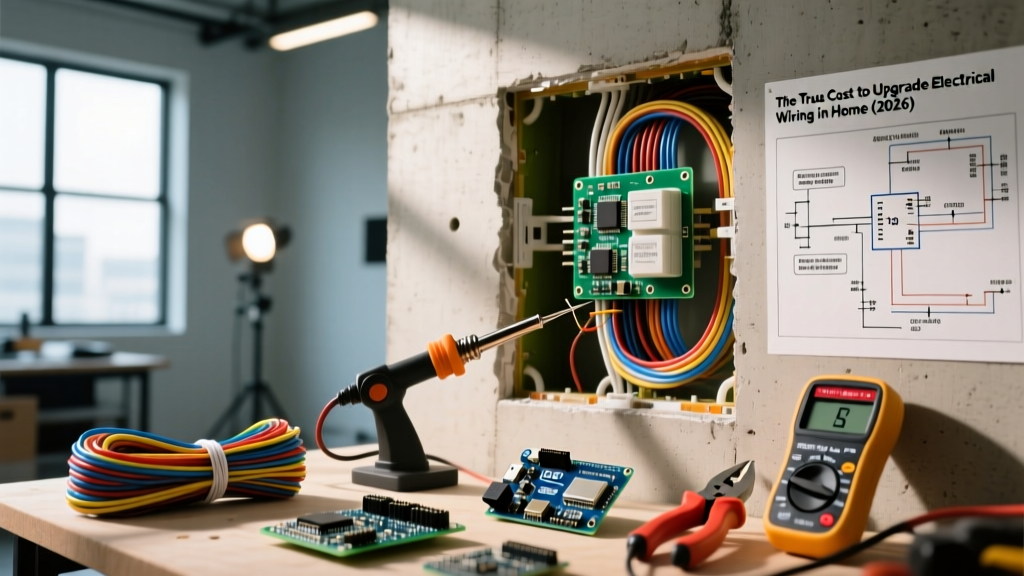

Troubleshooting: Does Your Home Actually Need a Full Rewire?
Before you commit to the massive undertaking of rewiring your home, it is critical to accurately troubleshoot the root cause of your electrical issues. Not every flickering light or tripped breaker necessitates a whole-house rewiring project. In 2026, with the rising cost of copper and skilled labor, accurately diagnosing localized failures versus systemic degradation can save homeowners thousands of dollars. According to the U.S. Fire Administration, electrical malfunctions remain a leading cause of residential fires, making proper diagnosis a critical safety imperative.
The Homeowner's Wiring Failure Checklist
Use this diagnostic checklist to determine if your home's electrical infrastructure is failing systemically or if you are dealing with isolated circuit faults:
- Persistent Arcing Sounds: If you hear a faint buzzing or sizzling sound behind outlets or switches, this indicates loose terminal connections or degraded wire insulation. This is an immediate fire hazard.
- Discolored or Warm Faceplates: Brown scorch marks or faceplates that are warm to the touch point to high-resistance connections, often caused by backstabbed wiring (push-in connectors) failing under continuous load.
- Frequent AFCI/GFCI Nuisance Tripping: If newly installed Arc Fault Circuit Interrupter (AFCI) breakers trip immediately, it often indicates damaged wire insulation somewhere in the branch circuit, allowing current to leak to the ground or neutral.
- Two-Prong Ungrounded Outlets: Homes built before 1962 often lack an Equipment Grounding Conductor (EGC). While you can install GFCI receptacles for shock protection, this does not provide a true ground path for surge protectors or sensitive electronics.
- Aluminum Branch Wiring (1965-1973): The Consumer Product Safety Commission (CPSC) warns that older aluminum branch wiring oxidizes at connection points, leading to thermal expansion, loose connections, and severe fire risks. If your home has solid aluminum branch wiring (marked 'AL' or 'Aluminum' on the cable jacket), a full replacement or COPALUM pigtailing is highly recommended.
The 2026 Cost to Replace Electrical Wiring in House
If your troubleshooting confirms systemic failure, outdated knob-and-tube, or hazardous aluminum wiring, a full rewire is unavoidable. The national average cost to replace electrical wiring in house in 2026 ranges from $8,500 to $22,000, heavily dependent on square footage, wall accessibility, and local labor rates.
Cost Breakdown by Home Size (2026 Estimates)
| Home Size (Sq. Ft.) | Average Cost Range | Cost Per Sq. Ft. | Typical Panel Requirement |
|---|---|---|---|
| 1,000 - 1,200 | $8,500 - $13,000 | $8.50 - $10.80 | 150-Amp or 200-Amp |
| 1,500 - 1,800 | $12,500 - $18,500 | $8.30 - $10.20 | 200-Amp |
| 2,000 - 2,500 | $17,000 - $26,000 | $8.50 - $10.40 | 200-Amp or 320-Amp (Split) |
| 3,000+ | $25,000 - $40,000+ | $8.30 - $13.00+ | 320-Amp or Dual 200-Amp |
Material Deep Dive: What Are You Paying For?
Understanding the specific materials your electrician is billing for helps you verify quotes and avoid price gouging. In 2026, copper prices remain volatile, but stabilized supply chains have kept Non-Metallic (NM) sheathed cable prices relatively predictable.
Wire and Cable Costs
- 14/2 NM-B (15-Amp Circuits): Used for general lighting and bedroom receptacles. Expect to pay $0.65 to $0.85 per linear foot. Brands like Southwire Romex SIMpull are industry standard due to their slip-coat jacket that drastically reduces pulling friction.
- 12/2 NM-B (20-Amp Circuits): Required for kitchens, bathrooms, dining rooms, and outdoor receptacles per NEC code. Costs $0.95 to $1.25 per linear foot.
- 10/2 NM-B (30-Amp Circuits): Used for heavy appliances like electric dryers and water heaters. Priced at $1.60 to $2.10 per linear foot.
- 6/3 NM-B or THHN in Conduit (50-Amp): Required for electric ranges and EV charging stations. Costs $3.50 to $5.00+ per linear foot.
Panel and Breaker Upgrades
Rewiring a house almost always requires upgrading the main service panel to handle modern electrical loads (HVAC, EV chargers, induction stoves). Upgrading from an outdated 100-amp fuse box or breaker panel to a modern 200-amp main breaker panel (such as the Square D QO or Eaton BR series) adds $1,800 to $3,200 to the total project cost. Furthermore, the widespread adoption of the NEC 2023 code (enforced in most municipalities by 2026) mandates AFCI protection for nearly all living spaces and GFCI protection for kitchens, baths, and garages. Dual-function CAFCI/GFCI breakers cost between $45 and $65 each, which can add $800 to $1,500 to the material bill for an average home.
Labor, Permits, and Hidden Structural Costs
The physical wire is only a fraction of the expense. Labor accounts for 60% to 70% of the total cost to replace electrical wiring in house. Electricians typically charge $85 to $150 per hour in 2026, and a full rewire requires a crew of 2 to 3 electricians working for 5 to 10 days.
The Hidden Costs of Older Homes
When budgeting, homeowners frequently overlook the structural collateral damage caused by running new cables through finished walls. Be prepared for the following secondary costs:
- Drywall Cutting and Patching: Electricians will cut strategic access holes (usually 4x4 inches) to fish wires. Hiring a drywall contractor to patch, tape, and mud these holes will cost $1,500 to $3,500.
- Plaster and Lath Repair: In pre-1950s homes, plaster walls are brittle. Fishing wires can cause large sections to blow out, requiring specialized plaster restoration at $75 to $120 per hour.
- Asbestos Abatement: If your home was built before 1980, drilling through floor joists or HVAC bulkheads may disturb asbestos-containing materials. Testing and localized abatement can add $1,500 to $4,000 to the project timeline and budget.
- Municipal Permits and Inspections: Expect to pay $300 to $900 for electrical permits. The U.S. Department of Energy highly recommends ensuring all work is permitted and inspected, as unpermitted work can void home insurance policies and derail future real estate transactions.
Repair vs. Replace: The Decision Matrix
How do you know if a targeted repair is sufficient, or if a full replacement is the only safe option? Use this decision matrix based on your troubleshooting findings:
| Troubleshooting Symptom | Recommended Action | Estimated 2026 Cost |
|---|---|---|
| Isolated dead outlet or flickering light | Repair (Replace receptacle, tighten pigtails) | $150 - $250 |
| Two-prong ungrounded outlets | Upgrade (Install GFCI or run new EGC ground wire) | $200 - $400 per room |
| Aluminum branch wiring (1960s-70s) | Replace (Full rewire) or Pigtail (COPALUM/Alumiconn) | $8,500+ (Rewire) or $80-$120 per connection (Pigtail) |
| Knob-and-Tube wiring (Pre-1950) | Replace (Full rewire mandatory for insurance) | $15,000 - $30,000+ |
| Frequent main breaker tripping under load | Upgrade (Heavy-up to 200A/320A service) | $2,500 - $4,500 |
Step-by-Step: What to Expect During a Full Rewire
If you decide to proceed with replacing the electrical wiring in your house, understanding the workflow will help you prepare your home and schedule your life around the disruption.
- Day 1: Preparation and Demolition. The crew will lay down floor protection, set up scaffolding, and cut access holes in drywall or plaster. The main power will be shut off, and a temporary power pole may be set up outside for their tools.
- Days 2-4: Rough-In Wiring. Electricians will drill through studs and joists, pulling hundreds of feet of new Romex and THHN cable. They will mount new 'old work' boxes for outlets and switches. This is the most invasive and noisy phase.
- Day 5: Panel Installation. The old panel is decommissioned. The new 200-amp or 320-amp panel is mounted, grounded to a new copper ground rod system, and the utility company will reconnect the external service mast.
- Days 6-7: Trim-Out and Terminations. The crew installs new receptacles, switches, and light fixtures. They will terminate all wires in the panel, torqueing lugs to exact manufacturer specifications using a calibrated torque screwdriver to prevent future hot spots.
- Day 8: Testing and Municipal Inspection. Every circuit is tested for proper polarity, ground continuity, and AFCI/GFCI functionality. The local electrical inspector performs the final walkthrough to issue the certificate of completion.
Final Thoughts on Wiring Replacement
The cost to replace electrical wiring in house is a significant financial investment, but it is fundamentally an investment in life safety and modern functionality. By thoroughly troubleshooting your current system, understanding the specific material and labor costs in 2026, and hiring a licensed, insured electrical contractor who pulls proper permits, you ensure your home remains safe, code-compliant, and fully capable of supporting the electrical demands of the 21st century. Never attempt to bypass safety devices or ignore the warning signs of degrading insulation; the cost of a rewire is always lower than the cost of a structural fire.