
The 5000-Watt Baseline: Understanding Dryer Load Calculations
When planning the wiring for electric dryer installations, the National Electrical Code (NEC) establishes a strict baseline for load calculations. According to NEC Article 220.54, electric clothes dryers must be calculated at a minimum of 5,000 watts (volt-amperes) or the nameplate rating, whichever is larger. In modern 2026 appliance landscapes, many high-capacity smart dryers with steam functions and advanced moisture sensors pull between 5,500W and 6,000W. Therefore, relying on the absolute minimum 5,000W baseline can lead to undersized infrastructure if the specific appliance nameplate exceeds it. Always verify the manufacturer's specification sheet before pulling wire.
Code Highlight: NEC Article 220.54 mandates that electric dryer loads shall be calculated at 5000W or the nameplate rating, whichever is larger. When sizing branch circuits, the nameplate rating always supersedes the generic baseline.
Core Component Matrix: Breaker, Wire, and Receptacle Sizing
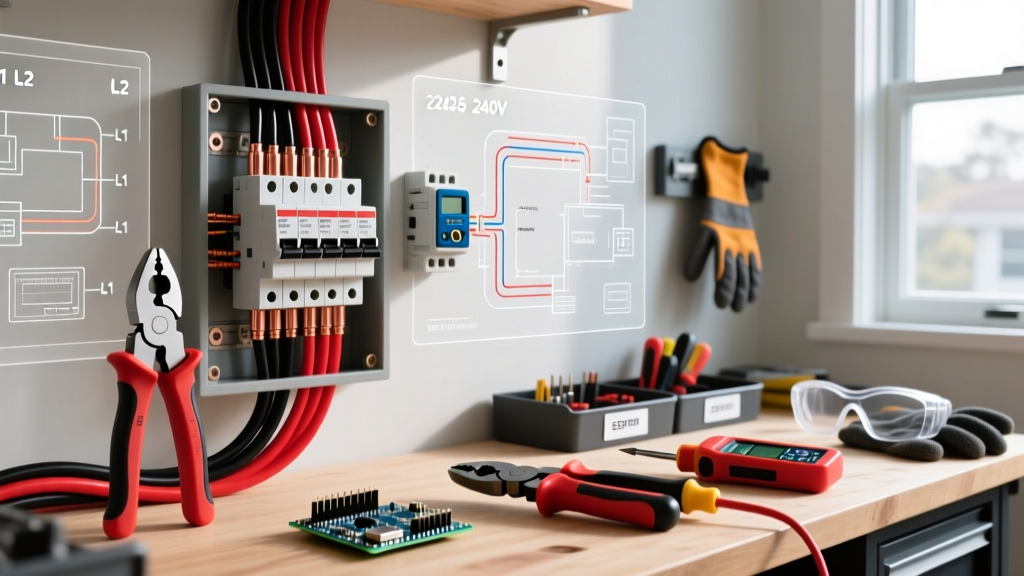
A standard residential electric dryer requires a dedicated 240-volt branch circuit. The most common configuration utilizes a 30-ampere double-pole breaker and 10 AWG copper conductors. Below is the definitive sizing matrix for standard residential installations.
| Component | Specification | NEC Reference | Notes & Edge Cases |
|---|---|---|---|
| Overcurrent Protection | 30A Double-Pole Breaker | Article 240.4(B) | Must be a common-trip 2-pole breaker. Do not use two handle-tied single-pole breakers. |
| Conductor Size (Standard) | 10 AWG Copper | Article 310.16 | 10/3 NM-B (Romex) or 10 AWG THHN/THWN-2 in conduit. Rated for 30A at 60°C/75°C termination limits. |
| Conductor Size (Long Run) | 8 AWG Copper | Article 310.15(B) | Required for runs exceeding 100 feet to maintain voltage drop below 3% (7.2V on a 240V circuit). |
| Receptacle | NEMA 14-30R | Article 406.4 | 4-prong, 125/250V, 30A. Must be listed by UL or equivalent NRTL. |
| Equipment Grounding | 10 AWG (Bare or Green) | Article 250.122 | Must be routed within the same cable assembly or raceway as the ungrounded (hot) and neutral conductors. |
The 4-Prong Mandate: Separating Neutral and Ground
One of the most critical aspects of modern wiring for electric dryer setups is the strict separation of the neutral (grounded) conductor and the equipment grounding conductor. Prior to the 1996 NEC cycle, 3-prong NEMA 10-30 receptacles were standard, and the appliance frame was bonded to the neutral wire. This created a dangerous scenario where a broken neutral could energize the dryer's metal chassis with 120 volts.
Under the current NEC Article 250.140, new installations must utilize a 4-wire system (NEMA 14-30). The neutral carries the unbalanced 120V return current (used by the dryer's timer, motor, and control boards), while the dedicated ground wire provides a safe fault path back to the panel.
What About Existing 3-Prong Installations?
If you are replacing a receptacle in an older home and the wall box only contains a 3-wire cable (two hots and a neutral, with no equipment ground), Exception No. 1 to NEC 250.140 allows you to retain the 3-prong NEMA 10-30R receptacle. However, you cannot install a new 3-wire circuit. Any new construction, remodel, or circuit extension mandates a 4-wire setup. For comprehensive safety guidelines on appliance grounding, refer to the National Fire Protection Association (NFPA) guidelines on NEC adoption.
Voltage Drop: The Hidden 100-Foot Threshold
While 10 AWG copper is legally permitted for a 30-amp circuit regardless of length under standard ampacity tables, NEC Informational Note 310.15(B) strongly recommends keeping voltage drop under 3% for branch circuits. For a 240V dryer circuit, a 3% drop equals 7.2 volts.
- Under 100 Feet: 10 AWG copper is perfectly adequate. Voltage drop will remain within acceptable limits, ensuring the dryer's heating elements operate at full thermal efficiency.
- 100 to 150 Feet: Step up to 8 AWG copper. The heating elements in electric dryers are highly sensitive to voltage sag. A 10% voltage drop can result in a 19% reduction in heating power, drastically increasing dry times and straining the motor.
- Over 150 Feet: Consider 6 AWG copper, especially if the circuit is routed through hot attics where temperature correction factors (NEC 310.15(B)(1)) require derating the wire's ampacity.
Torque Requirements: The Overlooked NEC 110.14(D) Rule
A frequent failure point in DIY and even some professional dryer installations is loose terminal connections. The NEC introduced strict torque requirements in Article 110.14(D), mandating that all listed torque specifications must be met using a calibrated torque tool.
When terminating 10 AWG or 8 AWG wires on a Leviton or Hubbell NEMA 14-30R receptacle, the manufacturer typically specifies a torque value between 14 and 18 inch-pounds. Hand-tightening with a standard screwdriver often results in under-torqued connections. Over a few months, the thermal cycling of the dryer (drawing 25+ amps during heating cycles) causes the wire to expand and contract, eventually loosening the terminal. This creates high resistance, arcing, and ultimately, a melted receptacle or electrical fire. Always use a dial-indicating or digital torque screwdriver for the final termination.
Cable Routing and Physical Protection (NEC 300.4)
When routing 10/3 NM-B cable through wall cavities, physical protection is paramount to prevent nail or screw punctures. NEC Article 300.4(A)(1) requires that cables run through bored holes in wooden studs must maintain at least a 1-1/4 inch clearance from the edge of the stud. If this clearance cannot be maintained—common in older homes with narrow 2x4 studs or when navigating plumbing chases—you must install a 1/16-inch thick steel nail plate over the stud face to protect the wiring.
Furthermore, when passing through metal framing or metal junction boxes, the cable must be protected by listed bushings or conduit nipples to prevent the metal edges from slicing the NM-B cable jacket and shorting the 240V conductors to the grounded frame.
Common Failure Modes and Code Violations
When inspecting or troubleshooting wiring for electric dryer circuits, look out for these dangerous, non-compliant scenarios:
- The 'Bootleg' Ground: An installer wires a 4-prong NEMA 14-30R receptacle but only has 3-wire cable in the wall. They install a jumper wire between the neutral terminal and the ground terminal inside the receptacle. This is a severe violation of NEC 250.140 and creates a shock hazard if the neutral wire ever breaks upstream.
- Shared Neutrals: Attempting to save wire by sharing the neutral conductor of the dryer circuit with a nearby 120V lighting circuit. Dryer neutrals must be dedicated and isolated to the specific 240V branch circuit.
- Undersized Breakers on 8 AWG Wire: While 8 AWG wire can be used on a 30A breaker (often for voltage drop reasons), some installers mistakenly upsize the breaker to 40A because 'the wire can handle it.' The NEMA 14-30 receptacle and the dryer's factory pigtail are only rated for 30A. A 40A breaker will fail to protect the receptacle and cord from melting during a fault.
- Missing Strain Relief: Failing to install a proper UL-listed strain relief clamp where the 4-prong dryer pigtail enters the appliance's rear access panel. Vibration from the dryer's spin cycle can fray the cord insulation against the sharp metal knockout hole.
Frequently Asked Questions
Can I use aluminum wire for a 30A dryer circuit?
Yes, but you must upsize the conductor. According to the Leviton NEMA Wiring Configurations Guide and NEC ampacity tables, 10 AWG aluminum is not rated for 30A. You must use a minimum of 8 AWG aluminum (SER or XHHW-2) for a 30A circuit. Additionally, you must apply an antioxidant compound (like Noalox) to aluminum terminations and ensure the receptacle is explicitly marked 'AL/CU'.
Does a GFCI breaker protect a 240V electric dryer?
As of the 2023 NEC cycle, standard 30A 240V receptacles in laundry areas do not universally require GFCI protection unless local amendments or specific state codes (like Massachusetts or Washington) have adopted stricter interpretations of NEC 210.8(A). However, AFCI protection is frequently required for the 120V branch circuits in the laundry room. Always consult your local Authority Having Jurisdiction (AHJ) for localized amendments.
Where can I find authoritative guidance on dryer receptacle configurations?
The Mike Holt Enterprises NEC Resources portal provides excellent visual breakdowns of NEMA configurations and grounding schemes. Always cross-reference manufacturer installation manuals with the latest adopted NEC cycle in your municipality before energizing a new circuit.