
The Shift to Pre-Assembled Harnesses in Commercial Builds
In the realm of commercial and industrial electrical installations, the traditional method of point-to-point field wiring inside control panels is rapidly becoming obsolete. As commercial systems—ranging from large-scale HVAC rooftop units (RTUs) to automated manufacturing conveyors and data center power distribution units (PDUs)—grow in complexity, the demand for precision and reliability has skyrocketed. The modern electrical wiring harness is no longer just an automotive or aerospace component; it is a critical infrastructure element in commercial electrical contracting.
Deploying a custom-designed electrical wiring harness in commercial control panels reduces field installation time by up to 75%, virtually eliminates wiring errors, and ensures strict adherence to the National Electrical Code (NEC) and UL 508A standards. For commercial electricians and panel builders in 2026, understanding the design, fabrication, and routing of these harnesses is essential for maintaining profitability and passing rigorous municipal inspections on the first attempt.
Anatomy of a Commercial-Grade Harness
A commercial harness is fundamentally different from residential cable assemblies. It must withstand higher ambient temperatures, resist chemical exposure, and manage significant electromagnetic interference (EMI). Below is a breakdown of the core components specified in modern commercial panel builds.
| Component | Specification / Model | Commercial Use Case | Est. Cost (2026) |
|---|---|---|---|
| Conductors | Southwire XHHW-2 (12-10 AWG) | Motor starters, VFDs, 600V mains | $0.18 - $0.32 / ft |
| Connectors | TE Connectivity Dynamic D-3 Series | Pluggable panel interfaces, high-vibration RTUs | $1.45 / pole |
| Sleeving | Expandable Braided PET (Halogen-Free) | Abrasion resistance for moving machinery | $0.35 / ft |
| Routing Looms | Panduit Slotted PVC Wiring Duct (2x3 in) | Internal panel routing and bend-radius management | $4.20 / ft |
| Identification | Brady BMP71 PermaSleeve Markers | Permanent circuit tracing and NEC compliance | $0.12 / marker |
While THHN wire is common in residential conduit runs, XHHW-2 is the superior choice for commercial harnesses. Its cross-linked polyethylene insulation is thinner than PVC, allowing for tighter bend radii inside cramped Panduit ducts, and it carries a 90°C rating in both wet and dry locations, which is critical for commercial HVAC and outdoor industrial enclosures.
Step-by-Step: Fabrication and Routing Protocols
Building a commercial electrical wiring harness requires a transition from 'field crafting' to 'manufacturing precision'. Here is the professional workflow for panel builders.
1. Schematic to Nailboard Mapping
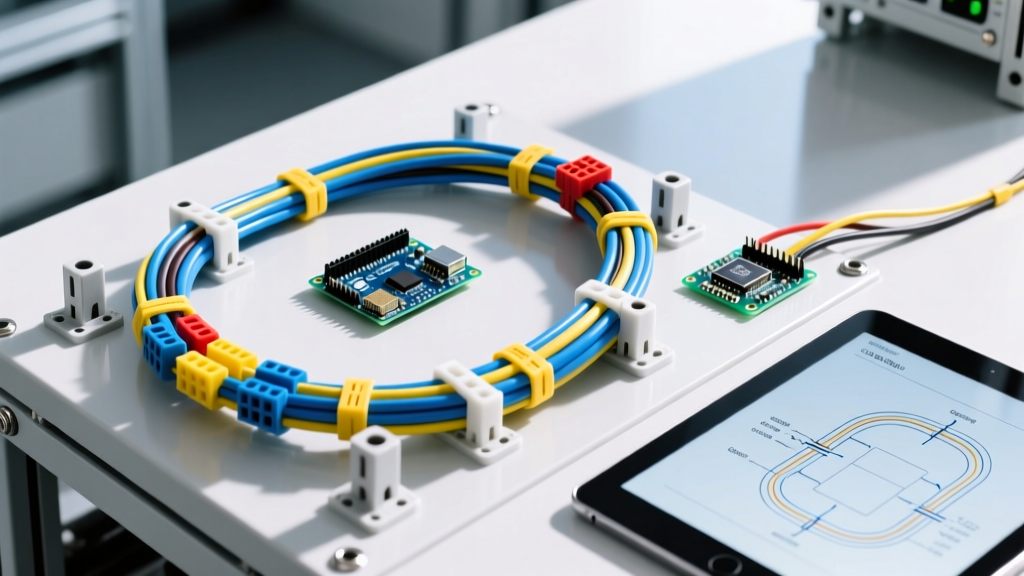
Before a single wire is cut, the electrical schematic is translated into a 1:1 scale physical or digital 'nailboard' (form board). This dictates the exact breakout lengths, bend radii, and connector orientations. For complex 40+ circuit panels, software like Zuken E3.series or Autodesk AutoCAD Electrical is used to generate the harness form, automatically calculating exact wire cut lengths including the stripping allowances.
2. Automated Cutting and Stripping
Manual stripping introduces inconsistencies that can nick the copper strands, reducing the ampacity and creating hot spots under heavy commercial loads. Professional shops use automated cut-and-strip machines like the Schleuniger MultiStrip 9480. These machines process XHHW-2 and THHN wire with a tolerance of ±0.1mm, ensuring the exact strip length required for TE Connectivity or Molex crimp terminals without exposing bare copper outside the crimp barrel.
3. Precision Crimping and Pull-Testing
According to the IPC/WHMA-A-620 Standard, every crimp must meet specific mechanical and electrical criteria. In commercial applications, crimping is performed using calibrated pneumatic tools, such as the TE Connectivity CERTI-CRIMP II. A critical, often overlooked step is the pull-force test. For a 12 AWG wire, the terminal must withstand a minimum pull force of 60 lbs without the wire slipping or breaking. Commercial shops perform this destructive test on the first and last crimp of every production batch.
4. Bundling and Lacing
While nylon zip-ties are ubiquitous, they are increasingly banned in high-vibration commercial environments (like generator enclosures and heavy machinery) because thermal cycling causes them to become brittle and snap. The industry standard is returning to wax-coated braided lacing tape (e.g., 3M Glass Braid Lacing Tape). Lacing provides continuous, even pressure around the harness bundle, preventing the internal wires from shifting and chafing against one another during equipment vibration.
Navigating NEC and NFPA Compliance
Routing an electrical wiring harness inside a commercial enclosure is heavily regulated. Failure to comply can result in failed inspections, voided equipment warranties, and severe fire hazards.
Code Spotlight: NFPA 70 (National Electrical Code) Article 409 governs Industrial Control Panels, while NFPA 79 specifically dictates the electrical standards for industrial machinery harnesses, including mandatory color-coding and routing separation.
Separation of Power and Signal
One of the most common code violations in commercial panel wiring is running high-voltage power wires and low-voltage communication wires in the same harness bundle. NEC Article 725 strictly requires the physical separation of Class 1 (power) and Class 2 (signal/data) circuits to prevent inductive coupling and EMI. When designing your harness, power conductors (e.g., 480V 3-phase motor feeds) must be routed in a dedicated Panduit duct on the left side of the panel, while 24V DC control and Ethernet harnesses must be routed on the right. If they must cross, they must do so at a strict 90-degree angle.
Bend Radius Limitations
NEC Article 300.34 and general manufacturer specifications dictate that the bending radius of a harness or individual conductor must not be less than 4 to 8 times the outside diameter of the wire, depending on the insulation type. Crushing a harness bundle with excessive zip-tie tension or forcing it into a tight corner compromises the dielectric strength of the XHHW-2 insulation, leading to arc faults inside the panel.
Cost Analysis: Field Wiring vs. Pre-Assembled Harnesses
Commercial electrical contractors often hesitate at the upfront material cost of a custom electrical wiring harness. However, when analyzing the total installed cost (TIC) in 2026, the financial advantage of harnesses becomes undeniable. Below is a cost matrix based on a standard 48-circuit commercial HVAC control panel.
| Metric | Traditional Field Wiring | Pre-Assembled Harness Integration |
|---|---|---|
| Material Cost | $180 (Bulk wire, terminals, duct) | $650 (Custom fabricated harness) |
| Labor Time | 24 Hours | 3.5 Hours |
| Labor Cost (at $145/hr) | $3,480 | $507 |
| Error/Rework Rate | 8% (Requires troubleshooting) | < 0.5% |
| Total Installed Cost | $3,660 + Rework | $1,157 |
By outsourcing the harness fabrication to a specialized wire house, the commercial contractor frees up their highly paid field electricians to focus on pulling main feeders, terminating high-voltage lugs, and testing systems, drastically improving overall project margins.
Expert Troubleshooting for Harness Failures
Even with meticulous design, commercial harnesses can fail in the field. Understanding the specific failure modes allows electricians to diagnose issues rapidly without tearing apart an entire control panel.
Fretting Corrosion in High-Vibration RTUs
The Problem: Rooftop HVAC units experience constant vibration from compressors and fans. Over time, this micro-movement causes the tin-plated terminals inside the harness connectors to rub against the male pins, creating a non-conductive tin-oxide layer known as fretting corrosion. The circuit will show continuity on a multimeter but will fail under load due to high resistance.
The Fix: Never use standard tin-plated terminals in high-vibration commercial RTUs. Specify gold-flashed terminals for low-current control circuits, or apply a high-quality dielectric grease (like MG Chemicals 8463) inside the connector housing before mating. If a harness has already suffered fretting, the entire connector block must be cut back and re-crimped; simply cleaning the pins will not remove the deep oxide pitting.
Thermal Degradation near VFD Heat Sinks
The Problem: Variable Frequency Drives (VFDs) generate massive amounts of harmonic heat. If a control harness is routed too close to the VFD's heat sink or braking resistor, the ambient temperature can exceed the 90°C rating of the wire insulation, causing it to melt and short against the grounded panel backplane.
The Fix: Maintain a minimum 4-inch clearance between any harness bundle and VFD heat sources. If spatial constraints in a compact commercial panel make this impossible, the harness must be re-sleeved in fiberglass silicone sleeving (rated up to 200°C) or routed through flexible liquid-tight metallic conduit to act as a thermal shield.
Conclusion
The integration of a professionally engineered electrical wiring harness is a hallmark of elite commercial electrical contracting. By shifting from chaotic point-to-point field wiring to structured, code-compliant harness routing, contractors ensure faster commissioning, longer equipment lifespans, and bulletproof NEC compliance. Whether you are upgrading a legacy manufacturing facility or wiring a new fleet of commercial RTUs, investing in harness design is an investment in the reliability of the entire electrical infrastructure.