
The Commercial Standard: Beyond Consumer-Grade Boat Trailer Electrical Wiring
When managing a commercial fleet of boat trailers—whether for a high-volume marina, a heavy-duty transport company, or a marine dealership network—consumer-grade wiring harnesses are a critical liability. Retail auto-parts store kits typically utilize copper-clad aluminum (CCA) wire and basic vinyl splices that degrade within a single season of saltwater exposure and highway vibration. For commercial operators, a failed brake light on a 10,000-pound commercial haul results in Department of Transportation (DOT) fines, vehicle impoundment, and severe fleet downtime.
Upgrading and maintaining commercial boat trailer electrical wiring requires a paradigm shift from basic connectivity to marine-grade survivability. This guide outlines the exact materials, DOT-compliant architectures, and preventative maintenance matrices required to keep commercial fleets operational, safe, and legally compliant in 2026 and beyond.
FMVSS 108 and ABYC E-11 Compliance for Fleet Operators
Commercial boat trailers occupy a unique regulatory intersection. On the highway, they must adhere to the Federal Motor Vehicle Safety Standard (FMVSS) 108, which dictates lamp placement, photometric output, and wiring durability for all commercial vehicles. You can review the specific federal mandates for lighting devices and reflectors via the NHTSA FMVSS 108 documentation. However, once the trailer enters the water, the electrical system is subjected to marine environments. Therefore, commercial upfitters must also cross-pollinate highway standards with the American Boat & Yacht Council (ABYC) E-11 standards for marine-grade DC wiring, ensuring that the harness survives total submersion without shorting or accelerating galvanic corrosion.
Conductor Metallurgy: Tinned Copper vs. CCA
The most common failure mode in commercial trailer wiring is internal oxidation. Standard CCA wire relies on a thin copper coating over an aluminum core. Once the wire is cut, crimped, or abraded, the aluminum core is exposed to moisture, leading to rapid galvanic corrosion that travels under the wire insulation, turning the conductor into a brittle, high-resistance powder.
Commercial fleets must exclusively use UL 1426-rated tinned copper wire. The electroplated tin coating acts as a sacrificial anode, preventing oxygen and saltwater from reaching the copper strands. While the upfront cost is higher, the total cost of ownership (TCO) drops significantly due to a 10x increase in lifespan.
| Wire Gauge (AWG) | Max Ampacity (Marine) | Commercial Application | Approx. Cost per Foot (2026) |
|---|---|---|---|
| 10 AWG | 30A | Main 7-Way Feed / Heavy Winch Power | $1.45 |
| 12 AWG | 20A | Brake Controllers / Auxiliary 12V | $0.95 |
| 14 AWG | 15A | Turn Signals / Stop Lamps | $0.65 |
| 16 AWG | 10A | Clearance / Marker / License Lights | $0.45 |
Note: Ampacity ratings are based on marine-grade bundling standards, which require a 15% derating compared to open-air automotive chassis wiring due to heat retention in loom.
Waterproofing Architecture and Connection Standards
In commercial marine environments, water intrusion at the splice point is inevitable. Standard crimp connectors with vinyl or nylon insulation sleeves are strictly prohibited in fleet builds. Commercial wiring requires a multi-layered waterproofing architecture.
The 3M MDS Heat Shrink Protocol
Every mid-harness splice or pigtail connection must utilize marine-grade adhesive heat shrink, such as the 3M MDS series. Unlike standard heat shrink, MDS tubing features an inner lining of thermoplastic adhesive. When heated to 250°F, the tubing shrinks, and the adhesive melts, flowing into the wire strands and creating a hermetic, waterproof seal that blocks capillary action.
Fleet Technician Warning: Never use a standard open-flame lighter to shrink marine tubing. The uneven heat will scorch the polyolefin outer layer before the inner adhesive reaches its flow point. Commercial shops must use temperature-controlled heat guns (set to 300°F) with reflector nozzles to ensure uniform adhesive activation.
Mid-Harness Connectors: Deutsch DT Series
For modular components like removable bunks, guide poles, or auxiliary winch lights, avoid hardwiring. Instead, integrate Deutsch DT series connectors. These thermoplastic housings utilize silicone rear seals and copper alloy contacts rated for 13 amps per pin. They are completely submersible and allow maintenance crews to swap a damaged light assembly in under 60 seconds without cutting or splicing wires.
The 7-Way RV/Commercial Blade Standard
While 4-way flat connectors are common on lightweight consumer trailers, any commercial boat trailer exceeding 3,000 GVWR or equipped with electric-over-hydraulic (EOH) brakes requires a 7-way blade connector. The Epicord 27700030 heavy-duty 7-way plug is the fleet standard, featuring a spring-loaded dust cover and heavy-gauge brass terminals.
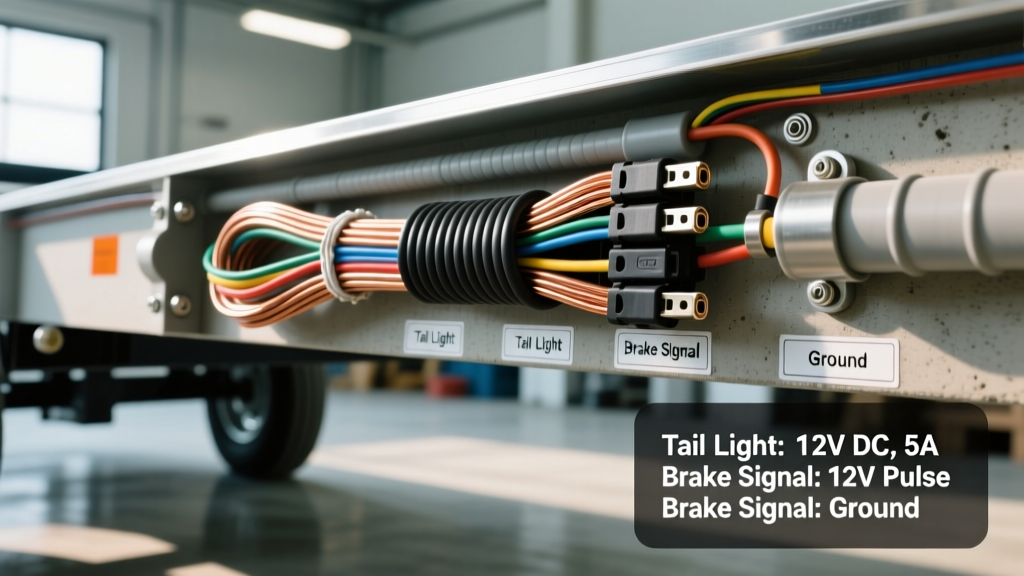
When wiring the 7-way plug, commercial upfitters must follow the standardized RVIA pinout:
- Pin 1 (White): Ground Return (Must be bonded directly to the trailer chassis with a star washer, not just daisy-chained from a light).
- Pin 2 (Blue): Electric Brake Power (10 AWG minimum for EOH actuators).
- Pin 3 (Green): Tail / Running Lights.
- Pin 4 (Black): 12V Auxiliary Power (For winch solenoids or interior cabin charging).
- Pin 5 (Red): Left Turn / Stop.
- Pin 6 (Brown): Right Turn / Stop.
- Pin 7 (Yellow): Reverse Lights / Backup Alarm Trigger.
LED Retrofitting: Managing Amp Draw and Flasher Relays
Transitioning a commercial fleet from halogen to LED lighting is mandatory for reducing alternator load and eliminating bulb-failure downtime. A standard halogen stop/tail lamp (e.g., Peterson 421) draws approximately 2.1 amps. A commercial-grade LED equivalent, such as the Optronics STL78RB GloLight, draws a mere 0.25 amps.
However, this massive drop in amp draw creates a secondary electrical issue: hyper-flashing. Standard thermal flasher relays in tow vehicles rely on high amp draw to heat a bimetallic strip and create the flashing cadence. When LEDs are installed, the relay doesn't draw enough current to trigger the flash, causing the turn signals to blink rapidly or stay solid.
The Fleet Solution: Do not install inline load resistors, which generate excessive heat and defeat the purpose of LED efficiency. Instead, mandate the installation of a smart solid-state relay, such as the Novita Technologies EP35, in the tow vehicle's fuse panel. This electronic relay flashes at a DOT-compliant 85 flashes per minute regardless of the circuit's amp draw, ensuring legal compliance and eliminating heat-related fire risks.
Chassis Routing and Physical Protection
The physical routing of the harness dictates its mechanical lifespan. Commercial trailers endure extreme debris impact, dock scraping, and constant UV exposure.
- Primary Loom: Avoid cheap corrugated split loom, which degrades under UV light and traps moisture against the wire. Instead, use nylon braided sleeving (e.g., Techflex F6). It is UV-stabilized, allows water to drain freely, and resists abrasion from shifting cargo.
- Chassis Attachment: Never use standard zip ties directly around the wire harness; the sharp edges of the zip tie head will eventually cut through the insulation under vibration. Use stainless steel cushion clamps (P-clamps) with EPDM rubber liners, bolted directly to the frame with Nylock nuts.
- Drop-Down Protection: Where the harness drops from the frame to the axle or suspension components, wrap the loom in heavy-duty split-loom wire protector with a thick rubberized exterior to prevent the harness from being severed by suspension travel or road debris.
Fleet Preventative Maintenance Matrix
To maintain DOT compliance and prevent roadside failures, commercial marina and transport fleets must implement a strict preventative maintenance schedule for all trailer electrical systems.
| Interval | Inspection Task | Action / Correction |
|---|---|---|
| Pre-Trip (Daily) | Visual check of all marker, brake, and turn lights. | Replace failed LED modules immediately; log in fleet management software. |
| Monthly | Inspect 7-way plug pins and ground ring terminal. | Clean brass pins with contact cleaner; apply dielectric grease to plug face. Torque ground bolt to 15 ft-lbs. |
| Bi-Annual | Check braided sleeving and chassis clamps. | Replace frayed sleeving. Re-torque stainless steel P-clamps and check for EPDM rubber degradation. |
| Annual (Off-Season) | Megohmmeter (Megger) insulation resistance test. | Test harness insulation at 500V DC. Any reading below 1 Megohm indicates internal moisture intrusion; replace affected harness segment. |
By adhering to these commercial-grade specifications, fleet managers can virtually eliminate electrical-related downtime, ensuring that every boat trailer in the fleet remains DOT-compliant, structurally sound, and ready for heavy-duty deployment. For further guidance on commercial vehicle safety standards and lighting requirements, refer to the Federal Motor Carrier Safety Administration (FMCSA) resources.