
Understanding Modern Electrical Wiring Systems
When planning a new construction build, a major remodel, or a commercial fit-out, selecting the correct electrical wiring systems is the most critical decision an electrician or DIYer will make. An electrical wiring system is not just the copper inside the walls; it encompasses the conductors, the insulation, the outer jacket or raceway, and the termination hardware. In 2026, with copper prices fluctuating and the National Electrical Code (NEC) enforcing stricter safety margins, understanding the material science and application limits of these systems is mandatory for passing inspections and ensuring long-term safety.
This material and tool guide breaks down the primary wiring systems used in residential and light-commercial applications, complete with real-world pricing, specific product recommendations, and the exact tools required for professional-grade installation.
Core Wiring Systems Compared: NM-B vs. MC vs. Conduit
The choice between Non-Metallic (NM) cable, Metal-Clad (MC) cable, and individual conductors in a raceway (conduit) depends on the environment, local code amendments, and budget. Below is a 2026 comparison matrix of the most common systems.
| System Type | Jacket / Armor Material | Avg. Cost (12/2 AWG) | Best Application | Primary NEC Article |
|---|---|---|---|---|
| NM-B (Romex) | PVC Jacket with Paper Wrap | $0.45 - $0.60 / ft | Interior dry walls, residential framing | Article 334 |
| MC Cable | Interlocked Aluminum Armor | $0.85 - $1.10 / ft | Exposed walls, garages, commercial drops | Article 330 |
| AC Cable (BX) | Flexible Steel Armor | $0.90 - $1.20 / ft | Retrofit, exposed residential (declining use) | Article 320 |
| EMT Conduit + THHN | Galvanized Steel Tube | $1.50 - $2.20 / ft (installed) | Commercial, surface mounts, high-physical damage | Article 358 |
| PVC Schedule 40 | Rigid Polyvinyl Chloride | $0.80 - $1.30 / ft (installed) | Underground feeds, concrete slabs | Article 352 |
Deep Dive: Non-Metallic Sheathed Cable (NM-B)
NM-B cable, universally known by the brand name Romex, remains the undisputed king of residential interior wiring. Modern NM-B features a color-coded PVC outer jacket (yellow for 12 AWG, white for 14 AWG, orange for 10 AWG) that wraps around two or more insulated THHN/THWN-2 conductors and a bare copper ground.
Material Innovations: The SIMpull Advantage
When purchasing NM-B in 2026, look for cables featuring SIMpull technology (pioneered by Southwire). This patented jacket treatment reduces pulling friction by up to 50%. When fishing wires through existing walls or pulling long runs through bored studs, SIMpull significantly reduces the physical strain on the installer and prevents the PVC jacket from tearing on rough wood edges.
Ampacity and Temperature Derating
A common failure mode for novice installers is misinterpreting the temperature rating stamped on the NM-B jacket. While the individual THHN conductors inside are rated for 90°C, NEC Article 334.80 strictly dictates that the ampacity of NM-B cable must be determined using the 60°C column of Table 310.16. Therefore, 14 AWG is capped at 15 Amps, 12 AWG at 20 Amps, and 10 AWG at 30 Amps, regardless of the 90°C insulation inside.
Metal-Clad (MC) and Armored Cable (AC) Systems
For areas subject to physical damage, or where local codes prohibit exposed NM-B (such as unfinished basements or garage walls below 8 feet), Metal-Clad (MC) cable is required.
Expert Distinction: MC vs. AC Cable
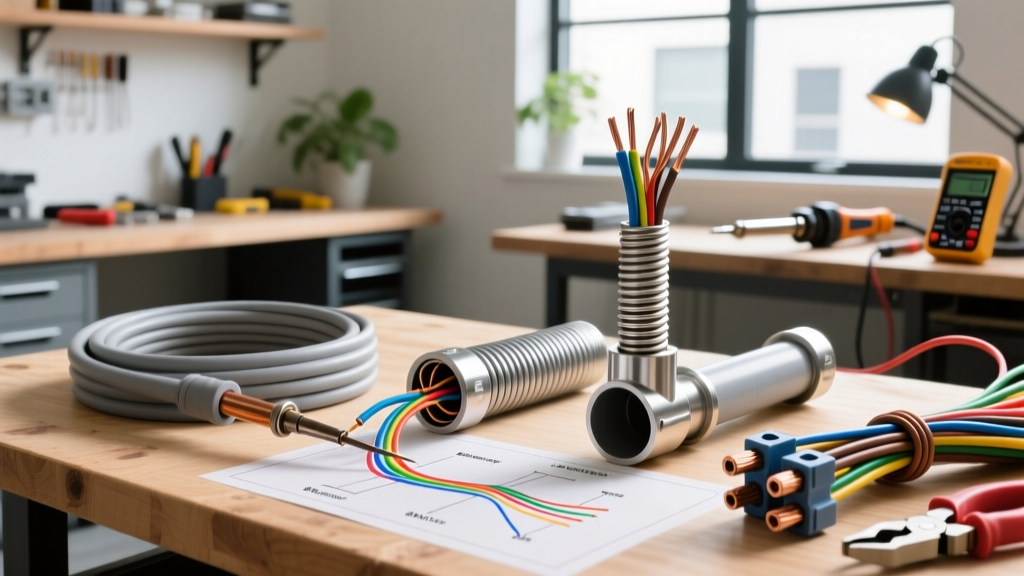
Do not confuse MC with AC (Armor Clad/BX) cable. AC cable relies on the steel armor itself as the equipment grounding conductor (EGC) via an internal bonding strip. MC cable, however, contains a dedicated green insulated or bare copper grounding wire inside the aluminum armor. Modern MC cable with a "grounding armor" rating (like AFC Cable) allows the armor to serve as a parallel ground path, but standard MC requires the internal green wire to be terminated at every box.
When cutting MC cable, you must use a specialized rotary cutter or a hacksaw with a fine-tooth blade to avoid nicking the internal conductors. Always use red anti-short bushings (often called "redheads") when terminating MC cable into metal boxes to protect the wire insulation from the sharp, freshly cut aluminum armor edges, even if the manufacturer claims they are optional.
Essential Tools for Wiring System Installation
Installing electrical wiring systems requires precision. Using the wrong tool can damage conductors, leading to high-resistance hot spots that cause fires years after the drywall is closed.
1. Wire Stripping and Preparation
- Klein Tools 11063W Wire Stripper: Handles 8-22 AWG solid and stranded wire. Failure Mode Alert: Using pliers or a utility knife to strip insulation often scores the copper. A scored 12 AWG wire effectively becomes a 14 AWG wire at the nick, creating a bottleneck for current and generating excess heat.
- Southwire Romex Splitter Tool: Essential for cleanly slitting the PVC jacket off NM-B cable without damaging the internal THHN insulation or the bare ground wire.
2. Pulling and Fishing
- Gardner Bender GFW-100 Fish Tape: A 100-foot, 1/8-inch steel tape for conduit runs. For long conduit pulls, pair this with Ideal 35-001 Clear Wire Pulling Lubricant to reduce tension and prevent jacket burn.
- Milwaukee 48-22-7100 Fiberglass Fish Tape: Required for pulling wires through existing walls with active electrical systems, as fiberglass is non-conductive and prevents accidental short circuits if the tape hits a live terminal.
3. Termination and Torque
The 2023 and 2026 NEC updates heavily emphasize proper termination torque. The Copper Development Association notes that under-torqued lugs cause arcing, while over-torqued lugs strip threads or shear the wire. Invest in a calibrated torque screwdriver, such as the Klein Tools 32500 series, set to the manufacturer’s specified inch-pounds (typically 20-25 in-lbs for standard 15A/20A residential breakers).
Navigating NEC Code Requirements for Wiring Systems
Material selection is only half the battle; code compliance dictates how those materials are deployed. According to the National Fire Protection Association (NFPA), which publishes the NEC, two major rules govern modern residential wiring systems:
- AFCI Protection (NEC 210.12): Almost all 120-volt, single-phase, 15- and 20-ampere branch circuits supplying dwelling unit outlets require Arc-Fault Circuit Interrupter (AFCI) protection. This impacts material selection, as you must either use AFCI breakers at the panel or combination AFCI receptacles at the first outlet in the circuit.
- Physical Protection (NEC 300.4): When boring holes through wooden studs for NM-B cable, the edge of the hole must be at least 1-1/4 inches from the nearest edge of the stud. If this distance cannot be maintained, you must install a 1/16-inch thick steel nail plate over the stud face to prevent drywall screws from piercing the wiring system later.
Frequently Asked Questions (FAQ)
Can I mix NM-B and MC cable in the same residential circuit?
Yes. It is common practice to use NM-B for the concealed runs inside walls and transition to MC cable for the exposed drop down to a receptacle in a garage or basement. The transition must occur inside an approved junction box or panel; you cannot simply splice the two cables together outside of an enclosure.
Is THHN wire better than Romex for home wiring?
THHN (Thermoplastic High Heat-resistant Nylon-coated) is a single-conductor wire type, whereas Romex (NM-B) is a cable assembly that actually contains THHN conductors inside. You cannot pull bare THHN wire through residential wall cavities without a raceway (conduit). THHN is strictly for use inside conduit systems, panels, or specific approved cable assemblies.
How does copper pricing affect my 2026 wiring budget?
Copper remains a globally traded commodity subject to supply chain shifts. In 2026, expect to pay between $180 and $240 for a 250-foot spool of 12/2 NM-B. To mitigate costs, accurately calculate your linear footage before purchasing and avoid buying pre-cut, boxed retail spools, which carry a 30% to 50% markup over contractor-grade reels from electrical supply houses.
Final Thoughts on System Selection
Choosing the right electrical wiring systems requires balancing upfront material costs against labor efficiency and long-term safety. While NM-B remains the most cost-effective choice for standard residential framing, integrating MC cable in vulnerable areas and utilizing EMT conduit for heavy appliance feeds ensures a robust, code-compliant infrastructure. Always pair premium materials with precision tools and verify your local municipality’s specific amendments to the NEC before pulling your first wire.