
The Anatomy of Residential Split-Phase AC Power
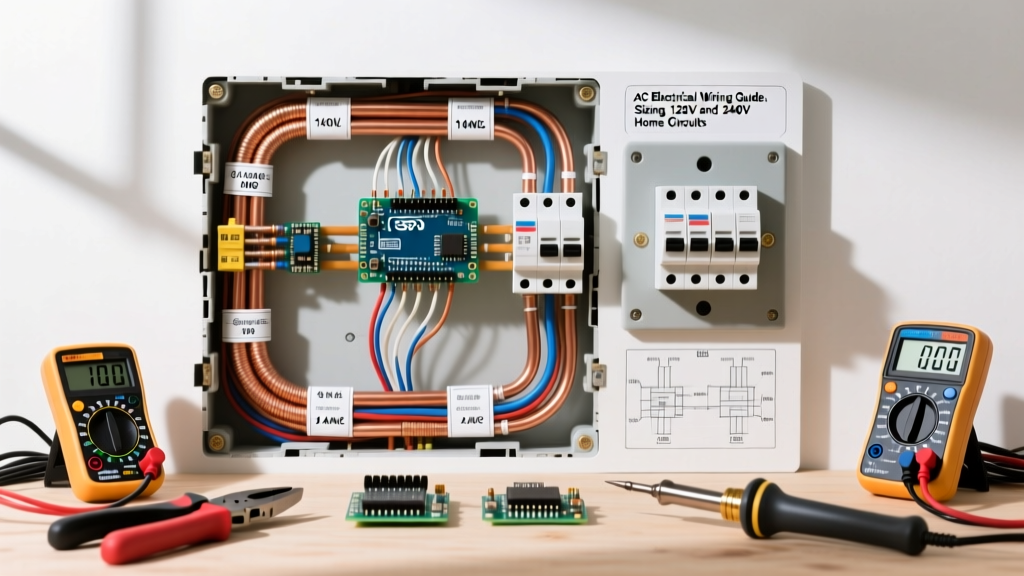
Before pulling any wire or terminating a connection, it is critical to understand the nature of the power supplied to your home. In North America, residential AC electrical wiring relies on a 120/240V single-phase, three-wire split-phase system. The utility transformer on your street features a center-tapped secondary winding. This center tap is bonded to ground and becomes your neutral conductor.
The two ends of the winding provide the 'hot' legs (L1 and L2). Measured from either hot leg to the neutral, you get 120V AC. Measured across both hot legs (L1 to L2), the waveforms—being 180 degrees out of phase—combine to deliver 240V. Understanding this paradigm is the foundation of all home electrical projects, whether you are wiring a standard 15-amp lighting circuit or a heavy-duty 50-amp receptacle for an electric vehicle (EV) charger.
2026 NEC Code Updates Impacting AC Electrical Wiring
The National Electrical Code (NEC) is updated every three years, and recent cycles have drastically expanded ground-fault (GFCI) and arc-fault (AFCI) protection requirements. For any home project involving AC electrical wiring, you must adhere to the latest local amendments, which generally reflect the 2023 or 2026 NEC standards.
- AFCI Expansion (Article 210.12): Arc-Fault Circuit Interrupters are now mandatory for virtually all 120V, single-phase, 15- and 20-amp branch circuits supplying bedrooms, living rooms, kitchens, and laundry areas. You must use combination-type AFCI breakers or receptacles.
- GFCI Requirements (Article 210.8): Ground-Fault Circuit Interrupter protection is required for all 125V through 250V receptacles supplied by single-phase branch circuits rated 150 volts or less to ground, in areas like garages, outdoors, and crawl spaces. According to the Electrical Safety Foundation International (ESFI), GFCIs prevent severe electrical shocks by detecting ground leakage as low as 4 to 6 milliamps.
- EV Charging Specifics (Article 210.17): If your AC wiring project involves an EV charging station, the NEC now strictly requires GFCI protection for indoor and outdoor receptacles used for EV supply equipment (EVSE), which has led to a rise in hardwired EVSE units to avoid nuisance tripping.
Wire Gauge and Breaker Sizing Matrix
Selecting the correct conductor size is non-negotiable. Undersized wiring leads to voltage drop, insulation melting, and fire. The table below outlines standard copper wire sizing for common residential AC electrical wiring applications based on NEC Article 310.15 ampacity tables (60°C and 75°C columns).
| Appliance / Circuit Type | Voltage | Max Amperage | Min. Copper Wire (NM-B) | Breaker Size |
|---|---|---|---|---|
| General Lighting / Receptacles | 120V | 15A | 14 AWG | 15A (AFCI) |
| Kitchen Small Appliance / Laundry | 120V | 20A | 12 AWG | 20A (AFCI/GFCI) |
| Electric Water Heater | 240V | 30A | 10 AWG | 30A (Double Pole) |
| Electric Range / Oven | 240V | 40A - 50A | 6 AWG | 40A or 50A |
| Level 2 EV Charger (Continuous) | 240V | 40A | 6 AWG | 50A (Double Pole) |
Pro Tip: Continuous loads (those expected to run for 3 hours or more, like EV chargers or space heaters) must be derated to 80% of the breaker's capacity. Therefore, a 40-amp continuous EV charger requires a 50-amp breaker and 6 AWG wire.
Project Guide: Wiring a 50-Amp 240V Circuit for an EV Charger
According to the U.S. Department of Energy's Alternative Fuels Data Center, Level 2 home charging is the most practical solution for daily EV use, requiring a dedicated 240V AC circuit. Here is a deep dive into executing this project safely and to code.
Step 1: Panel Preparation and Load Calculation
Before purchasing materials, perform a Standard Load Calculation (NEC Article 220). A typical 200-amp residential panel can usually accommodate a 50-amp EV circuit, provided you do not have an all-electric home with simultaneous heavy draws (like electric baseboard heat and an electric range running together). Turn off the main breaker. Verify zero voltage at the bus bars using a non-contact voltage tester and a multimeter.
Step 2: Material Selection and Pricing
For a 60-foot run from the panel to the garage, you have two primary choices for AC electrical wiring:
- 6/2 NM-B (Romex) with Ground: Best for running through drilled studs in unfinished walls. Current 2026 pricing averages $2.15 per foot.
- 6 AWG THHN in 3/4-inch EMT Conduit: Required if the wire is exposed on the surface of garage walls. THHN wire costs roughly $1.25 per foot per conductor (you need Black, Red, White, and Green), plus $1.50 per foot for the metal conduit.
Step 3: Pulling Conductors and Torque Specifications
The most common failure point in high-amperage 240V AC wiring is a loose termination. The NEC now mandates that terminals be tightened to the manufacturer's specified torque using a calibrated torque screwdriver or wrench.
- Breaker Termination: A standard Siemens Q250 50-amp double-pole breaker requires approximately 45 in-lbs of torque for 6 AWG solid or stranded copper.
- Receptacle Termination: If installing a NEMA 14-50R receptacle (like the Leviton 214-S00), the line and neutral lugs typically require 35 in-lbs, while the ground lug requires 15 in-lbs. Always check the sticker on the back of the specific device.
Step 4: GFCI Compliance and Hardwiring
If you install a 14-50 receptacle in a garage, the 2023/2026 NEC requires a 50-amp GFCI breaker. These breakers are expensive (often exceeding $150) and are prone to nuisance tripping due to the internal EMI filters in modern EV chargers. To bypass the receptacle GFCI requirement, many electricians now hardwire the EVSE directly to a junction box, as the EVSE unit itself contains built-in ground-fault protection that satisfies the code.
Common AC Wiring Failure Modes in DIY Projects
When troubleshooting or inspecting existing AC electrical wiring, look out for these specific edge cases and failure modes:
1. Multi-Wire Branch Circuit (MWBC) Neutral Overloading
An MWBC shares a single neutral wire between two 120V hot legs (L1 and L2). If wired correctly, the 180-degree phase cancellation means the neutral only carries the imbalance. However, if a DIYer accidentally connects both hot wires to the same phase leg (e.g., both on L1), the neutral will carry the additive sum of both circuits. On two 15-amp circuits, the shared 14 AWG neutral could carry 30 amps, melting the insulation and causing a fire without ever tripping the breakers. Fix: Always use a handle-tied or double-pole breaker for MWBCs to ensure they land on opposite legs and disconnect simultaneously.
2. Voltage Drop on Long Runs
The NEC recommends a maximum voltage drop of 3% for branch circuits and 5% overall. If you are wiring a 240V outlet for a welder in a detached barn 150 feet away, standard 10 AWG wire will result in an unacceptable voltage drop under load, potentially damaging the equipment's motor windings. You must upsize the wire to 6 AWG or even 4 AWG to compensate for the distance, despite the breaker only being 30 amps.
3. Bootleg Grounds on 3-Prong to 4-Prong Conversions
Older homes often feature 3-prong 240V dryer outlets (NEMA 10-30), which lack a dedicated equipment grounding conductor. When upgrading to a modern 4-prong NEMA 14-30, some DIYers mistakenly bond the neutral terminal to the metal box or use the armor of old BX cable as a ground. This is highly dangerous. You must pull a new 4-wire cable (10/3 NM-B) with a dedicated ground from the panel.
Frequently Asked Questions
Can I use aluminum wire for residential AC electrical wiring?
Yes, but typically only for heavy feeder lines (like subpanels or service entrances) sized 2 AWG or larger. Aluminum is lighter and cheaper than copper but requires anti-oxidant paste (like Noalox) and specific CO/ALR rated terminals. Never use aluminum for standard 15A or 20A branch circuits due to historical issues with thermal expansion and fire hazards at receptacle connections.
Why does my 240V baseboard heater not require a neutral wire?
Pure 240V resistive loads, like baseboard heaters or well pumps, only utilize the two hot legs (L1 and L2). Because the current flows back and forth between the two opposing phases, no neutral return path is needed. You will wire these using a 2-wire cable with a ground (e.g., 12/2 NM-B), utilizing the black and white wires as hot conductors (you must wrap the white wire in black electrical tape to re-identify it as a hot leg).
What is the difference between NM-B and THHN wire?
NM-B (Non-Metallic Sheathed Cable) is a bundle of insulated wires wrapped in a PVC jacket, designed for dry, indoor, concealed spaces like inside walls. THHN (Thermoplastic High Heat-resistant Nylon-coated) is a single, highly durable insulated conductor designed to be pulled through conduit in exposed areas, outdoors, or in wet locations.