
Defining the Core: What Is a Conductor in Electricity?
When DIYers, apprentices, and engineers ask, "what is a conductor in electricity," the immediate mental image is usually a spool of shiny copper wire. However, from a strict Code & Standards perspective—specifically governed by the National Electrical Code (NEC) in the United States and IEC standards globally—the definition is far more rigid, nuanced, and critical to preventing electrical fires and equipment failure.
In fundamental physics, a conductor is any material that permits the free flow of electrical charge (electrons) due to its atomic structure. Metals like copper, silver, and aluminum have loosely bound valence electrons that easily detach and move when a voltage potential is applied. But in the realm of electrical installations, a conductor is not just the bare metal; it is a highly regulated component defined by its ampacity, insulation rating, material alloy, and application environment.
NEC Article 100: The Legal Definition of a Conductor
To understand conductors in a practical wiring scenario, we must look at the legal definitions that govern electrical inspections. The National Fire Protection Association (NFPA) outlines these definitions in NEC Article 100. Legally, the NEC distinguishes between the conductive metal itself and the assemblies that house it.
According to NEC Article 100, a conductor is defined as 'A material or body that allows electric current to pass through it continuously.' However, the Code carefully separates 'conductors' from 'cables' and 'cords'.
Conductors vs. Cords vs. Fixture Wire
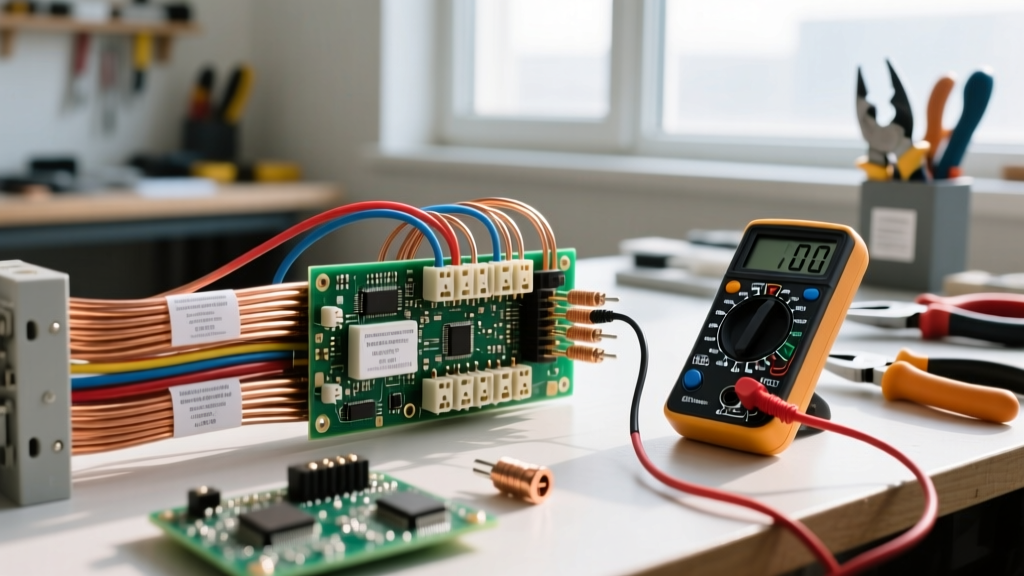
- Conductor: Refers to the individual metal wire, whether bare, covered, or insulated. When an electrician pulls three individual THHN wires through a conduit, they are installing three conductors.
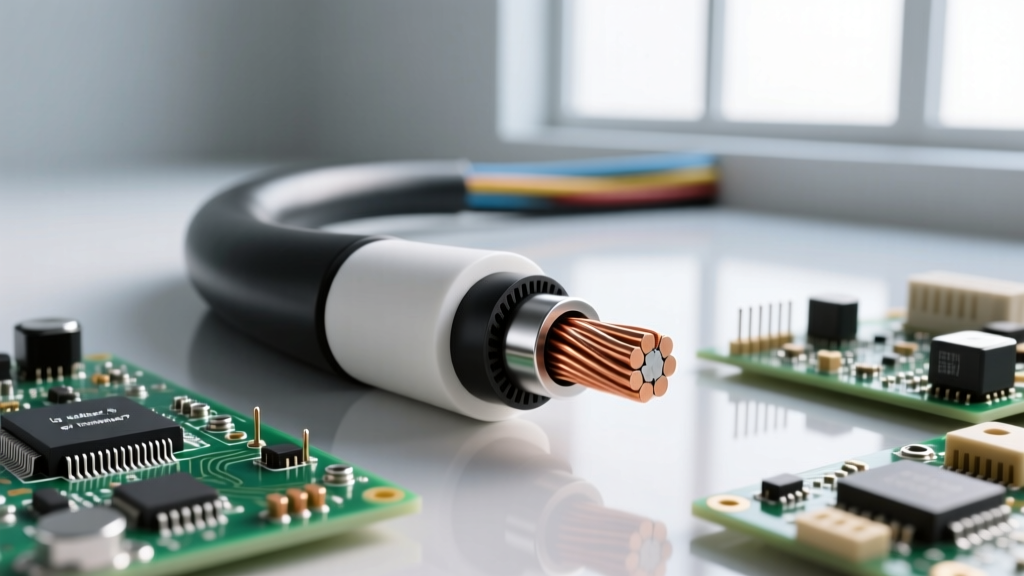
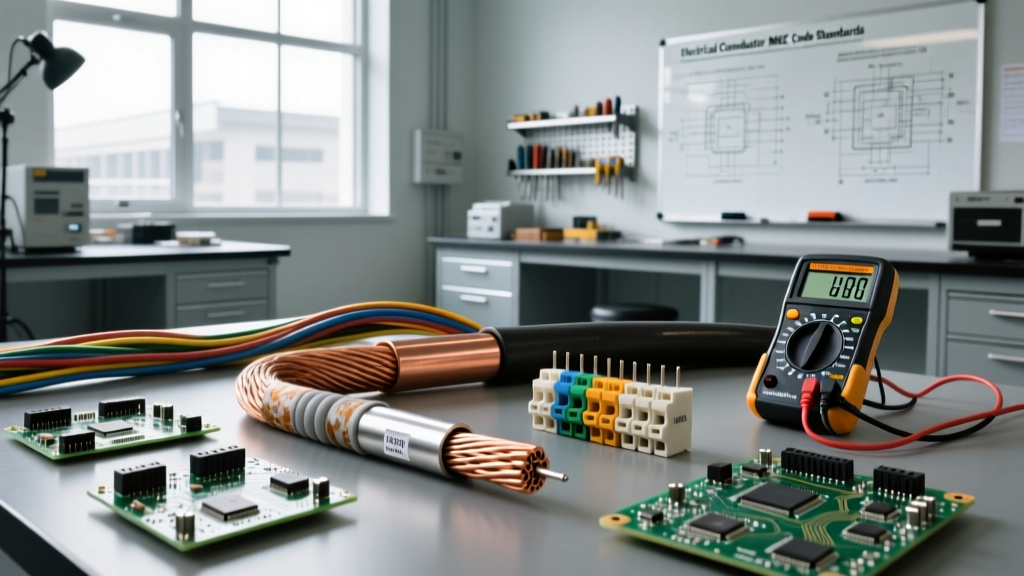
- Cable: An assembly of two or more conductors enclosed within an overarching jacket (e.g., Nonmetallic-Sheathed Cable like Romex, or Metal-Clad Cable). The individual wires inside the jacket are the conductors; the entire assembly is the cable.
- Flexible Cord: Stranded conductors designed for temporary use, movement, and vibration (e.g., SOOW or SJTW). The NEC strictly prohibits using flexible cords as a substitute for the fixed wiring of a structure (NEC 400.12).
Approved Conductive Materials Under NEC Section 310
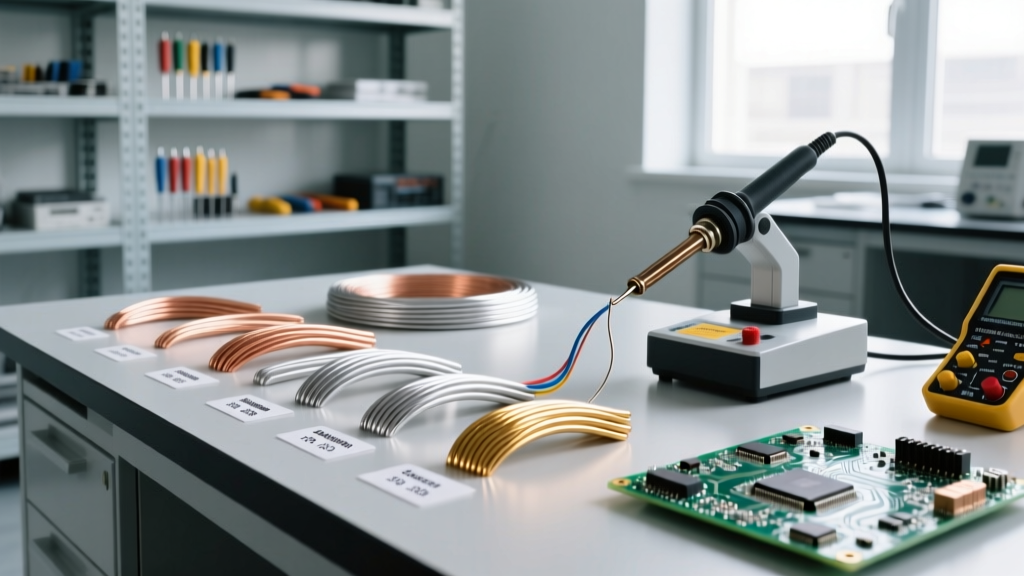
Not all metals are legally permitted for use as electrical conductors in building wiring. While silver is the most conductive element on earth, its cost makes it impractical for structural wiring. Therefore, the electrical industry relies on standardized materials measured against the International Annealed Copper Standard (IACS).
The Copper Development Association (CDA) establishes pure annealed copper as the 100% IACS baseline. All other conductive materials are measured as a percentage of this baseline. NEC Section 310.14 explicitly dictates the acceptable materials and their specific alloy requirements.
| Material | NEC Designation | Relative Conductivity (% IACS) | Typical Application | Code Caveat & Restriction |
|---|---|---|---|---|
| Copper (Cu) | Standard | 100% | Branch circuits, feeders, control wiring | Must be insulated unless specifically permitted as a bare ground. |
| Aluminum (Al) | AA-8000 Series | ~61% | Service entrances, large feeders, utility transmission | Pure aluminum is banned for branch circuits. Must use AA-8000 alloy and anti-oxidant paste. |
| Copper-Clad Aluminum | CCA | Varies (usually ~63%) | Rarely used in modern NEC-compliant branch circuits | Often confused with solid copper. Must be terminated using aluminum torque specifications. |
The Aluminum Wiring Hazard and the AA-8000 Mandate
During the copper shortage of the late 1960s and 1970s, builders installed pure aluminum (AA-1350) for standard 15A and 20A branch circuits. This resulted in catastrophic failure modes. Pure aluminum suffers from 'creep'—a slow, permanent deformation under the mechanical pressure of screw terminals. Combined with aluminum's rapid oxidation rate (which creates a highly resistive, heat-generating aluminum oxide layer), thousands of homes experienced melted receptacles and electrical fires.
Today, NEC 310.14 mandates that aluminum conductors must be an AA-8000 series electrical grade alloy, which incorporates iron and other elements to resist creep and maintain termination integrity. Furthermore, when terminating aluminum, installers must use specific wire connectors marked 'AL/CU' and apply antioxidant compounds to prevent galvanic corrosion.
The Semantic Trap: Grounded vs. Grounding Conductors
One of the most dangerous misunderstandings in electrical fundamentals is the terminology surrounding 'ground.' The NEC uses highly specific language to differentiate between conductors that carry normal load current and those that exist solely for safety. Misidentifying these can lead to lethal shock hazards and improper neutral-to-ground bonds.
1. The Grounded Conductor (Neutral)
The 'grounded conductor' is what DIYers commonly call the neutral wire. It is a current-carrying conductor that is intentionally connected to the earth (grounded) at the main service disconnect to stabilize the system voltage. Under NEC 200.6, this conductor must be identified by white or gray insulation (or three continuous white stripes). In a standard 120V single-phase circuit, it carries the exact same unbalanced load current as the hot (ungrounded) conductor.
2. The Equipment Grounding Conductor (EGC)
The EGC is the true 'safety ground.' It is not intended to carry current under normal operating conditions. Its sole purpose is to provide a low-impedance fault current path back to the source to trip the breaker during a short circuit. Per NEC 250.119, the EGC must be bare, covered, or insulated, and if insulated, the outer finish must be green or green with yellow stripes.
3. The Equipment Bonding Jumper
A bonding jumper is a specific type of conductor used to ensure electrical continuity between metal parts that might otherwise become isolated (e.g., connecting a metal water pipe to the grounding electrode system, or bridging a flexible metal conduit). Bonding ensures that all non-current-carrying metal parts remain at the same zero-potential, preventing shock hazards if a hot wire chafes against a metal enclosure.
Insulation Ratings and Termination Physics
A bare metal wire is rarely permitted as a conductor in building wiring, save for specific grounding applications. Therefore, understanding a conductor requires understanding its dielectric insulation. Insulation prevents phase-to-phase shorts, phase-to-ground faults, and protects the metal from environmental degradation.
The NEC categorizes conductors by their thermal rating and environmental resistance. Two of the most common building wire insulations are:
- THHN (Thermoplastic High Heat-resistant Nylon-coated): Rated for 90°C in dry locations. The nylon jacket provides excellent abrasion resistance, making it ideal for pulling through PVC or metal conduit.
- XHHW-2 (Cross-linked Polyethylene High Heat Water-resistant): Rated for 90°C in both wet and dry locations. The XLPE insulation is thicker and more resistant to moisture and chemical breakdown than PVC, making it the preferred choice for underground conduits or damp environments.
The NEC 110.14(C) Termination Rule
A common and dangerous mistake made by novice electricians is sizing a breaker based on the 90°C ampacity column of NEC Table 310.15(B)(16). However, OSHA and NEC enforcement heavily rely on Section 110.14(C). This rule states that the ampacity of a conductor is ultimately limited by the temperature rating of the equipment terminations (lugs, breakers, receptacles). Because most standard residential and commercial breakers and receptacles are rated for only 75°C, you must size your conductor ampacity using the 75°C column, even if the wire's insulation is rated for 90°C. The 90°C rating is primarily used for ampacity derating calculations when bundling multiple conductors in a single raceway.
Real-World Failure Modes: When Conductors Violate Code
Understanding what a conductor is theoretically is only half the battle; knowing how they fail in the field separates a true professional from an amateur. Here are two specific failure modes related to conductor misuse:
Harmonic Overloads on the Grounded Conductor
In modern commercial buildings filled with non-linear loads (LED drivers, variable frequency drives, computer servers), the grounded conductor (neutral) faces a hidden threat. These devices generate 'triplen' harmonics (3rd, 9th, 15th). Unlike fundamental currents which cancel out on the neutral in a balanced 3-phase system, triplen harmonics add together arithmetically. This can cause the neutral conductor to carry significantly more current than the phase conductors, leading to overheating and fires. NEC 310.15(B)(5) addresses this, often requiring the grounded conductor to be sized larger than the ungrounded phase conductors in heavily harmonic-loaded feeders.
Undertorquing and Thermal Cycling
A conductor is only as good as its termination. If a copper or aluminum conductor is not torqued to the manufacturer's exact inch-pound specification, the connection will exhibit micro-movements during thermal cycling (the heating and cooling of the wire under load). This loosening increases contact resistance. According to Ohm's Law (P = I²R), as resistance rises at the joint, the power dissipated as heat increases exponentially. This localized heating further expands the metal, loosens the screw, and eventually results in a high-impedance arc fault or a melted lug. The 2017 NEC update to Section 110.14(D) now strictly mandates the use of calibrated torque tools for all covered electrical connections.
Summary
So, what is a conductor in electricity? From a physics standpoint, it is a pathway for electrons. But from a Code & Standards perspective, it is a highly engineered, legally defined component governed by strict rules regarding alloy composition, insulation chemistry, ampacity derating, and termination physics. Whether you are pulling 14 AWG copper for a bedroom receptacle or terminating 500 kcmil aluminum at a main switchboard, respecting the NEC definitions and material limitations is the only way to ensure a safe, lasting, and code-compliant electrical system.