
The Sci-Fi Myth vs. Physics Reality
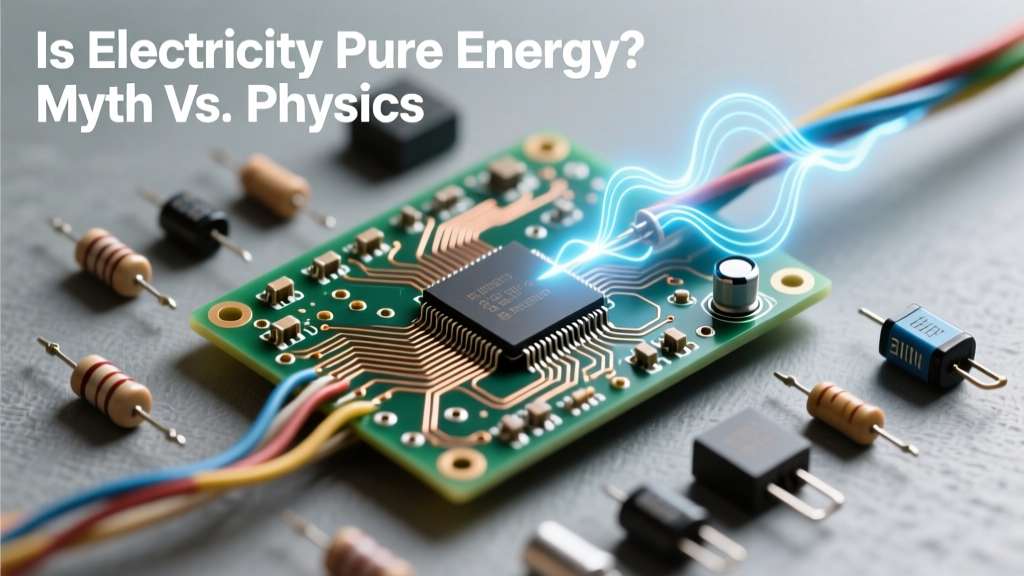
A common question among electronics hobbyists and DIYers entering the world of circuit design is: is electricity pure energy? The short answer, grounded in classical physics and electrical engineering, is an absolute no. The concept of "pure energy" is largely a science fiction trope. In the real world, energy is not a substance, a fluid, or a tangible object that can be bottled or flowed through a pipe. Instead, energy is a property of a physical system—specifically, its capacity to do work.
When we talk about electricity in the context of wire sizing, soldering, and microcontroller circuits, we are referring to the movement of charge carriers (typically electrons in copper wires, or ions in electrolytes). Because electrons are fundamental particles with mass, they are matter, not "pure energy." Understanding this distinction is not just an academic exercise; it is the foundational reason why wires heat up, why voltage drop occurs, and why the National Electrical Code (NEC) mandates strict ampacity ratings for different American Wire Gauge (AWG) sizes.
Defining the Terms: Charge Carriers vs. Energy States
To debunk the pure energy myth, we must separate the carrier from the property.
The Electron: Matter in Motion
Electrons are subatomic particles that possess a rest mass. According to the NIST fundamental physical constants, the mass of an electron is approximately 9.109 × 10⁻³¹ kilograms. Because electrons have mass and occupy physical space (governed by the Pauli exclusion principle), they are undeniably matter. When you connect a battery to a copper wire, you are not injecting "pure energy" into the wire; you are applying an electromotive force (voltage) that pushes existing, physical electrons through the metallic lattice.
Energy: The Ability to Do Work
Energy, on the other hand, is a mathematical property describing the state of the system. In an electrical circuit, this manifests as electrical potential energy (voltage) and kinetic energy (current). When an electron moves through a resistor, it doesn't "lose pure energy"; rather, it transfers its kinetic energy to the atomic lattice of the resistor via collisions, generating phonons (vibrational energy), which we measure as heat.
Comparative Breakdown: Electron Flow vs. Electromagnetic Waves
Confusion often arises because people conflate electrical current (the flow of electrons) with electromagnetic radiation (light, radio waves). While both can transfer energy, their physical mechanics are vastly different. Below is a comparison of how these phenomena operate in electrical systems.
| Characteristic | Electrical Current (Electron Flow) | Electromagnetic Radiation (Photons) |
|---|---|---|
| Physical Nature | Fermions (Matter with mass) | Bosons (Massless force carriers) |
| Propagation Speed | Extremely slow (Drift velocity ~0.1 mm/s) | Speed of light (c) in a vacuum |
| Medium Requirement | Requires a conductive medium (e.g., Copper, Aluminum) | Can propagate through a vacuum |
| Resistance / Loss | Experiences Ohmic resistance (Joule heating) | No Ohmic resistance, but subject to scattering/absorption |
| Role in a Wire | Provides the boundary conditions and charge gradient | Carries the actual energy through the surrounding dielectric |
As noted by Georgia State University's HyperPhysics, the actual drift velocity of electrons in a standard 12 AWG copper wire carrying 15 amps is astonishingly slow—often less than a millimeter per second. Yet, when you flip a switch, the light turns on instantly. This is because the energy is not being carried by the physical electrons bumping into each other like billiard balls; it is carried by the electromagnetic field.
The Poynting Vector: Where Does the Energy Actually Flow?
Here is where the "pure energy" misconception completely unravels, revealing one of the most fascinating realities of electrical engineering. If you ask a layperson where the electrical energy flows in a DC or AC circuit, they will almost universally point to the inside of the copper wire. This is physically incorrect.
According to Poynting's Theorem, the directional energy flux (the rate of energy transfer per unit area) is described by the Poynting vector (S = E × H). In a standard circuit, the electric field (E) exists between the conductors, and the magnetic field (H) circles the conductors. The cross-product of these fields dictates that the actual electromagnetic energy flows through the dielectric material (the insulation or air) surrounding the wire, not through the copper itself. For a deeper dive into this counterintuitive phenomenon, The Feynman Lectures on Physics provides a masterful breakdown of field energy propagation.
The copper wire's primary job is to act as a waveguide. The physical electrons (matter) inside the wire move slowly, continuously colliding with the copper lattice, which creates resistance and heat. The energy (the property of the field) zooms through the space outside the wire at a significant fraction of the speed of light, guided by the physical boundary of the conductors.
Why This Distinction Dictates Wire Sizing and Ampacity
Understanding that electricity is the flow of matter (electrons) rather than "pure energy" is critical for practical wire sizing and thermal management in DIY electronics and residential wiring.
1. Joule Heating and Lattice Collisions
Because electrons have mass and physical dimensions, they cannot pass through a copper conductor without interacting with the copper atoms. Every collision transfers kinetic energy from the electron to the copper lattice. This is known as Joule heating, calculated by the formula P = I²R. If electricity were pure energy (like light passing through a vacuum), there would be no collisions, no resistance, and no heat. Because it is matter, we must calculate voltage drop and select wire gauges that can safely dissipate this heat without melting the insulation.
2. Skin Effect in AC Circuits
In alternating current (AC) systems, the changing magnetic field pushes the physical electrons toward the outer perimeter of the conductor. This is called the skin effect. At 60 Hz (standard US mains power), the skin depth in copper is about 8.5 mm, meaning standard AWG wires are fully utilized. However, at high frequencies (like RF signals or PWM microcontroller outputs), the electrons are forced into a microscopic outer layer of the wire. This effectively reduces the cross-sectional area available for the matter to flow through, increasing AC resistance. This is why high-frequency RF engineers use Litz wire (many individually insulated thin strands) to maximize surface area for the electrons to travel.
3. NEC Ampacity Derating
The National Electrical Code (NEC) Article 310 ampacity tables are entirely based on the thermal limits of insulation materials (like PVC, THHN, or XLPE) when subjected to the physical friction of electron flow. If you bundle multiple wires together in a conduit, the heat generated by matter-collision cannot escape. Therefore, the NEC requires you to "derate" the ampacity (lower the maximum allowed current). You are managing the thermal consequences of moving matter, not just routing abstract energy.
Common Misconceptions in Electrical Fundamentals
- Myth: Electrons travel from the battery to the bulb at the speed of light.
Fact: The electromagnetic signal propagates near the speed of light, but the physical electrons drift at a fraction of a millimeter per second. - Myth: A wire is a hollow pipe that gets "filled" with pure energy.
Fact: A wire is a solid lattice of atoms already saturated with free electrons. Voltage simply applies a directional pressure to the existing sea of matter. - Myth: Ground wires absorb "excess energy."
Fact: Ground and bonding conductors provide a low-impedance physical path for fault currents (electrons) to return to the source, tripping the breaker before the matter-collisions cause a fire.
Summary: The Engineering Perspective
So, is electricity pure energy? No. Electricity is the physical movement of subatomic matter (charge carriers) guided by electromagnetic fields. Energy is simply the mathematical property that describes the work this system can perform. As an electrical DIYer, maker, or engineer, respecting the physical reality of electron flow is what keeps your circuits functional and safe. By acknowledging that electrons possess mass, experience friction, and generate heat, you can properly utilize wire sizing charts, calculate circular mils for voltage drop, and design robust microcontroller systems that stand the test of time.