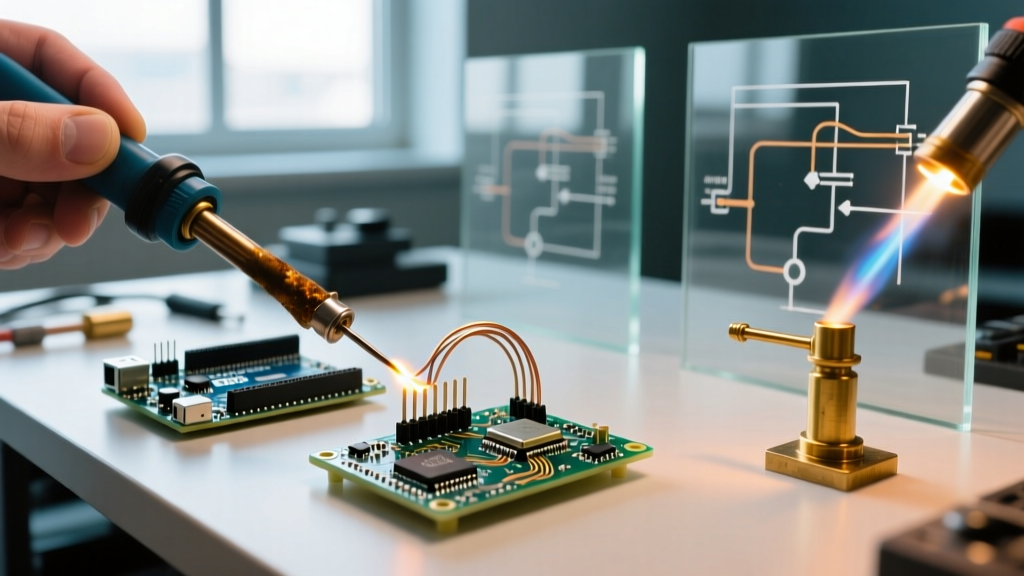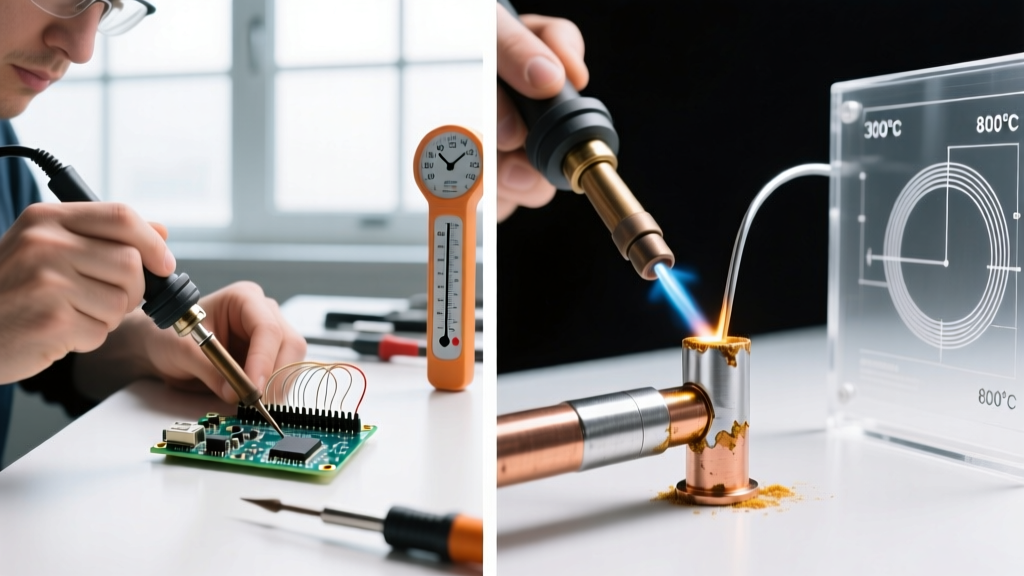

When joining metals in HVAC, electronics, or structural plumbing, confusing your thermal processes can lead to catastrophic joint failure. While both rely on capillary action and a filler metal that melts at a lower temperature than the base metals, the difference between brazing and soldering dictates the mechanical strength, thermal resilience, and cost of your assembly. As a professional, understanding the metallurgical boundary between these two processes is non-negotiable.
The Metallurgical Boundary: The 840°F (450°C) Rule
The most critical distinction between these two processes is defined by the American Welding Society (AWS) A3.0 standard. The dividing line is exactly 840°F (450°C). If the filler metal melts below this threshold, the process is soldering. If it melts above this threshold, it is brazing. In both processes, the base metal must never melt; the joint is formed entirely through capillary action and metallurgical bonding at the surface interface.
According to American Welding Society (AWS) standards, this temperature boundary is not arbitrary. It represents the point where filler metals transition from relatively soft, low-tensile alloys (like tin-lead or tin-silver) to high-strength, structurally sound alloys (like copper-phosphorus or silver-based braze). Understanding this boundary is the first step in selecting the right technique for your specific application.
Deep Dive: Soldering Mechanics & Pro Techniques
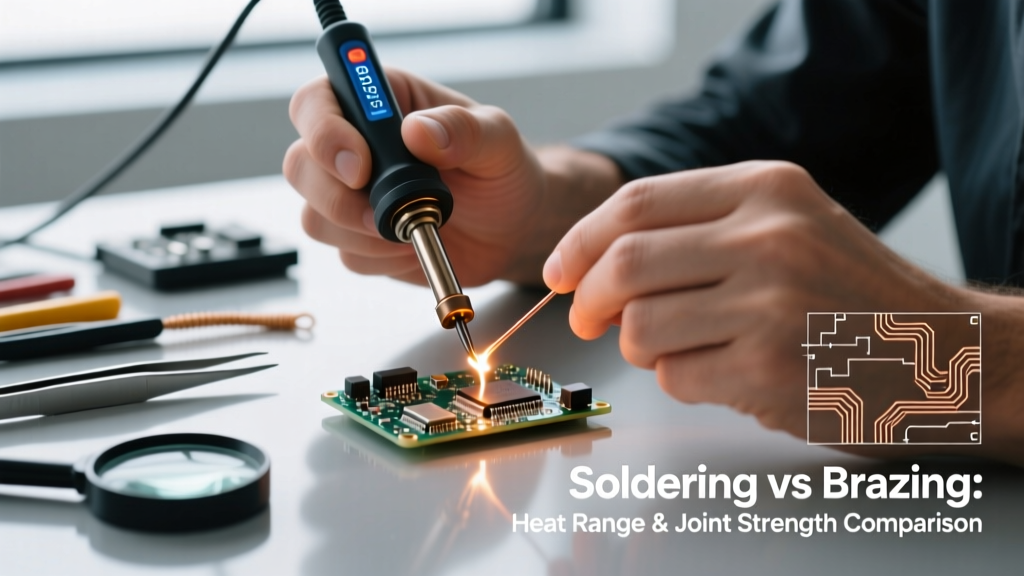
Soldering is the domain of electronics, low-pressure domestic plumbing, and delicate sheet metal work. Because the temperatures are relatively low (typically between 350°F and 600°F), soldering minimizes thermal distortion and prevents damage to heat-sensitive components.
Electronics vs. Plumbing Alloys
- Electronics (SAC305): In 2026, the industry standard for lead-free PCB assembly remains SAC305 (96.5% Tin, 3.0% Silver, 0.5% Copper). It melts around 422°F (217°C) and requires a no-clean or rosin-mildly-activated (RMA) flux to prevent oxidation without leaving corrosive residues.
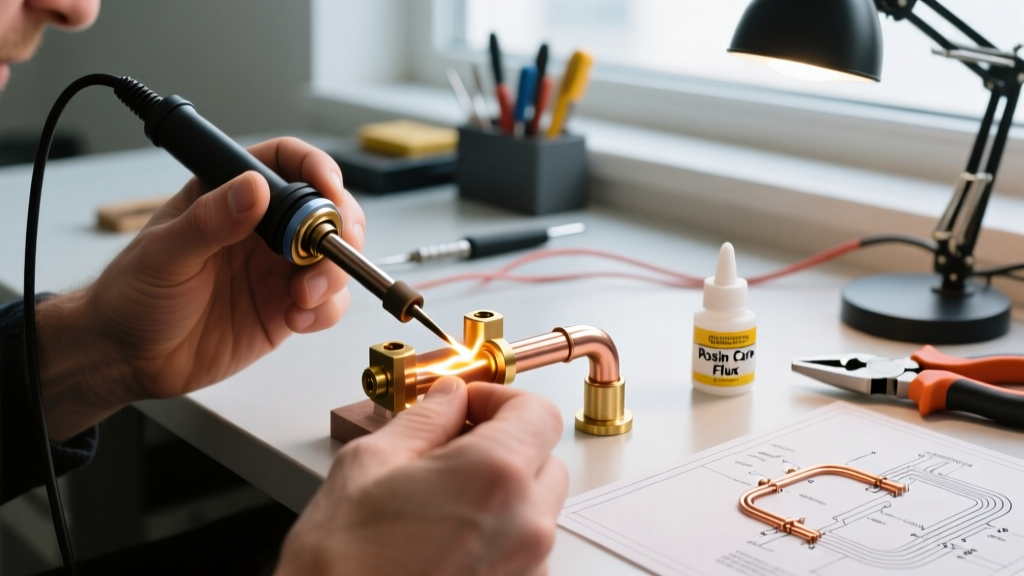
- Plumbing (95Sn/5Cu): For potable water lines, a 95% Tin / 5% Copper alloy is standard. It melts at roughly 450°F (232°C), just below the AWS threshold, and provides the necessary tensile strength for municipal water pressures (up to 150 psi).
The Capillary Requirement
For solder to flow correctly, the joint clearance must be precise. For copper-to-copper plumbing joints, the optimal capillary gap is between 0.002 and 0.005 inches. If the gap is too wide, the solder will not bridge the space; if it is too tight, the flux will be trapped, leading to internal corrosion and eventual pinhole leaks.
Deep Dive: Brazing Mechanics & Pro Techniques
Brazing is utilized when joints must withstand high mechanical stress, extreme temperatures, or severe vibration. Common applications include HVAC/R compressor lines, aerospace structural components, and high-pressure hydraulic manifolds.
"The most common field failure in commercial refrigeration piping is not a bad braze, but a solder joint masquerading as a braze on the high-pressure discharge side, leading to catastrophic refrigerant loss."
Silver-Bearing and Copper-Phosphorus Alloys
Unlike soldering, brazing alloys are significantly more expensive due to their silver content. As noted in Lucas-Milhaupt's brazing fundamentals, selecting the right AWS classification is vital:
- BCuP-5 (15% Silver): The workhorse for copper-to-copper HVAC joints. The phosphorus acts as a self-fluxing agent, meaning you do not need to apply external flux when joining pure copper. Melts at 1,175°F (635°C).
- BAg-29 (45% Silver): Required for dissimilar metals, such as copper-to-brass or copper-to-steel. The high silver content lowers the melting point to 1,225°F (663°C) and increases ductility, allowing the joint to absorb thermal expansion mismatches without cracking.
Torch Setup and Heat Management
While MAP-Pro torches can technically braze small-diameter copper lines, professionals in 2026 rely on Oxy-Acetylene or Oxy-Propane setups for anything larger than 3/4-inch pipe. The goal is to heat the base metal, not the rod. A common rookie mistake is melting the brazing rod with the torch flame and letting it drip onto a cold joint, resulting in a superficial 'cold braze' with zero capillary penetration.
Comparison Matrix: Soldering vs. Brazing
| Parameter | Soldering | Brazing |
|---|---|---|
| Temperature Threshold | Below 840°F (450°C) | Above 840°F (450°C) |
| Tensile Strength | 5,000 - 15,000 psi | 30,000 - 70,000+ psi |
| Base Metal Prep | Mechanical abrasion + chemical clean | Mechanical abrasion + solvent degrease |
| Flux Chemistry | Rosin, Mild Organic Acids | Fluorine compounds, Borax/Boric Acid |
| Material Cost (Filler) | Low ($5 - $25 per lb) | High ($60 - $150+ per oz depending on Ag) |
| Thermal Distortion | Minimal | Moderate to High (requires annealing awareness) |
Edge Cases & Professional Failure Modes
Understanding the theory is easy; navigating field edge cases is where professionals earn their keep. Here are three specific scenarios where confusing the two processes leads to failure.
1. The Dissimilar Metal Trap (Copper to Steel)
If you attempt to solder copper to mild steel using standard tin-antimony plumbing solder, the joint will fail under thermal cycling. Steel and copper have vastly different coefficients of thermal expansion. Solder lacks the ductility to absorb this shear stress. Pro Tip: You must use a silver brazing alloy (like BAg-7, 56% Silver) and a specialized white flux (like Harris Stay-Silv White Flux) to create a ductile bridge that accommodates the expansion mismatch.
2. Flux Entrapment in Capillary Joints
In brazing, high-temperature fluxes turn into a molten glass-like slag. If the joint clearance is too tight (under 0.002 inches), this slag cannot be expelled by the incoming braze alloy. The slag becomes trapped inside the joint, creating a brittle void. When the system is pressurized, the joint will fracture along the slag inclusion line. Always ream and size your pipes to maintain a 0.003 to 0.005-inch gap for brazing.
3. Annealing and Work Hardening
When brazing hard-drawn copper tubing (Type L or K), the intense heat (1,200°F+) will anneal the copper, turning it from a rigid, hard-drawn state to a soft, easily bent state. While this isn't an issue for straight runs, brazing near a structural support bracket can weaken the pipe's ability to hold its own weight over long spans. Professionals mitigate this by using localized heat sinks (wet rags or specialized heat-absorbing pastes) to protect adjacent work-hardened areas.
Choosing the Right Flux for the Job
Flux is not optional; it is the chemical engine that drives capillary action by dissolving metal oxides. However, the chemistry required for soldering is entirely inadequate for brazing.
- For Soldering: Use water-soluble organic acid pastes for plumbing, or RMA (Rosin Mildly Activated) liquid/paste for electronics. These burn off or become inactive at high temperatures.
- For Brazing: You need fluoride-based fluxes. Standard black flux (potassium fluoride) works up to 1,600°F, while high-temperature white flux (containing boric acid and fluoroborates) is required for stainless steel or high-silver alloys operating above 1,400°F.
Final Professional Takeaways
Mastering the difference between brazing and soldering comes down to respecting the 840°F threshold and matching the filler metal's mechanical properties to the joint's operational environment. Never use solder to save money on a high-pressure or high-vibration system, and never use expensive silver braze alloys on a low-stress domestic water line where standard solder will perform flawlessly. By selecting the correct alloy, maintaining precise capillary clearances, and utilizing the appropriate flux chemistry, you ensure joints that will outlast the systems they connect.