
The Thermal Reality: Why Electronics Flux Fails on the Bench
If you are transitioning from PCB repair to the jeweler's bench, your first instinct might be to reach for the rosin-core solder and electronics flux you already own. This is a catastrophic mistake. Electronics fluxes are designed to activate and clean at relatively low temperatures (around 390°F to 450°F). Jewelry soldering, however, operates in an entirely different thermal universe.
Sterling silver and gold alloys require high-temperature solders that flow between 1,200°F and 1,550°F. If you apply standard rosin or no-clean electronics flux to a silver ring shank and hit it with a butane or oxy-propane torch, the flux will instantly vaporize and burn off long before the metal reaches soldering temperature. Without a protective flux layer, the metal will oxidize, and your solder will ball up and refuse to flow. To succeed, you must understand the specialized flux for soldering jewelry, which is engineered to withstand extreme heat and actively dissolve metal oxides.
The Core Chemistry: Firescale and Oxidation
When sterling silver (92.5% silver, 7.5% copper) is heated in the presence of oxygen, the copper migrates to the surface and forms copper oxide. This manifests as a dark, stubborn purple-black layer known as firescale. Solder will not adhere to copper oxide. The primary job of jewelry flux is twofold: barrier protection (preventing oxygen from reaching the metal) and active cleaning (dissolving oxides that have already formed). According to Rio Grande's metallurgical resources, managing this oxide layer is the single most critical skill a bench jeweler must master.
The 3 Essential Fluxes for Jewelry Beginners
Unlike the electronics world where a single no-clean paste dominates, jewelry soldering often requires a combination of fluxes. Here is the definitive breakdown of the three consumables you need in your 2026 workshop.
| Flux Name | Chemical Base | Active Temp Range | 2026 Avg. Price | Primary Function |
|---|---|---|---|---|
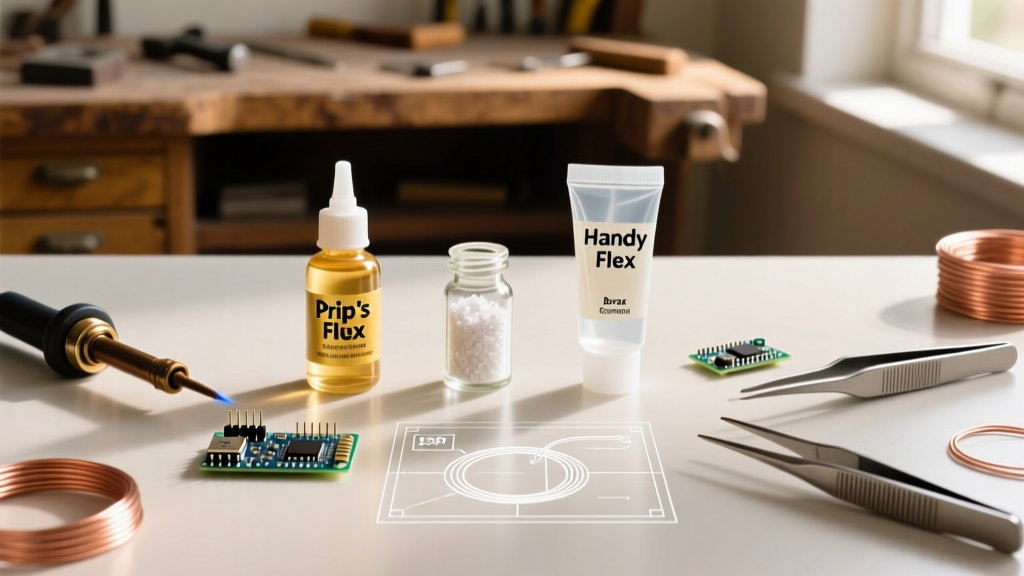
| Prip's Flux | Boric Acid / Borax Blend | 1,100°F - 1,500°F | $18 (8 oz) | Firescale Barrier |
| Borax Cone | Sodium Tetraborate | 1,100°F - 1,400°F | $12 (Cone + Dish) | General Active Cleaner |
| Handy Flux | Boric Acid / Fluorides | 1,100°F - 1,600°F | $28 (7 oz jar) | Heavy-Duty Active Cleaner |
1. Prip’s Flux: The Firescale Barrier
Prip’s is not an active cleaner; it is a protective shield. It is a liquid suspension of boric acid, borax, and water. When applied to warm metal and heated, it forms a hard, glassy boron-oxide coating that physically blocks oxygen from reaching the copper in the sterling silver. Pro Tip: Prip's must be applied to metal that is already warm (around 200°F). If applied to cold metal, it will pool, dry unevenly, and flake off when hit with the torch.
2. Borax Cone: The Traditional Workhorse
Borax (Sodium Tetraborate) has been used by metalsmiths for centuries. You purchase it as a solid ceramic-like cone and grind it in a specialized ceramic dish with a few drops of water until it reaches the consistency of heavy cream. As detailed in PubChem's chemical profile on Sodium Tetraborate, the compound melts into a glassy slag at high temperatures, effectively dissolving copper oxides and allowing the solder to wet the joint. It is incredibly cheap, highly effective, and the best starting point for beginners learning to control their torch.
3. Handy Flux: The Heavy-Duty Cleaner
Handy Flux is a commercial paste that contains boric acid combined with potassium fluoride. The addition of fluorides makes it a much more aggressive oxide cleaner than pure borax, and it remains active at higher temperatures (up to 1,600°F). It is ideal for soldering heavy gold alloys or repairing severely oxidized vintage pieces. However, it is more expensive and leaves a harder glassy residue that requires a longer soak in the pickle pot.
Step-by-Step: The Two-Flux Application Protocol
For flawless sterling silver soldering, professional jewelers use a two-flux system. Follow this exact sequence to eliminate firescale and ensure capillary action draws the solder perfectly into your seam.
- Surface Preparation: Sand the joint area with 400-grit sandpaper and clean the piece in an ultrasonic cleaner or with pumice powder. Solder will not flow through grease or fingerprint oils.
- Warm the Metal: Use a heat gun or a quick pass with a soft torch flame to warm the entire piece to roughly 200°F. You should be able to touch it briefly, but it should feel hot.
- Apply the Barrier (Prip's): Using a natural hair brush (never synthetic, as it will melt), paint a generous coat of Prip's Flux over the entire piece. The heat will flash off the water, leaving a white, chalky boron coating.
- Apply the Active Flux (Borax): Dip your brush into your ground Borax mixture. Paint the Borax strictly onto the seam or joint where the solder will flow. Do not coat the whole piece; Borax is your targeted oxide remover.
- Place Solder and Heat: Place your pallions of hard, medium, or easy solder on the joint. Apply a broad, sweeping flame to heat the entire piece evenly, then concentrate the inner blue cone of the flame directly on the seam until the solder flashes and flows.
The Quench: Pickle Pot Specifics
Once the solder flows and the metal's red glow fades to a dull black, quench the piece in water. Next, it must go into a pickle pot to dissolve the glassy flux residue and any remaining surface oxides.
Critical Safety & Chemistry Warning: The industry standard pickle is Sparex #2 (Sodium Bisulfate), mixed at a ratio of 1 cup of granules to 1 gallon of distilled water. Keep your dedicated crockpot at exactly 140°F. Never use steel tweezers to retrieve your jewelry. The acidic pickle will strip iron from the steel tweezers and deposit it onto your silver, resulting in a permanent, splotchy copper flash. Always use dedicated copper tongs.
Troubleshooting Common Bench Failures
Even with the right flux for soldering jewelry, beginners encounter specific failure modes. Here is how to diagnose them based on Jewelry Making Daily's bench tutorials and years of workshop experience:
- Solder Balls Up and Won't Flow: Your flux burned off before the metal reached flow temperature. You heated too slowly, or your Borax layer was too thin. Increase your torch gas flow and heat the surrounding metal to bring the whole piece to temperature faster.
- Flux Flakes Off and Exposes Bare Metal: You applied Prip's Flux to cold metal, or you applied it too thickly. The water must flash off instantly upon contact. If it pools, it will crack like dried mud when heated.
- Pitting on the Silver Surface: This occurs when Borax is left on the metal and allowed to cool completely before pickling, or if the pickle is too weak/cold. The borax crystallizes and etches the silver. Always quench and pickle while the piece is still warm.
- Solder Flows But Looks Grainy: You likely used 'Easy' solder (which contains more cadmium/zinc and melts at 1,325°F) but heated it to the temperature required for 'Hard' solder (1,530°F), causing the low-temp alloys to vaporize out of the solder matrix. Match your torch heat to your solder grade.
Frequently Asked Questions
Can I use welding flux for jewelry?
No. Welding fluxes (like those used for brazing copper pipes) often contain highly corrosive chlorides and fluorides designed for industrial plumbing. While they will clean silver, they will aggressively etch the metal, leave toxic residues, and are incredibly difficult to clean off in a standard jeweler's pickle pot.
How long does mixed Borax last in the dish?
Ground Borax paste will eventually dry out into a hard crust. Simply add a few drops of distilled water and let it sit for 10 minutes to rehydrate it. A single Borax cone can last a hobbyist several years, making it the most economical flux on the market.
Do I need to flux gold the same way as silver?
Gold alloys do not contain copper in high enough quantities to form firescale the way sterling silver does. Therefore, you can often skip the Prip's barrier flux when soldering 14k or 18k gold. A simple application of Borax or Handy Flux directly to the seam is usually sufficient to protect the joint and ensure flow.