
Beyond the Dictionary: The Metallurgical Soldered Definition
When procurement teams, electrical engineers, and manufacturing managers debate wire termination methods, the argument inevitably circles back to the fundamental 'soldered definition.' In casual DIY circles, soldering is often mistakenly defined as simply 'gluing' wires together with melted metal. However, from an industrial and cost-analysis perspective, this definition is dangerously incomplete. Understanding the true metallurgical nature of a soldered joint is the first step in accurately calculating its lifecycle cost compared to mechanical alternatives like crimping.
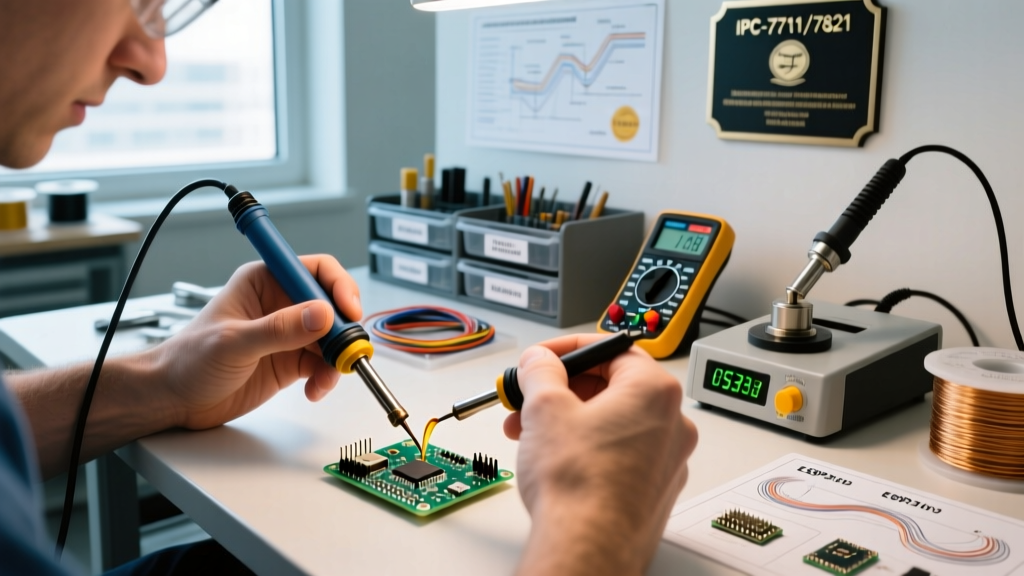
The Technical Soldered Definition: According to the guidelines established by the IPC (Association Connecting Electronics Industries), a proper soldered connection is not a mechanical wrap or an adhesive bond. It is a metallurgical weld where the molten solder alloy dissolves a microscopic layer of the base metal (usually copper) to form an Intermetallic Compound (IMC). This IMC layer, ideally between 1 to 3 microns thick, creates a continuous crystalline lattice that provides both electrical continuity and mechanical strength.
Because a soldered joint relies on chemical and thermal reactions rather than sheer mechanical force, the cost structure to achieve, verify, and maintain this bond differs vastly from crimping. In 2026, with supply chain fluctuations and stricter environmental compliance laws, analyzing the true cost of the 'soldered definition' requires looking far beyond the price of a spool of solder wire.
Capital Expenditure (CapEx): Tooling and Setup Costs
The initial investment required to achieve a reliable soldered joint is generally lower for low-volume operations but scales poorly compared to automated crimping. Let us break down the exact equipment costs required to meet IPC-A-610 Class 2 and Class 3 standards.
The Soldering Workstation
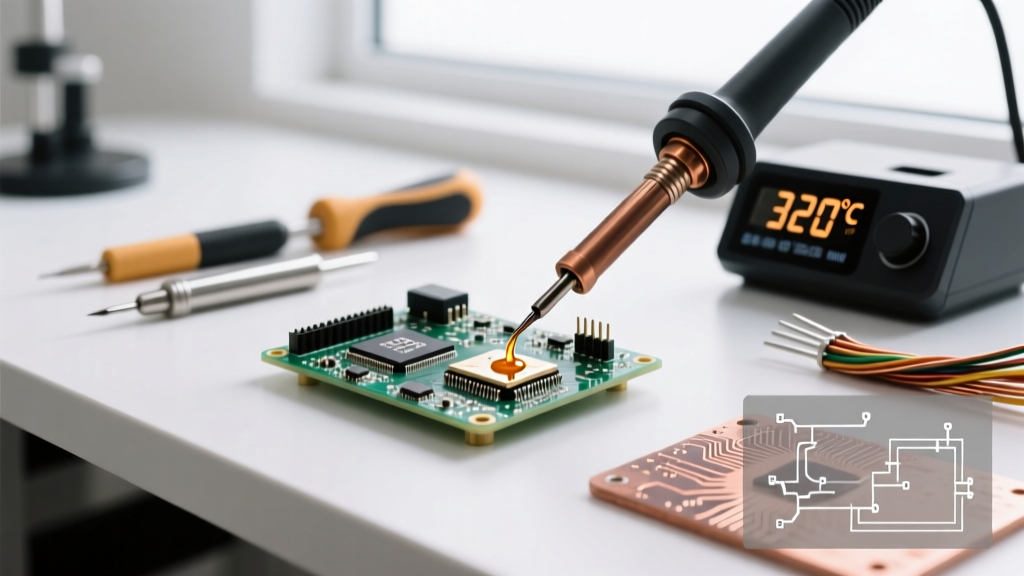
To achieve the precise thermal profiles required for the metallurgical soldered definition without causing thermal shock to components, a basic $20 hobby iron is insufficient. A professional setup requires:
- Soldering Station: Weller WE1010NA or Hakko FX-951 (Approx. $135 - $165). These provide closed-loop thermal recovery essential for consistent IMC formation.
- Fume Extraction: Compliance with workplace air quality standards mandates localized extraction. A Hakko FA-400 benchtop extractor costs around $150, while an industrial BOFA AD Oracle system for a production line exceeds $1,500.
- Pre-heaters: For heavy ground planes, a bottom pre-heater (e.g., PACE PH-100 at $450) is required to prevent cold joints, adding significant CapEx.
The Crimping Alternative
Conversely, manual crimping requires a precision ratcheting crimper like the IWISS SN-28B ($25) or an Asta AS-40 ($85). However, for high-volume manufacturing where the soldered definition becomes a bottleneck, facilities invest in pneumatic crimping presses (like the TE Connectivity AMP CERTI-CRIMP series), which can cost upwards of $3,500 per station but process thousands of terminations per hour with zero thermal variation.
Operational Expenditure (OpEx): The Per-Joint Cost Matrix
The most critical aspect of the cost analysis is the operational expenditure per joint. This encompasses raw materials, consumables, and the burdened labor rate of the technician. For this matrix, we assume a standard US/EU manufacturing burdened labor rate of $40.00 per hour ($0.011 per second).
| Cost Category | Soldered (Sn63/Pb37 Leaded) | Soldered (SAC305 Lead-Free) | Crimped (Molex KK 254) |
|---|---|---|---|
| Material Cost | $0.03 | $0.05 | $0.07 (Terminal + Housing) |
| Labor Time | 15 seconds | 18 seconds (slower wetting) | 5 seconds |
| Labor Cost (@ $40/hr) | $0.16 | $0.20 | $0.05 |
| Consumables (Flux, IPA, Tips) | $0.04 | $0.06 (aggressive fluxes) | $0.01 |
| Total Cost Per Joint | $0.23 | $0.31 | $0.13 |
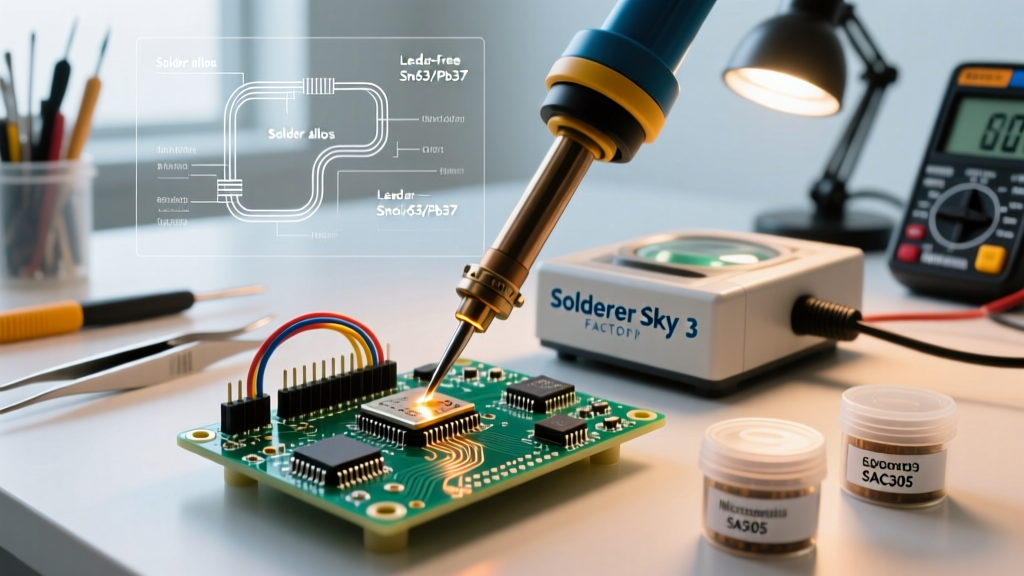
As the matrix illustrates, the literal 'soldered definition' is expensive to execute in high volumes. Lead-free SAC305 solder requires higher temperatures (217°C melting point vs 183°C for Sn63), which accelerates the oxidation of soldering iron tips. A standard Weller RT3 tip may last 3,000 joints with leaded solder but will degrade after just 1,200 joints with SAC305, driving up the consumables overhead significantly.
The Hidden Costs: Inspection, Rework, and Environmental Compliance
A true cost analysis must account for what happens after the joint is made. The metallurgical nature of soldering introduces hidden costs that mechanical crimping largely avoids.
1. Inspection and Quality Assurance
Verifying a crimped joint is relatively straightforward: a mechanical pull-test and a visual check of the crimp height. Verifying the 'soldered definition' is far more complex. Because the IMC layer is internal, visual inspection alone cannot confirm a strong metallurgical bond; it can only identify gross defects like cold joints, dewetting, or excess solder.
- Automated Optical Inspection (AOI): For PCB assemblies, 3D AOI machines (e.g., Omron VT-S730) cost upwards of $80,000, specifically programmed to analyze the meniscus and wetting angle of solder fillets.
- X-Ray Inspection: For hidden joints like BGAs or heavy ground-plane through-holes, 2D/3D X-ray systems are required to check for internal voiding, which must remain below 25% per IPC standards.
2. The Rework Penalty
When a soldered joint fails inspection, the rework process is thermally aggressive and time-consuming. Desoldering a multi-layer through-hole component requires a specialized desoldering gun (like the Hakko FR-4104 at $1,200) and extensive flux cleaning. Furthermore, every rework cycle degrades the copper pad and the barrel of the plated through-hole (PTH). According to reliability data published by the NASA Electronic Parts and Packaging (NEPP) Program, excessive thermal cycling during rework drastically increases the risk of barrel cracking and pad lifting, potentially scrapping an entire $500 circuit board over a $0.23 solder joint.
3. Environmental and Health Compliance
The thermal decomposition of rosin-based fluxes creates colophony fumes, a known respiratory sensitizer. Maintaining the 'soldered definition' in a production environment legally requires continuous fume extraction, HEPA filtration, and regular occupational health monitoring. Filter replacements for industrial extraction units cost between $85 and $150 every six months. Crimping, being a cold mechanical process, generates zero volatile organic compounds (VOCs) or particulate matter, entirely eliminating this compliance cost.
Lifecycle & Failure Cost Analysis: Vibration and Thermal Shock
Where the soldered definition reclaims its financial advantage is in specific high-stress environments. While a crimped joint relies on constant mechanical compression, it is susceptible to fretting corrosion and wire strand breakage under high-frequency vibration.
Data presented at the Surface Mount Technology Association (SMTA) international conferences frequently highlights that in aerospace and automotive applications subject to extreme thermal cycling (-40°C to +125°C), a properly formed IMC solder joint outperforms standard crimps. The solid metallic bond of solder prevents oxygen ingress, whereas the microscopic gaps in a crimped wire bundle can wick moisture, leading to galvanic corrosion over a 10-year lifecycle. If a product failure in the field results in a warranty claim or recall, the $0.18 savings per joint from crimping is instantly wiped out by a single $500 field repair.
Decision Framework: When the Soldered Definition Makes Financial Sense
Based on the 2026 cost landscape, engineers and buyers should use the following framework to choose between soldering and crimping:
- Choose Soldering When: The application involves high-frequency signal transmission (where crimp impedance variations cause signal reflection), extreme thermal cycling environments, or when terminating to rigid PCB pads where mechanical strain relief is managed by the board design.
- Choose Crimping When: You are producing high-volume wire harnesses (over 5,000 units), the wires are subject to continuous high-amplitude mechanical vibration (like heavy machinery engines), or when field-serviceability and rapid replacement are required without the need for thermal tools.
- Choose Hybrid (Solder-Crimp) When: The application demands absolute redundancy, such as in military or aviation life-support systems, despite the 3x multiplier in labor and material costs.
Conclusion
The 'soldered definition' is not merely a description of joining two metals; it is a complex metallurgical process that carries distinct capital, operational, and lifecycle costs. While the per-joint cost of soldering—especially with modern lead-free alloys and strict environmental compliance—often exceeds that of mechanical crimping, the long-term reliability in specific thermal and electrical environments justifies the premium. By moving beyond the dictionary definition and analyzing the true cost matrix, engineering teams can make financially sound, reliability-driven termination decisions.