
The Core Hazards: Why Safety Soldering Demands Method Selection
When discussing safety soldering, most DIYers and junior technicians immediately think of avoiding thermal burns. However, the most severe, long-term risks in electronics assembly are respiratory and neurological. According to the National Institute for Occupational Safety and Health (NIOSH), soldering fumes contain volatile organic compounds (VOCs) and fine particulate matter that can cause occupational asthma and chronic respiratory irritation.
Furthermore, if you are still working with legacy Sn63/Pb37 (leaded) solder, the Occupational Safety and Health Administration (OSHA) strictly regulates lead dust exposure. Even with lead-free SAC305 alloys, the flux core—specifically rosin (colophony)—is a known respiratory sensitizer. The UK's Health and Safety Executive (HSE) identifies colophony fumes as a leading cause of occupational asthma in electronics manufacturing.
To achieve true safety soldering in 2026, you must select the correct fume extraction and thermal management method. This guide compares the three primary safety soldering methods: Source-Capture (Local Exhaust Ventilation), Ambient Extraction, and Smart Thermal Management.
Method 1: Source-Capture (Local Exhaust Ventilation)
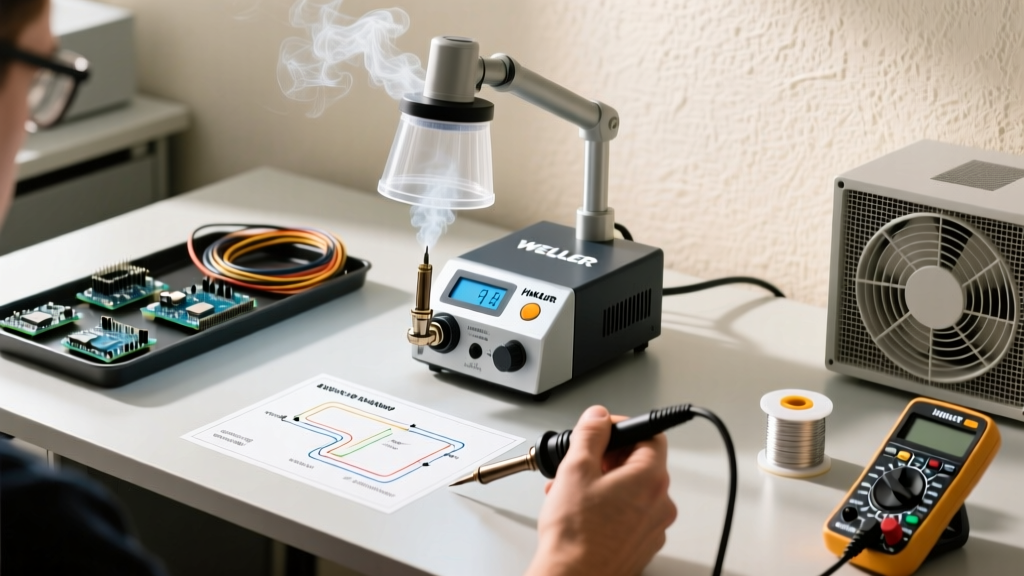
Source-capture, or Local Exhaust Ventilation (LEV), is the gold standard for safety soldering. This method captures fumes within 1 to 2 inches of the solder joint before they can enter the operator's breathing zone.
Equipment Spotlight & Pricing
- Entry-Level (Hakko FA-400 / Edsyn Fume Extractor): Priced around $65 to $90. These use small impeller fans and basic activated carbon filters. Verdict: Adequate for occasional hobbyist use (under 2 hours/week), but they lack the static pressure to capture heavy plumes from large ground planes.
- Professional Benchtop (Weller WFE-2S / Metcal MX-AIR): Priced between $800 and $1,100. These units utilize brushless DC motors generating high static pressure, pulling fumes through a multi-stage HEPA and activated carbon filter array. Replacement HEPA filters (e.g., Weller WFE-2S-HEPA) cost roughly $120 and require replacement every 6 months at 4 hours of daily use.
Failure Modes & Edge Cases
The most common failure mode in source-capture is improper nozzle placement. If the extraction nozzle is placed more than 3 inches from the soldering iron tip, the capture velocity drops below the required 0.5 meters per second (m/s), allowing flux VOCs to escape into the ambient air. Additionally, cheap 'desk fan' style extractors actually worsen safety by blowing unfiltered fumes directly across the operator's face.
Method 2: Ambient and Overhead Extraction
Ambient extraction relies on overhead hoods or downdraft workbenches to pull fumes away from the general workspace. This method is common in high-volume manufacturing cells where operators move rapidly between different assembly stations.
Equipment Spotlight & Pricing
- Industrial Overhead Systems (BOFA AD350 / Laser Fume Extraction hoods): Priced from $1,500 to $3,500+. These systems mount above the workbench and use high-volume, low-velocity airflow to capture the thermal plume as it rises.
- Downdraft Workbenches: Custom perforated tables connected to centralized HVAC filtration. Costs exceed $5,000 for commercial setups.
Failure Modes & Edge Cases
Ambient extraction is highly susceptible to cross-drafts. If your workspace has an HVAC vent, open window, or even a standing fan, the lateral airflow will push the soldering plume out of the overhead capture zone before it reaches the filter. Furthermore, ambient systems do not protect the operator during the 1-2 seconds the iron is moved from the board to the stand, exposing them to direct inhalation.
Method 3: Smart Thermal Management & Auto-Sleep
Safety soldering also encompasses fire prevention and tip oxidation. Leaving a 400°C iron unattended is a primary cause of bench fires and accelerates tip degradation, leading to poor wetting and the temptation to use excessive, unsafe flux volumes.
Equipment Spotlight
Modern smart stations like the JBC CD-2BQE ($450) and Weller WXsmart ($900) feature integrated motion sensors in the handpiece. When placed in the cradle, the tip temperature drops to 150°C within 90 seconds and enters full standby (0W) after 2 minutes. This thermal safety method reduces the ambient off-gassing of the iron's silicone grip and prevents accidental fires if the iron is knocked off the bench.
Head-to-Head Comparison Matrix
| Feature | Source-Capture (LEV) | Ambient / Overhead | Smart Thermal Sleep |
|---|---|---|---|
| Primary Target | Rosin VOCs & Lead Dust | General Workspace Air Quality | Fire Risk & Tip Oxidation |
| Capture Efficiency | 95% - 99% (at source) | 70% - 85% (draft dependent) | N/A (Thermal control only) |
| Avg. Setup Cost | $85 - $1,100 | $1,500 - $5,000+ | $450 - $900 (Iron station) |
| Maintenance | Filter changes ($100-$150/yr) | Duct cleaning & large filters | Tip & sensor replacement |
| Best Use Case | Detailed PCB rework, DIY, Labs | High-volume assembly lines | All environments (Mandatory) |
Actionable Setup Guide for 2026 Workbenches
To build a compliant, high-safety soldering environment, follow this sequential protocol:
- Audit Your Flux: Check your solder wire datasheet. If it uses ROL1 (Rosin, Low Activity, Halide 1) or REL1, the VOC output is high. You must use source-capture with an activated carbon stage. 'No-clean' (ROL0) fluxes still emit VOCs and require filtration.
- Position the LEV Nozzle: Mount your Weller or Hakko extraction arm so the nozzle sits exactly 1.5 inches above and slightly behind the solder joint. This utilizes the natural thermal rise of the plume.
- Verify Airflow: Use a handheld anemometer to test the nozzle face. You need a minimum face velocity of 0.5 m/s. If it is lower, replace clogged pre-filters immediately.
- Enable Smart Sleep: If using a JBC or Weller smart station, access the menu and set the 'Standby Time' to 2 minutes and 'Standby Temp' to 150°C. Do not leave it at 250°C, as flux will continue to carbonize and off-gas.
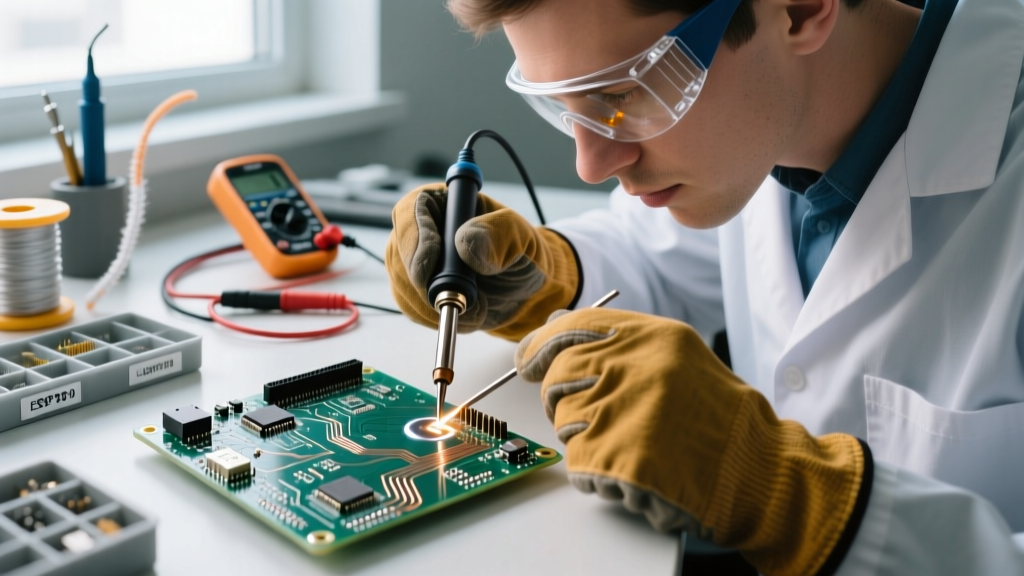
- Implement PPE Redundancy: For heavy desoldering (using solder wick or pumps), wear a 3M 6200 half-mask respirator equipped with 6006 (Multi-Gas/Vapor) cartridges, as localized extractors can be overwhelmed by sudden, massive plumes.
Frequently Asked Questions
Do I need fume extraction if I only use lead-free solder?
Yes. The primary respiratory hazard in modern electronics is not lead vapor (which only vaporizes at temperatures exceeding 1,700°C, far above your iron's 350°C tip). The hazard is the flux core. Rosin and synthetic resins decompose under heat into aliphatic aldehydes and other irritants that cause occupational asthma, regardless of the alloy's lead content.
Can I just use a standard PC cooling fan to blow fumes away?
No. This is a dangerous anti-pattern. A standard fan does not filter the air; it merely dilutes and redirects it. By blowing the plume away from the board, you are actively pushing concentrated colophony fumes into the general room air, where they will eventually be inhaled by you or others in the building. True safety soldering requires capture and filtration, not displacement.
How often should I replace the carbon filter in my benchtop extractor?
Activated carbon filters do not have a visual indicator for saturation. For a professional working 4 hours a day, 5 days a week, the carbon bed will saturate in approximately 4 to 6 months. A reliable sensory test: if you can smell the sweet, pine-like scent of rosin flux while the machine is running at full speed, the carbon bed is exhausted and must be replaced immediately.