
The Metallurgical vs. Mechanical Divide in Copper Joining
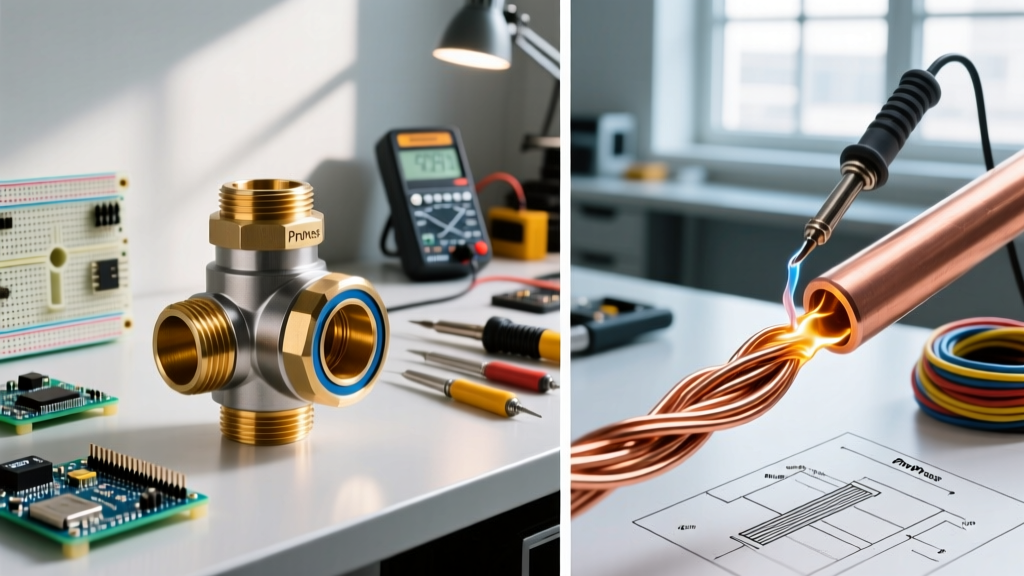
While ElectricalFlux primarily focuses on microelectronics, wiring, and PCB soldering, our advanced DIYers and multi-trade professionals frequently cross into HVAC, solar thermal loops, geothermal systems, and heavy-duty grounding infrastructure. In these domains, joining copper tubing is a mandatory skill. The modern tradesman is constantly weighing ProPress vs soldering—a debate that pits a century-old metallurgical art against 21st-century mechanical elastomeric engineering.
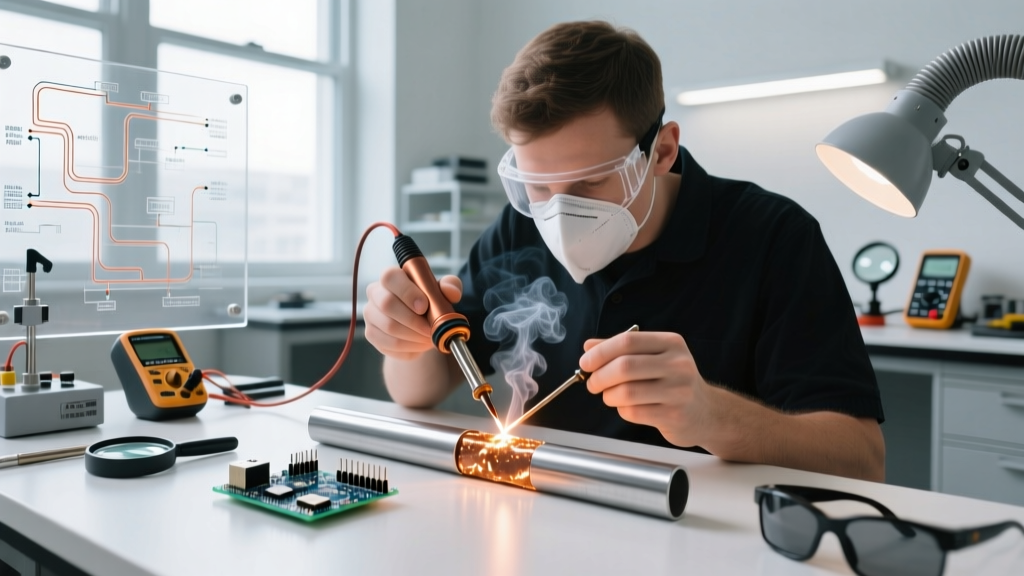
Traditional soldering (often called "sweating") relies on capillary action and a metallurgical alloy bond to fuse copper. ProPress, pioneered by Viega, utilizes a mechanical deformation process combined with an internal elastomeric O-ring to create a watertight seal. Understanding the physics, economics, and failure modes of both methods is critical for anyone designing or repairing fluid or thermal transfer systems in 2026.
The Physics of the Joint: Capillary Action vs. Radial Compression
To make an informed decision, you must understand what is happening at the microscopic level inside the fitting.
Soldering: The Metallurgical Bond
When you heat a properly fluxed copper joint to approximately 450°F (232°C) and introduce lead-free solder (typically a 95/5 tin-antimony or silver-bearing alloy), the flux strips away copper oxide. The molten solder is drawn into the microscopic gap between the pipe and the fitting via capillary action. The tin forms a thin intermetallic layer with the copper, creating a permanent, homogenous metallurgical bond. Once cooled, the joint is essentially a single continuous piece of metal.
ProPress: The Mechanical and Elastomeric Seal
ProPress fittings contain a pre-lubricated O-ring seated in a proprietary groove. When the pressing tool (such as a RIDGID RP-342 or Milwaukee M18 FORCE LOGIC) clamps down, it forces the stainless-steel press jaws to deform the copper fitting radially inward. This compression bites the fitting's stainless-steel grab ring into the pipe's exterior while simultaneously compressing the O-ring against the copper to form a watertight seal. There is no metallurgical bonding; the integrity of the joint relies entirely on the mechanical grip and the chemical stability of the rubber O-ring.
Tooling, Consumables, and the ROI Matrix
The economic argument between ProPress and soldering is heavily skewed by your volume of work. The upfront capital required for press technology is massive compared to the negligible cost of a torch kit.
| Category | Traditional Soldering (Sweat) | ProPress Mechanical System |
|---|---|---|
| Primary Tooling Cost | $75 - $150 (TS8000 Torch, strikers, heat shields) | $3,600 - $4,200 (Milwaukee M18 or RIDGID RP-342 kit) |
| Jaw/Head Wear Parts | N/A | $150 - $300 per jaw set (replace every ~10,000 presses) |
| Consumables per 1/2" Coupling | ~$0.65 (Wrought copper fitting) + $0.10 (flux/solder) | ~$3.85 (Viega ProPress fitting with integrated O-ring) |
| Time per Joint (1/2" to 1") | 3 to 5 minutes (clean, flux, heat, cool, wipe) | 15 to 30 seconds (deburr, mark, insert, press) |
| Fire Risk / Hot Work Permits | High (requires fire watch, heat shields, extinguishers) | Zero (cold work, no permits required) |
The Break-Even Reality: If you are a DIYer installing a single solar water heater loop, the $3,800 tooling cost makes ProPress financially illogical. However, for commercial contractors billing $100+ per hour, saving 4 minutes per joint across 500 joints pays for the tooling in a single week, while simultaneously eliminating the need for hot-work permits and fire-watch labor.
O-Ring Chemistry and Thermal Limits
The most critical vulnerability of the ProPress system is the O-ring. Because the seal relies on an elastomer, the joint is only as robust as the rubber's chemical and thermal tolerance. Viega utilizes two primary O-ring materials depending on the application:
- EPDM (Ethylene Propylene Diene Monomer): The standard black O-ring found in most residential ProPress fittings. It is highly resistant to water and steam but has a maximum continuous operating temperature of 230°F (110°C). It will rapidly degrade if exposed to petroleum-based oils or aggressive solvents.
- FKM (Fluoroelastomer / Viton): The green O-ring used in ProPress Gas or high-temperature applications. It can withstand continuous temperatures up to 284°F (140°C) and offers superior resistance to hydrocarbons and chemical corrosion.
By contrast, a properly sweated 95/5 lead-free solder joint has a melting point exceeding 450°F (232°C) and contains no organic materials to degrade. For high-temperature boiler returns or solar thermal collector loops where stagnation temperatures can exceed 300°F, traditional soldering (or brazing) remains the undisputed, code-compliant king.
Preparation Tolerances and Failure Modes
Both methods demand meticulous preparation, but the nature of their failure modes differs drastically.
Soldering Failure Modes
- Cold Joints: Caused by insufficient heat. The solder melts against the torch flame rather than the copper, resulting in a dull, grainy appearance and a weak physical bond that will leak under thermal expansion.
- Flux Inclusion: Using excessive acid flux can trap bubbles inside the capillary space, creating microscopic voids that eventually lead to pinhole leaks.
- Capillary Starvation: Failing to feed enough solder into the joint. A standard rule of thumb is that the length of solder wire fed should equal the circumference of the pipe.
ProPress Failure Modes
- O-Ring Pinching/Rolling: If the pipe is not deburred perfectly on the outside edge, or if the installer fails to use a depth-marking tool, the sharp edge of the copper tube can slice or roll the O-ring out of its groove during insertion. This results in an immediate, catastrophic leak upon pressurization.
- Incomplete Press Cycles: Modern tools like the RIDGID RP-342 feature automatic cycle completion, but if a battery dies mid-press or the jaws are misaligned, the stainless-steel grab ring will not fully bite into the copper, leading to a blowout under high pressure.
- UV and Ozone Degradation: If a ProPress fitting is left exposed to direct sunlight or high-ozone environments (like near certain electrical motors or UV sterilization lamps) before being pressed, the EPDM rubber can dry-rot and crack.
Inspector's Note on Smart Connect: Viega's proprietary "Smart Connect" feature is a massive advantage for press systems. Unpressed fittings are designed with a microscopic bypass channel. During the initial hydrostatic pressure test, any fitting the installer forgot to press will intentionally leak. Once the jaw compresses the fitting, the channel is permanently sealed. This eliminates the nightmare scenario of sealing drywall over an unpressed mechanical joint.
Code Compliance and System Longevity
Both methods are widely approved by the International Association of Plumbing and Mechanical Officials (IAPMO) and comply with the Uniform Plumbing Code (UPC) and International Plumbing Code (IPC) for potable water and hydronic heating. However, local amendments vary wildly. Some municipalities prohibit mechanical press fittings behind closed walls or under concrete slabs, mandating soldered or brazed joints for concealed spaces due to the theoretical 50-year degradation curve of elastomeric O-rings compared to the indefinite lifespan of a metallurgical copper bond.
According to the Viega technical documentation, ProPress fittings carry a 50-year limited warranty, but this assumes installation within strict environmental parameters. Soldered joints, when executed correctly without corrosive flux residues, routinely outlast the 70-year lifespan of the copper tubing itself.
The Final Verdict: Which Method Should You Choose?
The decision between ProPress and soldering is not about which is universally "better," but which is optimized for your specific operational constraints.
- Choose ProPress when: You are working in commercial retrofits, occupied homes where open flames are a liability, tight joist bays where a torch cannot fit, or when labor speed vastly outweighs the cost of consumable fittings.
- Choose Soldering when: You are a DIYer on a budget, working on high-temperature solar/boiler loops exceeding 230°F, burying lines under concrete slabs, or executing repairs on existing pipes where water cannot be 100% purged (ProPress O-rings will fail to seal if water is actively weeping through the joint during the press, whereas a torch can boil off minor residual moisture).
Mastering both the metallurgical art of the torch and the mechanical precision of the press tool ensures you are equipped to handle any copper joining challenge the field presents.