
The Hidden Hazards of the Soldering Bench
When enthusiasts and professionals alike approach the workbench, the focus is often heavily skewed toward joint aesthetics, wetting angles, and electrical continuity. However, applying the correct soldering technique is fundamentally a safety exercise. Poor methodology does not just yield cold joints or bridged pads; it actively exposes the operator to vaporized colophony (rosin), lead particulates, severe thermal burns, and electrostatic discharge (ESD) events. According to NIOSH guidelines on occupational lead exposure, even trace ingestion of lead dust from improper handling, sanding, or eating near soldered joints poses severe neurological and systemic risks over time. Furthermore, the vaporization of flux chemicals creates invisible respiratory hazards that can lead to chronic conditions if left unmanaged. This comprehensive guide dissects the safety-critical elements of correct soldering technique, moving beyond basic hobbyist tutorials into the industrial-grade protocols required for a truly safe, compliant workspace in 2026.
Respiratory Defense: Fume Extraction and Flux Chemistry
The most pervasive danger in soldering is not the heat, but the smoke. When rosin-based flux is heated to typical soldering temperatures (320°C to 380°C), it undergoes thermal decomposition, releasing a complex aerosol of aliphatic aldehydes and abietic acid. Abietic acid is a known respiratory sensitizer; repeated inhalation can trigger occupational asthma, a condition that is often irreversible even after exposure ceases. A correct soldering technique dictates that fumes must never be allowed to drift into the operator's breathing zone, nor should they be casually waved away with a hand or desk fan, which merely disperses the particulates across the room.
Choosing the Right Extraction System
Investing in proper local exhaust ventilation (LEV) is non-negotiable for professional environments and highly recommended for dedicated hobbyists. The market offers vastly different tiers of protection:
- Entry-Level Carbon Filters (e.g., Hakko FA-400, $55 - $65): These units use a small fan to pull fumes through a basic activated carbon filter. While they reduce the immediate odor and capture larger particulates, they are largely ineffective at trapping sub-micron rosin aerosols and do not neutralize all volatile organic compounds (VOCs). They are acceptable only for very occasional, low-volume lead-free soldering in highly ventilated rooms.
- Industrial HEPA/Carbon Systems (e.g., BOFA ADQ 200, $1,100 - $1,300): These multi-stage systems utilize a pre-filter, a massive deep-bed activated carbon core for chemical adsorption, and a HEPA filter capable of capturing 99.997% of particles down to 0.1 microns. This is the standard for production environments and ensures complete neutralization of colophony fumes.
Technique Tip: Position the extraction nozzle exactly 2 to 3 inches from the solder joint, slightly behind and above the work area, so the thermal updraft of the iron naturally carries the fumes into the intake. Never place your head between the joint and the extractor.
| Flux Type | Primary Chemical Hazard | Fume Volume | Required Extraction Level |
|---|---|---|---|
| Rosin (R / RMA) | Abietic Acid, Colophony | Moderate | HEPA + Carbon LEV |
| Rosin Activated (RA) | Abietic Acid, Halides | High | HEPA + Carbon LEV (Mandatory) |
| Water-Soluble (Organic) | Glycols, Organic Acids | Low to Moderate | Carbon LEV / Room Ventilation |
| No-Clean (Synthetic) | Synthetic Resins, Alcohols | Low | Standard Carbon LEV |
Thermal Profiling: Preventing Burns and Tip Degradation
A common misconception among beginners is that turning the soldering station to its maximum temperature (often 400°C to 450°C) will speed up the soldering process. In reality, this violates the core principles of correct soldering technique and introduces severe safety and equipment hazards. Excessive heat causes rapid oxidation of the solder, creating a thermal barrier that requires the operator to apply excessive physical pressure to the joint. This pressure increases the risk of the iron slipping, resulting in severe contact burns or damage to adjacent components.
Optimal Temperature Profiling by Alloy
Precise thermal management relies on understanding the metallurgy of your solder alloy. The iron should be set approximately 100°C to 150°C above the liquidus temperature of the solder to allow for rapid heat transfer without thermal shock.
- Leaded Eutectic (63/37 Sn/Pb): Melts at 183°C. The station should be set between 320°C and 350°C. This provides a liquid state window that promotes excellent capillary action and wetting without burning the flux core prematurely.
- Lead-Free (SAC305 - Sn96.5/Ag3.0/Cu0.5): Melts at 217°C - 220°C. The station should be set between 350°C and 380°C. Lead-free alloys require more thermal energy to flow properly, but exceeding 380°C accelerates tip degradation.
The Danger of Thermal Shock in Tip Maintenance
How you clean your tip is just as critical as the temperature you set. Traditional wet cellulose sponges cause rapid thermal shock to the iron plating. Dropping a 350°C tip onto a room-temperature wet sponge creates micro-fractures in the iron plating. Over time, the molten solder dissolves the underlying copper core through these fractures, leading to catastrophic tip failure, uneven heat distribution, and an increased risk of the operator touching the exposed, superheated copper core. Always use dry brass wire wool (e.g., Hakko 599B, $15 - $20) for tip cleaning. It removes oxidation without dropping the tip temperature, preserving the plating and maintaining safe, predictable thermal transfer.
Ergonomics, ESD, and Electrical Isolation Protocols
Correct soldering technique extends to how the operator physically interacts with the tools and the environment. Repetitive strain injuries (RSI) and electrostatic discharge (ESD) damage are two sides of the same operational hazard coin.
The Pencil Grip and Joint Stabilization
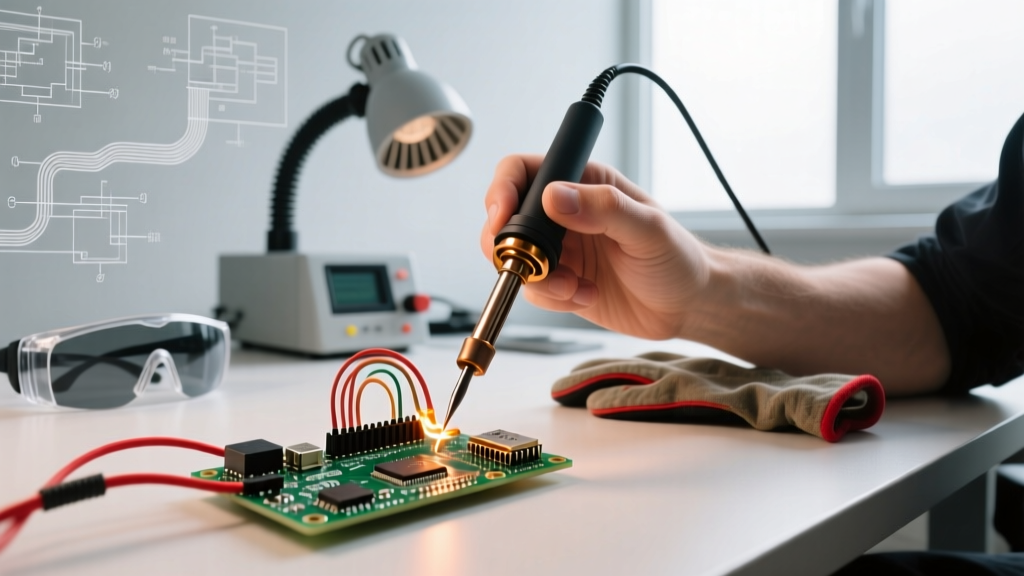
The soldering iron should be held using a relaxed 'pencil grip' approximately 1.5 inches from the handle. This provides maximum articulation for the wrist and prevents the carpal tunnel compression associated with the 'palmar grip'. The solder wire should be fed with the non-dominant hand using a hemostat or a specialized solder feeder tool to keep fingers safely away from the thermal envelope of the joint. Never wrap solder wire around your fingers, as a slip can result in the wire acting as a thermal bridge, burning the skin.
ESD Grounding and Matting
When working on sensitive microcontrollers, RF modules, or bare MOSFETs, an ESD event can rupture the gate oxide, causing latent failures that manifest weeks later. A correct soldering technique requires a fully grounded workspace. Utilize an ESD-safe dissipative mat (such as the Desco 19331 two-layer rubber mat, $45 - $60) connected to a verified earth ground. The operator must wear a conductive wrist strap (1 megohm resistor inline for personal shock protection) connected to the same common point ground. According to the NASA Soldering Workmanship Standards, verifying the continuity of your grounding path with a multimeter before every shift is a mandatory pre-flight check for high-reliability assemblies.
Step-by-Step Pre-Flight Safety Checklist
Before the iron is powered on, professionals run through a strict safety protocol to mitigate the risks outlined by OSHA's heavy metal and chemical hazard standards.
- Inspection: Check the iron's power cord for fraying or exposed copper. Ensure the grounding pin on the plug is intact.
- Tip Verification: Inspect the tip for pitting, black oxidation, or hollowed-out craters. Replace compromised tips immediately to prevent thermal runaway.
- Extraction Check: Power on the fume extractor and verify airflow using a visual indicator or anemometer. Ensure filters are not past their 6-to-12-month saturation lifespan.
- Workspace Clearance: Remove all flammable solvents (isopropyl alcohol, flux removers) from the immediate 3-foot radius of the soldering station. These vapors are highly combustible when exposed to a 350°C heating element.
- PPE Donning: Put on ANSI Z87.1 rated safety glasses to protect against microscopic solder splatter, which can occur when flux boils violently inside a poorly wetted joint.
Personal Protective Equipment (PPE) Matrix
Selecting the right PPE is the final layer of defense when executing a correct soldering technique. Below is a breakdown of required gear based on the specific soldering environment.
| PPE Item | Primary Purpose | Specification / Standard | When to Use |
|---|---|---|---|
| Safety Glasses | Prevent corneal burns from flux splatter | ANSI Z87.1+ (Impact rated) | Always mandatory |
| Nitrile Gloves | Prevent hand-to-mouth lead transfer | 4-mil thickness, powder-free | When handling leaded solder or bare PCBs |
| Respirator | Backup for inadequate LEV systems | N95 / P100 with Organic Vapor cartridges | Only if local extraction fails or is unavailable |
| ESD Wrist Strap | Protect sensitive ICs from static discharge | 1 Megohm inline resistor, adjustable | When assembling bare logic boards or RF tech |
Conclusion: Safety as the Foundation of Quality
Ultimately, there is no separation between a safe soldering practice and a high-quality solder joint. The correct soldering technique demands precise thermal control, rigorous fume management, and strict adherence to ergonomic and ESD protocols. By investing in proper HEPA extraction, utilizing temperature-appropriate profiles for your specific alloy, and maintaining your equipment with brass wool rather than wet sponges, you protect both your long-term health and the integrity of your electronic assemblies. Treat your workbench with the respect demanded by industrial chemistry and thermodynamics, and the quality of your work will naturally follow.