
The Evolution of Copper Pipe Joining
For over a century, sweating (soldering) copper pipe with a propane or MAPP gas torch has been the undisputed gold standard in residential and commercial plumbing. However, open flames pose severe fire hazards near wood framing and insulation, and the process demands completely dry pipes—a major hurdle during emergency repairs. Today, professionals and advanced DIYers increasingly seek ways to connect copper pipe without soldering. The two dominant technologies that have emerged to fill this gap are press-fit systems (like Viega ProPress) and push-to-connect fittings (like SharkBite).
This decision framework breaks down the engineering, economics, and code compliance of both methods, helping you choose the exact right approach for your specific plumbing scenario.
Method 1: Press-Fit Technology (ProPress)
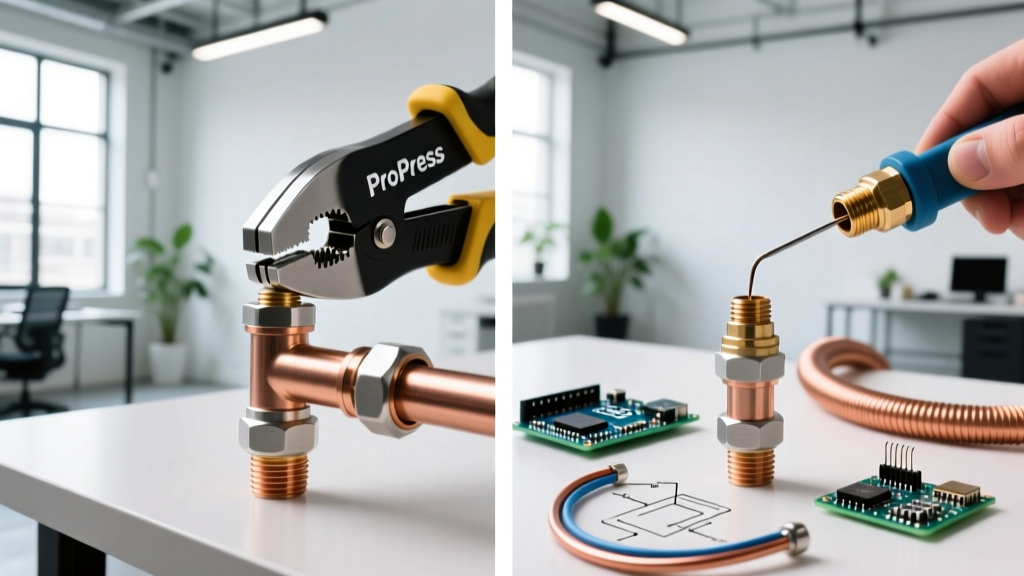
Press-fit technology utilizes a specialized motorized crimping tool to deform a stainless steel grab ring around the copper pipe, compressing an internal O-ring to create a watertight seal. Viega pioneered this with their ProPress line, which remains the industry benchmark.
The Engineering Behind the Seal
A standard Viega ProPress copper fitting contains a black EPDM (Ethylene Propylene Diene Monomer) O-ring pre-lubricated with a non-toxic, water-soluble silicone grease. When the press jaw cycles (typically taking 3 to 5 seconds), it forces the fitting's stainless steel grab ring to bite into the copper tube, permanently locking it in place while simultaneously compressing the EPDM O-ring against the pipe's outer diameter.
- Max Operating Temperature: 230°F (110°C) for standard black EPDM.
- High-Temp Variant: Yellow FKM (Viton) O-rings are available for solar and high-heat applications, rated up to 284°F (140°C).
- Max Pressure Rating: 200 PSI across all standard residential sizes (1/2 in. to 2 in.).
Tooling and Economic Reality
The barrier to entry for ProPress is the tooling. A professional-grade Milwaukee M18 FORCE LOGIC 1/2 in. to 1 in. Press Tool (Model 2473-22) retails between $1,600 and $1,900. However, the individual fittings are relatively inexpensive. A 1/2 in. Viega ProPress copper coupling costs roughly $2.50 to $3.00. For full-home repipes, the low per-fitting cost and rapid installation speed (up to 60% faster than soldering) easily justify the tool investment or a daily rental fee (typically $75 to $100 per day from local equipment yards).
Method 2: Push-to-Connect Fittings (SharkBite)
Push-to-connect fittings require zero specialized crimping tools. You simply cut the pipe, deburr it, mark the insertion depth, and push the fitting onto the tube until it clicks. SharkBite dominates this space, utilizing a patented release collar, a stainless steel grab ring, and an O-ring seal.
The Engineering Behind the Seal
SharkBite fittings use a similar EPDM O-ring but rely on the physical insertion force and the grab ring's teeth to maintain the seal. Because there is no mechanical deformation of the fitting body itself, the joint is technically releasable using a specialized disconnect clip or tongs.
- Max Operating Temperature: 200°F (93°C).
- Max Pressure Rating: 200 PSI.
- Material Compatibility: Hard-drawn copper (Type K, L, M), CPVC, and PEX (requires a PEX stiffener insert, not needed for copper).
Tooling and Economic Reality
The tooling cost is practically zero, making it the ultimate emergency repair solution. You only need a high-quality tube cutter (like the Ridgid 151 Close-Quarters Cutter, ~$45) and a deburring tool. However, the fittings carry a massive premium. A standard 1/2 in. SharkBite brass coupling (Model U008LF) costs between $6.50 and $8.00—more than double the price of a ProPress fitting and five times the price of a traditional solder coupling.
Head-to-Head Comparison Matrix
| Feature | ProPress (Crimped) | Push-to-Connect (SharkBite) | Traditional Solder (Sweat) |
|---|---|---|---|
| Tool Investment | $1,600+ (or ~$85/day rental) | $12 (Deburr/Depth Gauge) | $150 (Torch, gas, solder, flux) |
| Per-Fitting Cost (1/2 in.) | $2.50 - $3.00 | $6.50 - $8.00 | $0.60 - $0.90 |
| Wet Pipe Capability | Excellent (Water doesn't affect crimp) | Excellent (Water doesn't affect seal) | Poor (Requires completely dry pipe) |
| Installation Speed | ~5 seconds per joint | ~3 seconds per joint | ~3 to 5 minutes per joint |
| Concealed Space Code | Generally permitted (check local IPC) | Often restricted without access panels | Universally permitted |
The Decision Framework: Choosing Your Method
To determine how best to connect copper pipe without soldering, run your project through this three-step decision matrix:
Scenario A: The Full-Home Repipe or New Construction
Winner: ProPress. If you are replacing polybutylene or galvanized steel in a 4-bedroom home, you will be making hundreds of joints. At $7.00 per SharkBite fitting versus $2.50 for ProPress, the fitting cost savings alone will pay for a ProPress tool rental. Furthermore, the visual press indicator (a small plastic ring that snaps off when fully crimped) provides immediate quality assurance for the installer and the building inspector.
Scenario B: The Emergency Leak Repair or Tight Space
Winner: Push-to-Connect. If a pipe bursts behind a dishwasher at 11 PM, you do not have time to rent a ProPress tool, nor can you easily dry the pipe to solder it. SharkBite fittings can be pushed directly onto a dripping, wet copper pipe in seconds. They are also ideal for tight joist bays where swinging a press tool or maneuvering a torch is physically impossible.
Scenario C: High-Heat Applications (Solar Loops or Boiler Lines)
Winner: ProPress (with FKM O-rings) or Solder. Standard push-to-connect EPDM O-rings begin to degrade and fail near 200°F. If you are connecting copper lines for a closed-loop hydronic heating system or solar thermal array, you must use ProPress fittings equipped with the yellow FKM (Viton) O-rings, or revert to traditional silver-bearing solder (which melts at ~430°F).
Critical Failure Modes and Edge Cases
Both alternative methods are highly reliable when installed correctly, but they have distinct failure modes that DIYers must avoid. According to the Copper Development Association (CDA), improper tube preparation is the leading cause of leak-free joint failures in mechanical connections.
ProPress Failure Modes
- Deep Scratches: If the copper pipe has deep longitudinal scratches from being dragged across concrete, the EPDM O-ring cannot bridge the gap, resulting in a micro-leak. Always inspect the tube end.
- Out-of-Round Cuts: Using a dull hacksaw instead of a proper rotary tube cutter leaves the pipe ovalized. The press jaw will not compress evenly, leading to a blown O-ring under pressure.
Push-to-Connect Failure Modes
- Skipping the Deburr Step: This is the #1 cause of SharkBite failures. A standard tube cutter leaves a sharp inner and outer burr. If you push the fitting on without deburring, the sharp outer edge acts like a knife, slicing the internal O-ring during insertion. The joint will hold water initially but will fail under thermal expansion cycles.
- Ignoring Insertion Depth: Thermal expansion and contraction can cause copper to 'walk' out of a push fitting if it wasn't seated fully. Always use the SharkBite Depth Gauge to mark the pipe with a Sharpie before insertion.
Code Compliance for Concealed Spaces
Before closing up drywall, you must consult your local plumbing codes. The International Plumbing Code (IPC) Chapter 6 provides the baseline for water supply distribution. While ProPress is widely accepted by the IPC and UPC for concealed spaces (behind walls and under floors) because the joint is permanently deformed and mechanically locked, push-to-connect fittings face heavy scrutiny.
Many local jurisdictions mandate that push-to-connect fittings installed in concealed spaces must have a removable access panel. If your local inspector enforces this rule, you cannot use SharkBite behind a sealed drywall ceiling or tiled shower wall. Always check with your local Authority Having Jurisdiction (AHJ) before roughing in push-fit connections in concealed cavities.
Frequently Asked Questions
Can I bury ProPress or SharkBite fittings underground?
Yes, but with strict conditions. Both Viega and SharkBite allow direct burial, but the fittings must be wrapped in an impermeable, non-corrosive material (like silicone tape or a specialized burial wrap) to protect the metal and O-rings from soil chemicals and moisture degradation over decades.
Do I need to clean the copper pipe for press or push fittings?
Unlike soldering, which requires bright, shiny copper achieved with emery cloth and flux, mechanical fittings only require the pipe to be clean of dirt, grease, and heavy oxidation. A quick wipe with a Scotch-Brite pad to remove surface grime is sufficient. Do not use petroleum-based solvents, as they will destroy the EPDM O-rings.
Which method handles water hammer better?
Traditional soldered joints are rigid and handle hydraulic shock (water hammer) exceptionally well. ProPress is also highly resistant due to the mechanical bite of the grab ring. Push-to-connect fittings have a slight amount of lateral flex, which can actually help absorb minor shockwaves, but severe, un-arrested water hammer can eventually fatigue the grab ring teeth over many years. Install water hammer arrestors on quick-closing valves regardless of the joining method.