
Beyond Blinking LEDs: The 2026 Standard for Practical Builds
When most beginners search for awesome Arduino projects, they are met with endless tutorials on blinking LEDs, basic line-following robots, or simple weather stations that log data to an SD card but offer no actionable utility. While these are excellent for learning syntax, the true power of microcontrollers lies in solving tangible, real-world problems. In 2026, with the stabilization of semiconductor supply chains and the widespread adoption of the Arduino Uno R4 Minima (featuring a 48MHz Renesas RA4M1 ARM Cortex-M4 and a 14-bit ADC), hobbyists and engineers alike have unprecedented processing power at their fingertips.
According to EPA WaterSense, the average household leaks can waste nearly 10,000 gallons of water annually. Microcontroller-based automation can mitigate these losses, optimize energy consumption, and provide critical telemetry for off-grid systems. Below, we detail five highly practical, problem-solving Arduino builds, complete with specific component models, wiring logic, and real-world cost estimates.
5 Awesome Arduino Projects for Practical Problem Solving
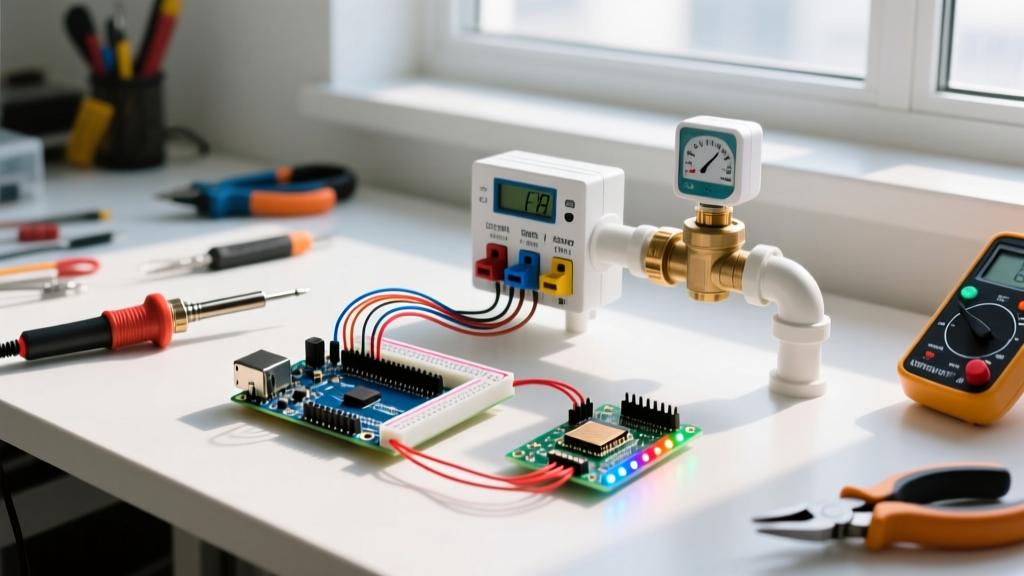
1. Automated Basement Sump Pump Monitor & Alert System
The Problem: A failed sump pump during a heavy storm results in catastrophic basement flooding, often costing tens of thousands of dollars in water damage.
The Solution: A non-contact water level monitoring system that tracks pump cycle frequency and triggers a Wi-Fi alert if the water level rises without the pump activating (indicating a mechanical or electrical failure).
- Core MCU: Arduino Nano ESP32 ($18.00)
- Sensor: XKC-Y25-T12V Non-Contact Liquid Level Sensor ($12.50)
- Telemetry: Native ESP32 Wi-Fi via MQTT to Home Assistant
Engineering Specifics: The XKC-Y25-T12V utilizes capacitive sensing through the plastic wall of your sump pit. Unlike float switches, it has no moving parts to jam with debris. Wire the sensor's signal line to a digital input pin with a 10kΩ pull-down resistor. In your code, implement a debounce timer of 500ms to prevent false triggers from water splashing. If the sensor reads HIGH for more than 120 seconds without the current draw (measured via an inline ACS712 hall-effect sensor) spiking, the ESP32 pushes an MQTT payload to your phone.
2. Smart Greenhouse Irrigation with Capacitive Feedback
The Problem: Standard resistive soil moisture sensors corrode within weeks due to electrolysis, leading to overwatering and dead crops.
The Solution: A closed-loop irrigation system utilizing capacitive soil moisture sensing and a 12V solenoid valve.
- Core MCU: Arduino Uno R4 Minima ($27.50)
- Sensor: Capacitive Soil Moisture Sensor v1.2 (Corrosion-resistant coating) ($4.00 each x 4)
- Actuator: 12V 1/2-inch N/C Solenoid Valve via 5V Optocoupler Relay Module ($14.00)
Engineering Specifics: Capacitive sensors measure the dielectric permittivity of the soil. Because the R4 Minima features a 14-bit ADC, you get vastly superior resolution compared to the older 10-bit ATmega328P. Calibrate your sensor by taking analog readings in dry air (approx. 550) and submerged in water (approx. 280). Map these values to a 0-100% moisture scale. Pro-Tip: Only power the sensors via a digital GPIO pin (set HIGH before reading, LOW after) to eliminate any residual electrolytic degradation and extend sensor life to over 5 years.
3. Non-Invasive Power Meter for HVAC Monitoring
The Problem: Identifying which appliances are driving up your monthly electricity bill without installing expensive, certified smart breakers.
The Solution: A split-core current transformer (CT) clamped around the main HVAC line to log real-time wattage and estimate monthly costs.
- Core MCU: Arduino Nano 33 IoT ($22.00)
- Sensor: SCT-013-000 100A Split-Core CT ($11.00)
- Conditioning: 33Ω Burden Resistor, 10µF Capacitor, dual 470kΩ voltage divider ($2.00)
Engineering Specifics: As detailed by OpenEnergyMonitor, the SCT-013-000 outputs an AC current proportional to the primary current. You must convert this to a voltage readable by the MCU using a burden resistor. For a 5V system, a 33Ω resistor is ideal. Because the Arduino ADC cannot read negative voltages, you must bias the signal to Vcc/2 (2.5V) using the voltage divider. Use the EmonLib library to calculate Real Power and Apparent Power, accounting for the phase shift introduced by the CT core.
4. Ultrasonic Water Tank Level Gauge with LoRa Telemetry
The Problem: Off-grid cabins and rural farms rely on large cisterns, but checking the water level requires physically climbing the tank.
The Solution: A waterproof ultrasonic sensor mounted at the top of the tank, transmitting data via LoRa to a base station inside the house.
- Core MCU: Arduino Pro Mini 3.3V (Low Power) ($8.00)
- Sensor: JSN-SR04T Waterproof Ultrasonic Module ($16.00)
- Radio: SX1278 LoRa 433MHz Module ($9.50)
Engineering Specifics: Standard HC-SR04 sensors fail in high humidity. The JSN-SR04T features a sealed, waterproof transducer. However, it has a blind spot of roughly 20cm. Mount the sensor at least 25cm above the maximum fill line. To achieve multi-year battery life on a 18650 Li-Ion cell, put the Arduino Pro Mini into deep sleep (using the LowPower library) and wake it via a hardware watchdog timer every 4 hours to take a reading, transmit the payload via LoRa, and return to sleep.
5. Automatic Pet Feeder with RFID Portion Control
The Problem: Multi-pet households struggle with one dominant pet eating the other's specialized (and expensive) prescription diet.
The Solution: A motorized hopper that only dispenses food and opens the bowl cover when the correct pet's RFID collar tag is detected.
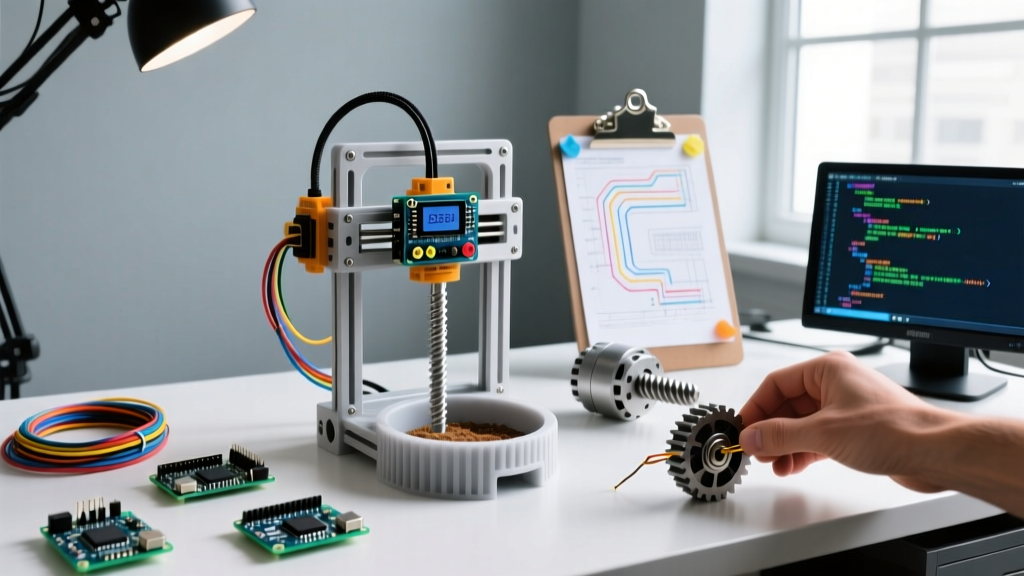
- Core MCU: Arduino Mega 2560 ($38.00)
- Actuator: NEMA 17 Stepper Motor with A4988 Driver ($18.00)
- Authentication: MFRC522 RFID Reader ($6.00)
Engineering Specifics: The Mega 2560 provides ample I/O for the stepper driver, RFID SPI bus, and an LCD status screen. Use the A4988 driver set to 1/16th micro-stepping for quiet, precise auger rotation. Program the system to read the 4-byte UID of the RFID tag. If the UID matches the authorized pet, the servo-actuated lid opens, and the stepper turns exactly 400 steps (dispensing roughly 1/4 cup of kibble). Implement a 30-minute cooldown timer in the EEPROM to prevent the pet from 'spamming' the sensor for extra food.
Component Cost & Complexity Matrix
| Project Name | Primary Problem Solved | Estimated BOM Cost | Coding Complexity | Hardware Skill Level |
|---|---|---|---|---|
| Sump Pump Monitor | Flood Prevention | $32.50 | Intermediate (MQTT) | Intermediate (120V awareness) |
| Greenhouse Irrigation | Crop Yield & Water Waste | $45.50 | Beginner (Analog Read) | Beginner (Low Voltage DC) |
| HVAC Power Meter | Energy Cost Optimization | $35.00 | Advanced (DSP/Math) | Advanced (Mains Voltage) |
| LoRa Water Tank Gauge | Off-Grid Resource Tracking | $33.50 | Intermediate (Sleep/Radio) | Intermediate (Soldering) |
| RFID Pet Feeder | Dietary Management | $62.00 | Intermediate (SPI/Stepper) | Intermediate (Mechanical) |
Common Failure Modes and Engineering Edge Cases
Building awesome Arduino projects for real-world deployment requires anticipating how hardware fails outside the sterile environment of a workbench.
- Capacitive Sensor Drift: Over time, mineral buildup on the outside of a sump pit or soil probe can alter the dielectric constant, causing false readings. Fix: Implement a software routine that auto-calibrates the 'dry' baseline once a month during known dry periods.
- CT Sensor Phase Shift Errors: When measuring HVAC real power, the inductive load of the compressor motor causes a phase shift between voltage and current. If your software doesn't apply a phase calibration constant (typically between 1.0 and 2.5 in EmonLib), your wattage calculations will be drastically inaccurate.
- Ultrasonic Blind Spots & Echoes: The JSN-SR04T can trigger off the side-walls of a narrow cistern if the beam angle (roughly 30 degrees) intersects the wall before the water surface. Fix: Use a PVC tube as a waveguide to narrow the acoustic beam, ensuring it only reads the water surface directly below.
- Stepper Motor Stalling: In the pet feeder, kibble jams can cause the NEMA 17 to stall, drawing maximum current and overheating the A4988 driver. Fix: Monitor the driver's temperature or implement a current-sensing feedback loop to detect stalls and reverse the auger 50 steps to clear the jam.
Expert Insight: Never power inductive loads (like solenoid valves or stepper motors) directly from the Arduino's 5V linear regulator. The voltage drop will cause the MCU to brownout and reset. Always use a dedicated buck converter (like the LM2596) to step down your 12V supply to 5V for the logic circuits, keeping the high-current actuators on a separate power rail with a common ground.
Frequently Asked Questions
Do I need to use the official Arduino Uno R4 for these projects?
No. While the Arduino Uno R4 Minima offers superior ADC resolution and processing speed, clones based on the ATmega328P (like the Nano or Pro Mini) are perfectly adequate for most of these tasks, provided you account for the 10-bit ADC limitations and lower clock speeds. For ESP32-based builds, the Nano ESP32 provides a familiar form factor with native Wi-Fi and Bluetooth.
How do I protect outdoor Arduino enclosures from condensation?
Even IP67-rated waterproof enclosures will suffer from internal condensation due to temperature swings. To solve this, place a small silica gel desiccant pack inside the enclosure, and drill a tiny 2mm hole at the very bottom, covering it with a breathable Gore-Tex vent membrane. This allows pressure equalization while blocking liquid water.
Can I integrate these projects into Apple HomeKit or Google Home?
Direct integration is difficult without a bridge. The most robust method in 2026 is to use an ESP32 or ESP8266 as the microcontroller and flash it with ESPHome. ESPHome seamlessly bridges your custom sensors and logic into Home Assistant, which can then be exposed to Apple HomeKit via the HomeKit Bridge integration or to Google Home via the official Home Assistant Cloud add-on.