
The Arduino C++ Baseline: Recognizing the Ceiling
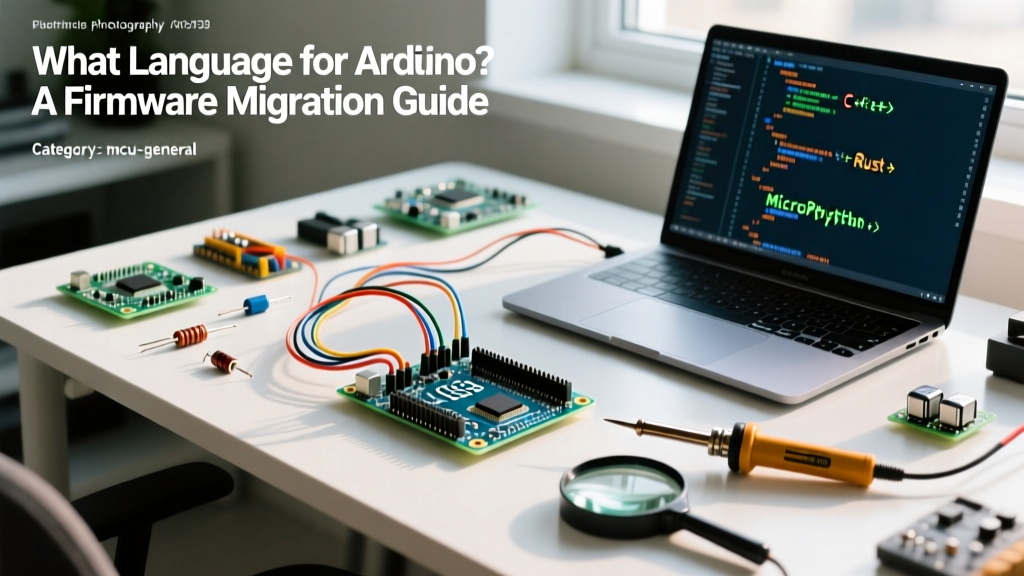
For millions of makers and engineers, the Arduino IDE and its simplified C++ dialect (built on the Wiring framework) serve as the perfect on-ramp to embedded systems. However, as projects evolve from weekend prototypes into commercial IoT products, complex robotics, or safety-critical industrial sensors, the limitations of the standard setup() and loop() paradigm become glaringly obvious. When scaling a project, engineering teams frequently ask: what language for Arduino ecosystem boards offers the most robust path forward?
The standard Arduino core relies on avr-gcc or arm-none-eabi-gcc under the hood. While accessible, it abstracts away hardware interrupts, lacks native multithreading, and encourages blocking code (like delay()) that cripples CPU utilization. If your firmware is suffering from memory leaks, race conditions, or unmanageable global state, it is time to migrate. This guide evaluates the premier upgrade paths for migrating away from legacy Arduino sketches toward modern, production-grade firmware languages and frameworks.
Evaluating Your Upgrade Paths
Migrating your microcontroller codebase is not just about changing syntax; it is about adopting a new toolchain, debugging methodology, and concurrency model. Below are the three primary migration routes for engineers outgrowing standard Arduino C++.
Path 1: MicroPython & CircuitPython (The Scripting Upgrade)
If your primary bottleneck is development speed and hardware iteration, migrating to a Python-based interpreter is highly effective. MicroPython and Adafruit's CircuitPython allow you to write high-level scripting code that interacts directly with hardware registers via C-based native modules.
- Target Hardware: ESP32-S3, Raspberry Pi Pico (RP2040/RP2350), and STM32 Cortex-M4/M7 boards. Note: You cannot run MicroPython on legacy ATmega328P boards; the interpreter requires a minimum of 24KB of SRAM, whereas the ATmega328P only has 2KB.
- Toolchain: Thonny IDE,
mpremoteCLI, and standard Python virtual environments. - The Upgrade Value: You gain a Read-Eval-Print Loop (REPL) for live hardware debugging, eliminating the 30-second compile-and-flash cycle of C++. According to the MicroPython ESP32 Quick Reference, you can dynamically allocate memory and test I2C sensor polling in real-time without reflashing the chip.
Path 2: Embedded Rust (The Safety & Concurrency Upgrade)
For teams building medical devices, automotive sub-systems, or high-reliability IoT nodes, memory safety is non-negotiable. Embedded Rust has matured significantly, offering zero-cost abstractions and a borrow checker that eliminates buffer overflows and data races at compile time.
- Target Hardware: STM32, nRF52/nRF53, ESP32-C3 (RISC-V), and the new RP2350 (which features both ARM and RISC-V cores).
- Toolchain:
cargo,probe-rsfor flashing/debugging via SWD, and theembassyframework for async/await concurrency. - The Upgrade Value: The Rust Embedded Working Group has standardized hardware abstraction layers (HALs). By migrating to Rust's
embassyframework, you replace blockingdelay()calls with asynchronous tasks. This allows an ESP32 to handle Wi-Fi provisioning, TLS encryption, and sensor polling concurrently on a single core without an RTOS, using a fraction of the RAM required by traditional C++ RTOS implementations.
Path 3: Modern C++ via Zephyr RTOS (The Enterprise Upgrade)
If your team already possesses deep C++ expertise but needs enterprise-grade networking, Bluetooth Low Energy (BLE) stacks, and over-the-air (OTA) update capabilities, migrating to Modern C++ (C++17/20) via the Zephyr RTOS is the industry standard.
- Target Hardware: Nordic nRF series, NXP i.MX RT, and high-end STM32 microcontrollers.
- Toolchain: CMake, Ninja, West (Zephyr's meta-tool), and PlatformIO.
- The Upgrade Value: The Zephyr Project Documentation provides a unified API across hundreds of microcontrollers. Instead of rewriting your SPI driver when migrating from an Arduino Mega to a custom nRF52840 PCB, Zephyr's device tree and C++ wrappers allow your business logic to remain entirely hardware-agnostic.
Firmware Language Comparison Matrix
To make an informed migration decision, compare the technical overhead and capabilities of each ecosystem. The table below benchmarks these languages for a standard IoT sensor node application (reading a BME280 via I2C and transmitting via BLE/Wi-Fi).
| Language / Framework | Min. SRAM Required | Concurrency Model | Compile/Flash Time | CI/CD Integration | Best Use Case |
|---|---|---|---|---|---|
| Arduino C++ (Wiring) | 2 KB | Super-loop (Blocking) | 10 - 30 seconds | Poor (Arduino CLI required) | Prototyping, Education |
| MicroPython | 64 KB (Recommended) | Asyncio / Threading | Instant (REPL) | Moderate (PyTest) | Rapid IoT Iteration |
| Embedded Rust (Embassy) | 8 KB | Async/Await (Executor) | 45 - 90 seconds | Excellent (Cargo/GitHub Actions) | Safety-Critical, Low-Power |
| Modern C++ (Zephyr RTOS) | 32 KB | Preemptive RTOS Threads | 60 - 120 seconds | Excellent (CMake/CTest) | Enterprise IoT, Complex BLE |
Step-by-Step Codebase Migration Strategy
Migrating a 5,000-line Arduino sketch to a modern framework requires a systematic approach to prevent hardware bricking and logic regression. Follow this four-phase migration protocol:
- Phase 1: Decouple Business Logic from Hardware (The HAL Extraction)
Before changing languages, refactor your Arduino sketch. Move all sensor math, state machines, and data parsing into pure C++ classes that do not includeArduino.h. Create an interface for hardware calls (e.g.,virtual void writeI2C(uint8_t addr, uint8_t* data)). This allows you to unit-test your core logic on your host PC using GoogleTest before touching the microcontroller. - Phase 2: Implement the New Toolchain
Set up your target environment. If migrating to Rust, initialize a Cargo workspace and configure yourmemory.xlinker script. If moving to Zephyr, define yourdevicetreeoverlay files to map your I2C and SPI pins. Invest in a hardware debugger like a Segger J-Link ($350) or a Raspberry Pi Debug Probe ($12) to enable breakpoint debugging via SWD, replacing serialSerial.println()debugging. - Phase 3: Port the Hardware Abstraction Layer
Translate your Arduino hardware calls to the new framework's HAL. For example, replaceWire.beginTransmission()with Zephyr'si2c_write()or Rust'sembedded-haltraits. Run a basic blink test and an I2C bus scan to verify clock speeds and pull-up resistor configurations. - Phase 4: Establish Automated CI/CD
Configure GitHub Actions or GitLab CI to compile your firmware on every pull request. Use tools likecppcheckfor C++ orclippyfor Rust to enforce memory safety and coding standards automatically. Generate binary size reports to ensure your firmware fits within the target MCU's flash partitions.
Expert Troubleshooting: Edge Cases in Migration
Migration is rarely seamless. Engineers frequently encounter specific edge cases when leaving the Arduino ecosystem. Anticipate these common failure modes:
- The Floating-Point Trap: Legacy AVR Arduinos (like the Uno) do not have a hardware Floating Point Unit (FPU). Standard Arduino C++ silently uses slow software emulation for
floatmath. When migrating to an ARM Cortex-M4 (like the Teensy 4.1 or STM32F4), ensure your new toolchain (CMake or Cargo) passes the-mfloat-abi=hardcompiler flag. Failing to do so will result in a 10x performance regression in PID control loops or DSP audio processing. - Interrupt Latency in RTOS: Moving from a bare-metal Arduino super-loop to Zephyr RTOS introduces context-switching overhead. If your application relies on microsecond-precise encoder counting, standard RTOS GPIO interrupts may jitter. Solution: Migrate time-critical pins to the MCU's dedicated hardware timer capture/compare registers, bypassing the RTOS interrupt controller entirely.
- Memory Fragmentation in Python: When migrating to MicroPython, long-running IoT scripts often crash with
MemoryErrorafter 48 hours due to heap fragmentation. Solution: Pre-allocate byte arrays and buffers during theboot.pyinitialization phase, and reuse these memory blocks in your main loop rather than instantiating new strings or lists dynamically.
Engineering Insight: The decision of what language for Arduino-derived hardware to use ultimately depends on your team's risk tolerance. If a firmware bug results in a minor inconvenience, MicroPython's speed of iteration is unmatched. If a firmware bug results in a recalled medical device or a bricked satellite, the strict compile-time guarantees of Embedded Rust are worth the steep initial learning curve.
Upgrading your microcontroller language stack is a significant investment, but it transitions your project from a fragile hobbyist sketch into a resilient, maintainable, and scalable commercial product. Evaluate your RAM constraints, concurrency needs, and team expertise to select the optimal migration path for your next hardware revision.