
The 2026 Community Roundup: Building the Ultimate Distance Detector Arduino Project
Building a reliable distance detector Arduino system remains a foundational rite of passage for makers, robotics enthusiasts, and IoT developers. However, the landscape of proximity and ranging sensors has evolved dramatically. While the classic ultrasonic transducer still holds its ground in budget builds, the maker community has increasingly adopted automotive-grade LiDAR modules and SPAD-based Time-of-Flight (ToF) arrays for millimeter precision.
In this community resource roundup, we synthesize insights from top maker forums, GitHub repositories, and robotics labs to curate the definitive guide to distance sensing in 2026. Whether you are building an autonomous rover, a smart parking assistant, or a liquid level monitor, choosing the right sensor topology is critical. Below, we break down the hardware, the essential community-maintained libraries, and the real-world edge cases that datasheets often fail to mention.
Sensor Comparison Matrix: Ultrasonic vs. LiDAR vs. ToF vs. IR
Before diving into specific builds, it is crucial to match your environmental constraints with the correct physics. Here is how the community's top four sensor choices stack up in 2026.
| Sensor Model | Technology | Effective Range | Interface | Avg Price (2026) | Best Use Case |
|---|---|---|---|---|---|
| HC-SR04 | Ultrasonic (40kHz) | 2cm – 400cm | GPIO (Pulse) | $1.50 | Budget robotics, basic obstacle avoidance |
| Benewake TF-Luna | LiDAR (850nm VCSEL) | 0.2m – 8m | UART / I2C | $18.50 | Long-range drones, high-speed rovers |
| VL53L1X (STMicro) | ToF (SPAD Array) | 4cm – 400cm | I2C | $7.95 | Indoor navigation, gesture control, SLAM |
| Sharp GP2Y0A21YK0F | Infrared Triangulation | 10cm – 80cm | Analog (ADC) | $4.20 | Edge detection, line following, analog-only MCUs |
Deep Dive: Community-Approved Sensor Setups
1. HC-SR04 Ultrasonic: The Budget Workhorse
The HC-SR04 operates by emitting a 40kHz acoustic burst and measuring the echo return time. At 20°C, the speed of sound is approximately 343 m/s. The community-standard formula for calculating distance in centimeters is distance = (pulse_duration * 0.0343) / 2.
Expert Insight: The most common failure mode for beginners is using blocking delay() functions or pulseIn() without a timeout, which freezes the Arduino sketch if the sound wave scatters into an acoustic shadow. The community universally recommends the NewPing GitHub Repository library. NewPing utilizes hardware timer interrupts to listen for echoes asynchronously, freeing up your MCU to handle motor control or telemetry simultaneously. Furthermore, if your project operates in fluctuating temperatures, integrate a DS18B20 temperature sensor to dynamically adjust the speed of sound constant ($v = 331.4 + 0.6T$), reducing measurement drift by up to 4% in outdoor environments.
2. Benewake TF-Luna LiDAR: For Long-Range Precision
When ultrasonic sensors fail due to wind noise or wide beam dispersion, the community turns to the TF-Luna. This micro-LiDAR uses an 850nm VCSEL (Vertical-Cavity Surface-Emitting Laser) and operates via UART at a default baud rate of 115200. It outputs a continuous 9-byte data frame starting with the header 0x59 0x59.
Hardware Edge Case: While the TF-Luna boasts an 8-meter range, community testing reveals that high ambient infrared light (direct sunlight) can saturate the receiver, dropping the effective range to under 2 meters. For outdoor rover projects, makers recommend 3D printing a narrow, matte-black shroud (minimum 15mm depth) around the receiver lens to restrict the field of view and block off-axis solar IR. Additionally, ensure your Arduino's UART buffer is cleared regularly; at 100Hz sampling, a 256-byte serial buffer will overflow in less than a second if not parsed efficiently using a state-machine approach rather than Serial.available() polling.
3. STMicroelectronics VL53L1X ToF: The Indoor Champion
The STMicroelectronics VL53L1X represents the gold standard for indoor precision. Unlike simple phase-shift ToF sensors, it uses a SPAD (Single Photon Avalanche Diode) array and advanced histogram processing to distinguish between multiple targets in its field of view. It communicates via I2C (default address 0x29).
Configuration Secrets: Out of the box, the VL53L1X can struggle with highly reflective surfaces (like mirrors or polished metal), causing 'multipath ghosting' where the laser bounces multiple times before returning. The community fix is to utilize the ST API to reduce the Timing Budget to 20ms for fast, short-range tracking, or increase it to 100ms for maximum 4-meter range in dark environments. Additionally, you can programmatically define the Region of Interest (ROI) on the SPAD array, narrowing the beam from a wide 27° cone down to a tight 4° spot, effectively turning the sensor into a precision liquid-level gauge for narrow tanks.
4. Sharp GP2Y0A21YK0F IR: The Analog Classic
Though largely superseded by digital ToF sensors, the Sharp IR sensor remains a favorite for analog-only microcontrollers or simple edge-detection tasks. It outputs an inverse voltage curve: as distance increases, voltage drops.
Critical Circuit Fix: The internal ADC of the Sharp sensor draws current in high-frequency spikes, causing massive voltage ripple on the power rail. If you connect this directly to an Arduino's 5V and GND pins, your analog readings will jitter wildly. The mandatory community fix is to solder a 10µF electrolytic capacitor directly across the sensor's VCC and GND pins, combined with a 100Ω resistor on the VCC line to form an RC low-pass filter. This simple $0.10 addition stabilizes the ADC readings, reducing noise variance by over 80%.
Essential Community Libraries & Code Resources
A robust distance detector Arduino setup relies heavily on optimized software. Here are the most trusted libraries maintained by the open-source community in 2026:
- NewPing (Ultrasonic): Supports up to 15 sensors simultaneously using a single timer interrupt. Eliminates the 74ms blocking delay inherent in standard
ping()functions. - Adafruit_VL53L1X (ToF): A wrapper around the ST API that simplifies ROI configuration and provides built-in ambient light compensation. Note: Requires
Wire.setClock(400000)to prevent I2C bus bottlenecking when polling multiple sensors. - TFMini/TF-Luna Parser Libraries: Look for libraries that implement checksum validation (adding bytes 0 through 6 and comparing to byte 7) to discard corrupted UART frames caused by EMI from brushed DC motors.
Real-World Troubleshooting: Edge Cases & Fixes
Community Warning: Acoustic Impedance Mismatch
When using ultrasonic sensors to detect liquid levels (e.g., water tanks), sound waves can pass directly through thin plastic walls rather than reflecting back. To force reflection, apply a small dab of hot glue or epoxy to the inside of the tank wall at the sensor's focal point, creating an acoustic impedance mismatch that guarantees an echo return.
Dealing with I2C Bus Lockups
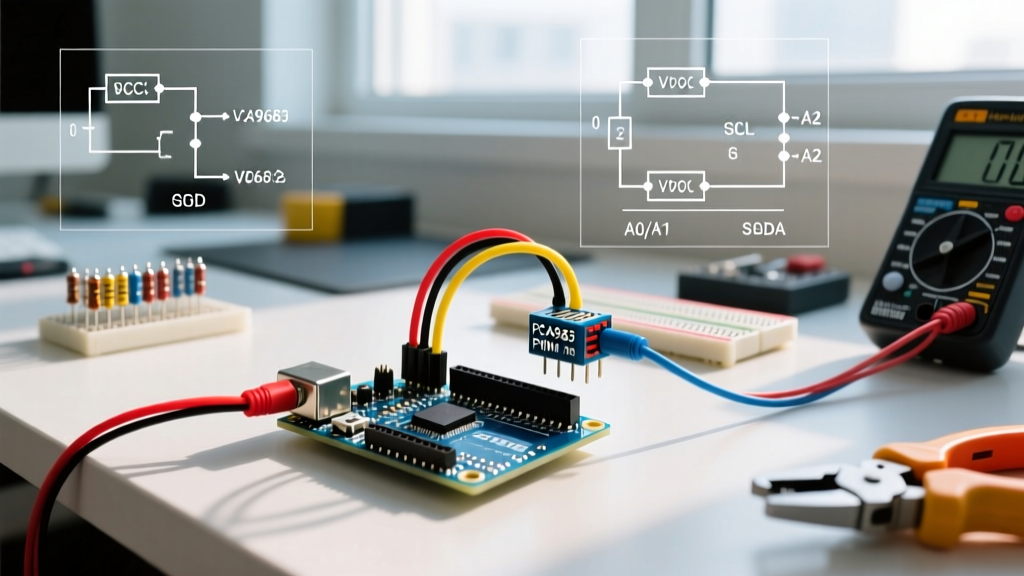
When integrating the VL53L1X alongside OLED displays and IMUs on the same I2C bus, voltage drops during the sensor's laser firing phase can cause the entire I2C bus to lock up. The Fix: Do not rely on the Arduino's internal pull-up resistors. Add dedicated 4.7kΩ external pull-up resistors to both SDA and SCL lines, tied directly to a clean 3.3V or 5V rail (depending on your logic level shifters). For detailed bus architecture, refer to the Arduino Serial and Communication Guide for best practices on isolating noisy peripherals.
FAQ: Community Questions Answered
Can I use multiple HC-SR04 sensors without cross-talk?
Yes, but not by firing them simultaneously. The 40kHz frequency is identical across all units. You must either fire them sequentially with a 50ms delay between pings, or use physical acoustic baffles (foam or cardboard tubes) to isolate their fields of view. Alternatively, use the NewPing library's event-driven ping scheduling to manage the timing automatically.
Which sensor is best for detecting clear glass?
Neither ultrasonic nor standard LiDAR is ideal for clear glass; sound waves often pass through or scatter, and lasers refract. For glass detection, the community recommends using a retro-reflective photoelectric sensor or mounting the VL53L1X at a 15-degree angle to catch the faint surface specular reflection rather than a direct perpendicular bounce.
How do I waterproof an ultrasonic sensor for outdoor use?
Standard HC-SR04 mesh grilles trap moisture, destroying the piezoelectric transducer. For outdoor agricultural or marine projects, upgrade to a sealed, waterproof ultrasonic transducer (like the JSN-SR04T), which features a solid plastic face and a sealed cable gland, rated for IP67 environments.