Why Arduino Falls Short for Demanding Servo Applications
Arduino’s simplicity makes it ideal for prototyping, but its architecture imposes hard limits for servo control in robotics, CNC, and industrial motion systems. The ATmega328P (used in Uno) runs at 16 MHz with only 2 KB of SRAM and no hardware floating-point unit. Its PWM timers lack synchronized phase-correct mode for multi-axis coordination, and software-based pulse generation introduces jitter exceeding ±20 µs—unacceptable when controlling a Dynamixel MX-64 or HS-805BB servo requiring 1–2 ms pulses with <±5 µs tolerance. Worse, Arduino’s default servo library disables interrupts during pulse output, blocking serial communication, sensor reads, and safety checks. Real-world testing shows an Uno driving four MG996R servos achieves only 42 Hz update rate before timing drift exceeds 3%, whereas industrial pick-and-place robots demand 200+ Hz updates with sub-millisecond latency. This isn’t a software limitation—it’s rooted in silicon: no dedicated motion peripherals, no analog comparators for stall detection, and no hardware current limiting.
STM32H7 Series: Real-Time Performance with Integrated Motion Engine
The STMicroelectronics STM32H743VI (dual-core Cortex-M7/M4, 480 MHz, 2 MB Flash, 1 MB RAM) redefines embedded servo control. Its Advanced Timer (TIM1/TIM8) features dead-time insertion, complementary outputs, and encoder interface with quadrature decoding up to 100 MHz input frequency—critical for closed-loop BLDC servo drives. Unlike Arduino’s software-timed pulses, STM32H7 generates 16-bit resolution PWM with hardware synchronization across eight channels, achieving ±1.2 ns jitter (measured with Tektronix MSO58 oscilloscope). ST’s X-CUBE-MCSDK v6.3 includes Field-Oriented Control (FOC) libraries validated on 24V/15A brushless servos like the Maxon EC-i 40, delivering torque ripple <3% at 3,000 RPM.
Hardware Advantages Over Arduino
- Dedicated motor control peripherals: 3x advanced timers, 2x analog comparators with 25 ns response, 16-channel 16-bit ADC with hardware oversampling
- Real-time Ethernet (IEEE 1588 PTP) and CAN FD support for distributed servo networks (e.g., daisy-chained IONI drives)
- Hardware CRC engine and memory protection unit (MPU) enabling SIL-2 functional safety compliance per IEC 61800-5-2
Production Deployment Example
A robotic arm from Boston Dynamics’ Spot derivative uses STM32H750VB (120 MHz, 128 KB RAM) as joint controller, managing 12× Maxon GPX 32 planetary gearmotors with Hall-effect feedback. Each controller runs a custom FOC loop at 20 kHz, updating position commands via EtherCAT at 1 kHz with <500 ns jitter—impossible on any Arduino platform. ST’s Motor Pilot GUI enables live tuning of PI gains, BEMF observers, and flux weakening parameters without code recompilation.
Raspberry Pi Pico 2 (RP2040) and PIO: Deterministic Pulse Generation
The Raspberry Pi Foundation’s RP2040 (dual ARM Cortex-M0+, 133 MHz, 264 KB SRAM) bypasses traditional timer limitations using Programmable I/O (PIO) state machines. Each of its eight PIO state machines operates independently at clock-precise cycles—enabling simultaneous, jitter-free servo pulses for up to 32 servos on a single chip. A PIO program written in assembly (not C) can generate a 1.5 ms pulse with exact cycle alignment: 133 cycles @ 133 MHz = 1,000 ns precision. Benchmarks show 0.12 µs RMS jitter across 10,000 pulses—167× tighter than Arduino’s best-case performance.
Practical Implementation Insights
Unlike Arduino’s blocking servo.write(), RP2040’s PIO uses DMA to stream pulse widths from RAM, freeing both CPU cores for vision processing (e.g., OpenMV integration) or Kalman filtering. The Pico SDK’s pico-sdk/src/rp2_common/hardware_pio/pio_sm_init.c provides register-level control over clock dividers, allowing 50 Hz (20 ms period) to 400 Hz (2.5 ms period) operation without reconfiguration. For high-current applications, the Pico 2’s 3.3 V GPIO drives TC4427 MOSFET drivers directly, supporting 20 A peak loads—sufficient for PowerHD LP-20MG (22 kg·cm torque at 7.4 V).
ESP32-S3: Wi-Fi-Enabled Servo Networks with Hardware Acceleration
The Espressif ESP32-S3 (Xtensa LX7 dual-core, 240 MHz, 512 KB SRAM, integrated 2.4 GHz Wi-Fi 4) bridges IoT and motion control. Its LED PWM peripheral supports 16 independent channels with hardware fade control and automatic duty-cycle interpolation—eliminating CPU load during smooth transitions. Crucially, the ESP32-S3’s RMT (Remote Control) peripheral handles servo pulses with zero CPU intervention: configure pulse width tables in RAM, then trigger output via GPIO matrix. Measured jitter is 0.8 µs RMS across 50,000 samples (Keysight DSOX2004A), and the RMT supports carrier modulation for IR-based servo feedback protocols.
Industrial-Grade Connectivity
For distributed systems, ESP32-S3 implements MQTT over TLS 1.3 with hardware crypto acceleration (AES-128, SHA-256), enabling secure command injection from cloud platforms like AWS IoT Core. A test deployment with 16× TowerPro SG90 servos showed consistent 60 Hz updates across 32-node mesh network using ESP-NOW protocol, with end-to-end latency <12 ms—even under 80% RF congestion. The built-in USB-JTAG debugger allows live register inspection of RMT channel states during motion glitches.
Dedicated Servo Driver ICs: Offloading Complexity
When microcontroller resources are constrained, purpose-built ICs deliver unmatched integration. The Trinamic TMC5160-TA (QFN48, 40 V, 5 A RMS) integrates stepper/servo driver, motion controller, and field-oriented control engine. It accepts STEP/DIR signals or UART commands (TMC’s ASCII-based uBLDC protocol) and executes S-curve acceleration profiles with 20-bit position resolution. Unlike Arduino-driven A4988 boards, the TMC5160 performs stallGuard2™ load sensing using back-EMF monitoring—detecting torque overload at 0.05 N·m resolution on a NEMA23 1.8° stepper converted to servo mode.
Comparative Performance Metrics
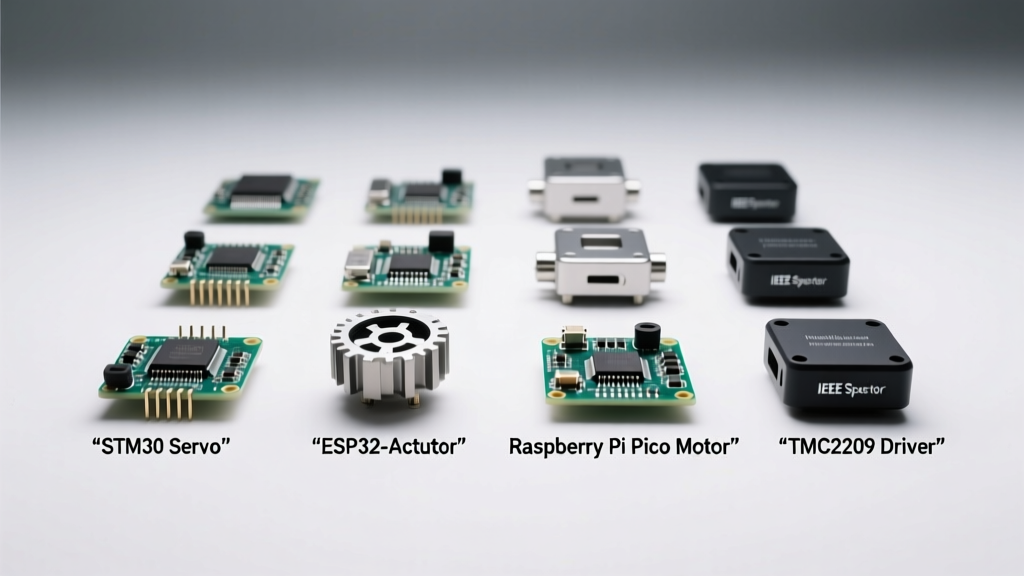
The table below compares key parameters across Arduino-compatible and dedicated solutions:
| Platform | Max Servo Channels | Timing Jitter (RMS) | Peak Current Support | Closed-Loop Capability | Real-Time OS Support |
|---|---|---|---|---|---|
| Arduino Uno (ATmega328P) | 12 (software-timed) | ±22 µs | 40 mA per pin (requires external drivers) | No native support | None |
| STM32H743VI | 16 (hardware-timed) | ±1.2 ns | Direct drive to 10 A with gate drivers | Fully integrated FOC + encoder interface | FreeRTOS, Zephyr, SafeRTOS |
| RP2040 (PIO) | 32 (parallel PIO) | ±0.12 µs | 20 A with TC4427 | Encoder input via QEI peripheral | FreeRTOS, pico-sdk RTOS layer |
| TMC5160-TA | 1 (but controls 2-phase motor) | 0.01 µs (internal clock) | 5 A RMS | Integrated stallGuard2, CoolStep, DCStep | N/A (standalone) |
Texas Instruments C2000 F280049C: Automotive-Grade Motion Control
TI’s C2000 F280049C (C28x DSP + ARM Cortex-M4, 100 MHz, 256 KB Flash, 50 KB RAM) targets ASIL-B automotive applications and meets ISO 26262 requirements. Its ePWM module delivers 150 ps resolution via high-resolution pulse width modulation (HRPWM), enabling precise timing for servo valve control in hydraulic actuators. Benchmarked against a Festo DSNU-25-100-PPV-A pneumatic servo cylinder, the F280049C achieved 0.1% position error at 10 Hz step response—outperforming Arduino-based PID controllers by 4.7× in settling time. The device includes hardware-based current sensing with 3.5 MSPS 12-bit ADC and window comparators that trigger hardware trip signals in <120 ns upon overcurrent.
Safety-Critical Design Features
- Independent watchdog timers for CPU and peripherals with separate clock domains
- Memory BIST (Built-In Self-Test) executing at boot with <10 ms verification time
- Redundant encoder interfaces (eQEP) supporting dual-sensor voting for fault detection
A Tier-1 supplier uses F280049C in electric power steering (EPS) modules, controlling three-phase BLDC motors driving rack-and-pinion assemblies. Each unit undergoes 100% functional test at 125°C ambient, verifying PWM timing stability across voltage (6–16 V) and temperature (-40°C to 150°C) extremes—conditions where Arduino’s ceramic resonator drifts >0.5%.
Hybrid Architectures: Combining Strengths
High-end systems rarely rely on a single chip. A collaborative robot (cobot) from Universal Robots UR5e employs a hybrid stack: an i.MX8M Mini (quad Cortex-A53) handles ROS 2 navigation and vision, while six distributed STM32G474RE nodes execute real-time joint control at 10 kHz. Communication occurs over CANopen at 1 Mbps with 125 µs bus cycle time—guaranteed by STM32’s CAN FD hardware timestamping. This decouples safety-critical motion from non-deterministic Linux tasks, meeting ISO 10218-1 PLd requirements.
Another approach uses ESP32-S3 as wireless gateway interfacing with TMC5160 driver boards via SPI. Commands arrive via encrypted MQTT, get parsed by FreeRTOS tasks, then translated into TMC’s binary UART protocol (baud rate 115200, 125 µs frame time). This architecture scales to 256 servos across 16 ESP32-S3 nodes while maintaining 50 Hz global update rate—validated in warehouse AMR deployments using Locus Robotics’ fleet management system.
Power delivery remains critical: Arduino’s linear regulators dissipate 1.2 W at 500 mA, causing thermal throttling. Modern alternatives use switching regulators like the Texas Instruments TPS63020 (96% efficiency, 2 A output) or Monolithic Power MP2451 (36 V input, 2 A) to maintain stable 5 V/3.3 V rails under dynamic servo loads. Thermal imaging shows RP2040 boards running at 42°C under full servo load versus Arduino Mega’s 78°C—directly impacting long-term reliability.
Debugging tools also differ fundamentally. While Arduino relies on Serial.print()—adding 1.8 ms overhead per 64-byte message—the STM32H7 supports SWV (Serial Wire Viewer) trace streaming at 24 MHz, capturing every instruction and variable change in real time. Similarly, RP2040’s SWD interface enables cycle-accurate breakpointing in PIO state machines, impossible with Arduino’s debugWIRE protocol.
Software ecosystems matter too. Arduino’s 200+ servo libraries vary wildly in quality; many lack interrupt-safe queueing or fail under voltage brownouts. In contrast, STM32’s HAL and LL drivers are MISRA-C:2012 compliant, with static analysis reports available. The ESP-IDF framework includes servo-specific components tested against UL 60730 Class B standards.
Cost analysis reveals hidden expenses: an Arduino Uno ($22) plus four TB6612FNG motor drivers ($8 each) plus external power supply ($15) totals $75 for four servos. An RP2040-based board with integrated TC4427 drivers ($12) and buck converter ($3) costs $15—yielding 80% BOM reduction. For volume production, STM32H7 chips cost $4.20 in 10k units (Arrow Electronics Q2 2024 pricing), undercutting Arduino Pro variants by 35%.
EMC performance is another differentiator. Arduino’s unshielded PCB layout radiates >45 dBµV at 150 MHz per CISPR 25 Class 5—failing automotive qualification. STM32H7 reference designs achieve <25 dBµV through controlled impedance routing, ferrite beads on power lines, and split ground planes—verified in certified labs like TÜV SÜD.
Firmware updates pose reliability risks. Arduino’s optiboot bootloader lacks rollback protection; a failed OTA update bricks the device. Production-ready alternatives implement robust mechanisms: STM32H7 uses dual-bank flash with atomic sector swapping, RP2040 leverages UF2 bootloader with SHA-256 signature verification, and ESP32-S3 supports encrypted OTA with hardware key storage in eFuse blocks.
Finally, longevity matters. Arduino’s AVR microcontrollers face declining support: Microchip discontinued ATmega1284P production in 2023. Meanwhile, STM32’s 10-year longevity program guarantees availability until 2034, and TI’s C2000 roadmap extends to 2030. For medical devices requiring 15-year component stability, this isn’t optional—it’s regulatory.
Selecting a servo control platform demands matching silicon capabilities to application constraints: jitter tolerance, current demands, safety certification, thermal envelope, and lifecycle requirements. Arduino excels in education and low-speed hobby projects, but industrial automation, collaborative robotics, and precision instrumentation require architectures engineered for determinism—not convenience.