
The Intersection of Regional Image Hosting and MCU Web Servers
For makers in Central Europe, Rajce (the photo hosting service operated by MAFRA under the iDNES.cz domain) is a ubiquitous tool for documenting DIY electronics. It offers free, high-capacity storage for Fritzing diagrams, KiCad PCB layouts, and breadboard photographs. However, a highly specific subset of error diagnosis arises when developers attempt to integrate these hosted assets into local Arduino or ESP32-based web servers. If you have ever typed rajce idnes cz arduino into a search engine out of frustration, you are likely battling a triad of integration failures: hotlink protection blocks, Cross-Origin Resource Sharing (CORS) rejections, and TLS certificate validation drops.
As of 2026, with the widespread adoption of the ESP32-S3 and ESP-IDF v5.2 frameworks in the Arduino IDE 2.3.x environment, the HTTPClient library has become stricter regarding security and header compliance. This guide provides a deep-dive diagnostic framework for resolving image-fetching errors when pulling from Rajce's CDN into your microcontroller dashboards.
Anatomy of the 403 Forbidden: Hotlink Protection
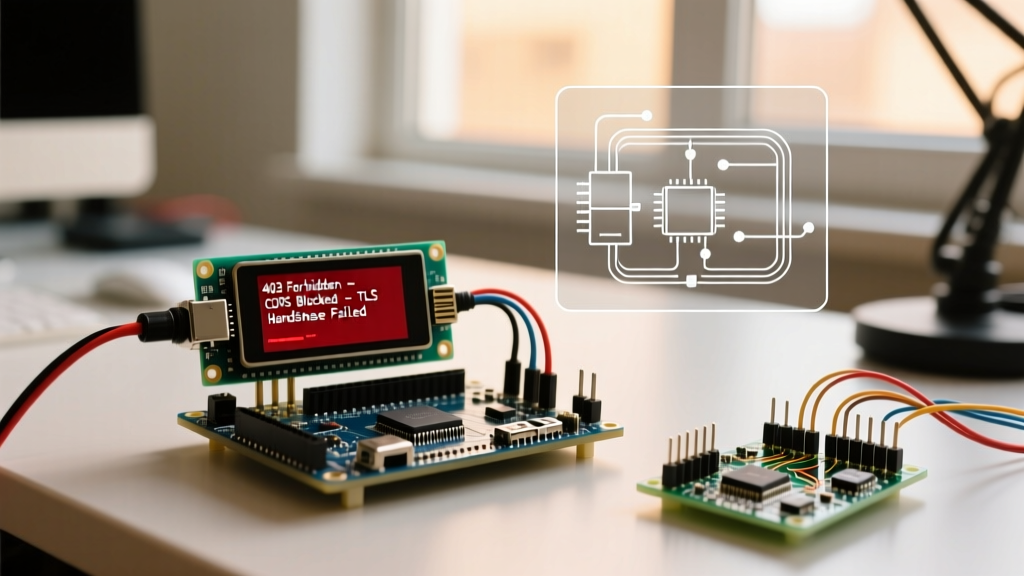
The most common error encountered when an ESP32 attempts to download a schematic from Rajce is the HTTP 403 Forbidden status. Rajce employs edge-server hotlink protection to prevent bandwidth theft. When your microcontroller sends a standard GET request, the CDN inspects the Referer and User-Agent headers.
By default, the Arduino HTTPClient library sends a minimal header profile. The Rajce CDN recognizes the absence of a valid browser fingerprint or a missing internal referer and immediately severs the connection.
Diagnostic Step: Header Spoofing
To bypass this, you must explicitly inject the expected headers into your HTTP request before calling http.GET(). Below is the exact implementation required for ESP32 architectures to mimic a legitimate browser session originating from the Rajce portal.
#include <WiFi.h>
#include <HTTPClient.h>
#include <WiFiClientSecure.h>

const char* ssid = 'YOUR_SSID';
const char* password = 'YOUR_PASSWORD';
const char* imageUrl = 'https://images.rajce.idnes.cz/your-album/your-schematic.png';

// Root CA certificate for iDNES CDN (Must be updated if CDN rotates to new Let's Encrypt intermediate)
const char* rootCACertificate = R'EOF(
-----BEGIN CERTIFICATE-----
[Insert Current ISRG Root X1 or X2 Certificate Here]
-----END CERTIFICATE-----
)EOF';

void setup() {
  Serial.begin(115200);
  WiFi.begin(ssid, password);
  while (WiFi.status() != WL_CONNECTED) { delay(500); }

  WiFiClientSecure client;
  client.setCACert(rootCACertificate);

  HTTPClient http;
  http.begin(client, imageUrl);

  // CRITICAL: Spoofing the Referer and User-Agent to bypass Rajce edge filters
  http.addHeader('Referer', 'https://www.rajce.idnes.cz/');
  http.addHeader('User-Agent', 'Mozilla/5.0 (Windows NT 10.0; Win64; x64) AppleWebKit/537.36');
  http.addHeader('Accept', 'image/avif,image/webp,image/apng,image/svg+xml,image/*,*/*;q=0.8');

  int httpCode = http.GET();
  Serial.printf('HTTP Response Code: %d\n', httpCode);

  if (httpCode == HTTP_CODE_OK) {
    int len = http.getSize();
    Serial.printf('Payload size: %d bytes\n', len);
    // Proceed to stream to SPIFFS, LittleFS, or TFT display
  } else {
    Serial.printf('Fetch failed. Error: %s\n', http.errorToString(httpCode).c_str());
  }
  http.end();
}

void loop() {}
According to the MDN Web Docs on the Referer header, edge CDNs heavily rely on this string to differentiate between embedded dashboard requests and direct scraping. Omitting it guarantees a 403 response from regional media servers.
Matrix of Common Rajce-Arduino Integration Errors
When monitoring the Serial output at 115200 baud, you will encounter specific HTTP and network-level codes. Use this diagnostic matrix to pinpoint the exact failure node.
| Error Code / Symptom | Root Cause in ESP32/Rajce Context | Resolution Protocol |
|---|---|---|
HTTP 403 Forbidden |
Missing or invalid Referer header; CDN hotlink block triggered. |
Inject http.addHeader('Referer', 'https://www.rajce.idnes.cz/'); |
HTTP 501 Not Implemented |
ESP32 HTTPClient defaulting to HTTP/1.0; Rajce CDN requires HTTP/1.1 for chunked image delivery. | Ensure you are using ESP-IDF v5.x or newer Arduino-ESP32 core which defaults to HTTP/1.1. |
SSL/TLS Handshake Fail (-100) |
Hardcoded SHA-1 certificate fingerprint expired. Rajce rotated to a new Let's Encrypt intermediate CA. | Abandon fingerprint validation. Use setCACert() with the PEM-formatted Root CA. |
net::ERR_INVALID_CHUNKED_ENCODING |
Browser-side dashboard failing to parse Rajce's gzip-compressed chunked image stream. | Add http.addHeader('Accept-Encoding', 'identity'); to force uncompressed stream delivery. |
CORS Policy Block |
Browser-based JS dashboard attempting to draw Rajce image to HTML5 Canvas for pixel manipulation. | Proxy the image through the ESP32 local server instead of direct browser-to-CDN fetching. |
TLS Certificate Rotations and the Fingerprint Trap
A frequent point of failure in legacy Arduino tutorials is the use of SHA-1 certificate fingerprints for HTTPS validation. In 2026, relying on fingerprints for the images.rajce.idnes.cz domain is a critical anti-pattern. Regional CDNs frequently rotate their edge certificates, sometimes weekly, to maintain forward secrecy and comply with modern CA/Browser forum baselines.
If your ESP32 code uses client.setFingerprint(), your dashboard will inevitably break without warning. The Espressif HTTPClient repository strongly advocates for Root CA validation. You must extract the current Root CA (typically ISRG Root X1 or X2 for Let's Encrypt) and embed it as a multi-line string literal in your sketch. This ensures your microcontroller trusts the entire certificate chain, surviving edge-server rotations seamlessly.
Schematic Degradation: The Hidden Cost of Auto-Compression
Error diagnosis is not limited to network protocols; it also encompasses data integrity. Rajce applies aggressive lossy compression to uploaded JPEGs to optimize mobile delivery. For makers uploading KiCad or Altium Designer schematics, this compression introduces artifacting around fine trace lines and 8pt silkscreen text, rendering pinout diagrams unreadable on low-resolution SPI TFT displays (like the ST7789 or ILI9341).
Preserving Signal Integrity in Images
- Force PNG Uploads: Rajce preserves lossless compression for .PNG files. Always export your EDA schematics as PNG-24 rather than JPEG.
- Resolution Limits: Images exceeding 2048px on the longest edge are automatically downscaled by the CDN. Design your Fritzing canvases to fit within a 1920x1080 boundary to prevent server-side interpolation blur.
- Contrast Enhancement: Before uploading, increase the contrast of trace lines by 15% in your image editor. This compensates for the gamma shifts applied by the CDN's image optimization pipeline.
Diagnosing CORS Failures in Browser-Side Dashboards
Suppose your ESP32 hosts a local web server (e.g., at 192.168.1.50) that serves an HTML dashboard. If your frontend JavaScript attempts to fetch a Rajce image using the fetch() API to draw it onto an HTML5 Canvas for dynamic annotation, the browser will block it due to Cross-Origin Resource Sharing (CORS) policies. Rajce's servers do not return the Access-Control-Allow-Origin: * header for direct image requests.
The Architectural Fix: Do not fetch directly from the browser. Instead, configure your ESP32 to act as a reverse proxy. The ESP32 fetches the image (using the header spoofing technique detailed above), caches it in LittleFS, and serves it to the browser via a local endpoint like /api/schematic. Because the image is now served from the same origin as your dashboard HTML, the browser's CORS policy is satisfied, and Canvas manipulation proceeds without security exceptions.
Step-by-Step Serial Diagnostic Protocol
When an image fails to render on your connected display or web dashboard, follow this strict serial debugging sequence to isolate the fault:
- Isolate the Network: Ping the Rajce CDN IP from your PC to rule out local DNS blocking or ISP-level routing issues.
- Inspect the Handshake: Enable ESP32 core debug logs in the Arduino IDE (
Tools -> Core Debug Level -> Verbose). Look formbedtlshandshake errors which indicate a Root CA mismatch. - Verify Payload Headers: Print the response headers to the Serial Monitor using
http.collectHeaders(headerKeys, 3);. Check theContent-Type. If it returnstext/htmlinstead ofimage/png, you have been redirected to an error or captcha page, meaning your header spoofing was rejected. - Measure Chunk Timing: If the download starts but hangs at 4380 bytes, you are experiencing a TCP window scaling issue common in older ESP32 Arduino cores. Update your board manager to the latest 2026 ESP32 core release to enable modern LWIP buffer management.
Summary
Integrating regional media hosts into embedded systems requires a thorough understanding of edge-server security postures. By correctly manipulating HTTP headers, implementing robust Root CA validation, and architecting around CORS limitations, you can reliably utilize Rajce as a zero-cost asset delivery network for your Arduino and ESP32 projects. Always prioritize lossless formats for technical schematics to ensure your documentation remains as precise as your code.