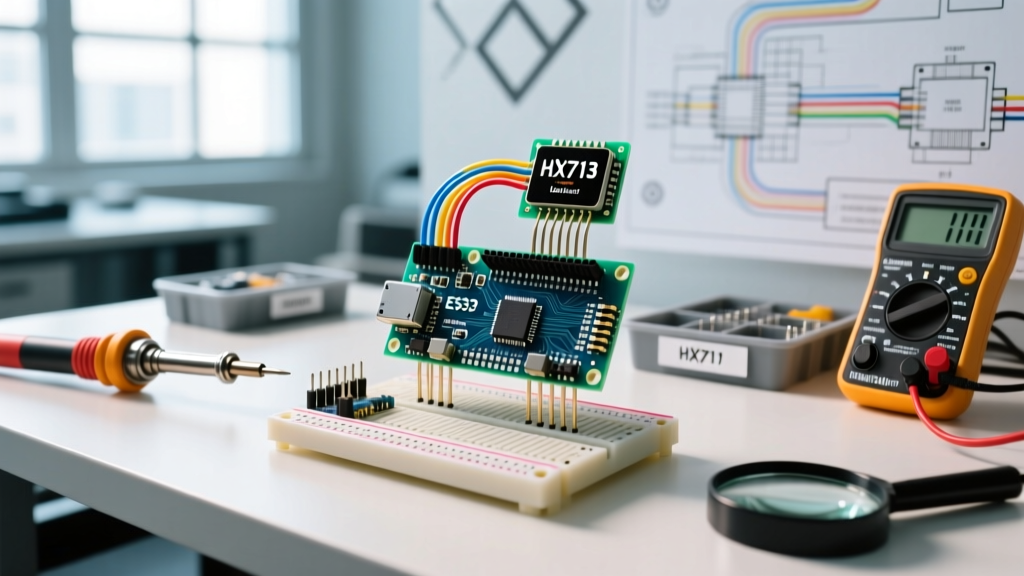

The HX711 24-bit analog-to-digital converter (ADC) remains the undisputed champion of DIY weighing scales, force gauges, and industrial IoT load monitoring. Despite being originally designed by Avia Semiconductor, the market in 2026 is flooded with functional silicon clones from various fabs. While the hardware is cheap and ubiquitous, getting stable, noise-free readings on modern microcontrollers requires navigating a minefield of EMI issues, blocking code, and thermal drift.
In this 2026 community resource roundup, we aggregate the most hard-won insights, library benchmarks, and hardware hacks from the Arduino Forum, Reddit’s r/arduino, and GitHub issue trackers. Whether you are building a smart beehive scale with an ESP32-S3 or a precision gram-scale with an Uno R4, this guide cuts through the noise.
Library Showdown: What the Community Actually Uses
The original bogde/HX711 library has been the default for a decade, but modern multi-core microcontrollers and real-time operating systems (RTOS) demand better. Here is how the top three community-maintained libraries stack up this year.
| Library | Best For | Blocking? | ESP32 / RTOS Safe? | Key Feature |
|---|---|---|---|---|
| bogde/HX711 | Legacy AVR (Uno/Mega) | Yes (Strict) | No (Causes WDT Resets) | Simplest API, massive legacy codebase |
| RobTillaart/HX711 | Multi-sensor arrays | No (Async) | Yes | Non-blocking, multi-instance support, moving average filters |
| olkal/HX711_ADC | Precision / Background tasks | No (Interrupt) | Yes | Continuous background sampling, median filtering, tare on the fly |
The ESP32 Interrupt Caveat
If you are using an ESP32-family board (including the S3 and C3 variants popular in 2026), the HX711’s custom 2-wire protocol can trigger watchdog timer (WDT) resets if read synchronously. The community consensus is to use the HX711_ADC library, which utilizes pin-change interrupts. Pro-Tip from the forums: When using FreeRTOS on the ESP32, ensure your I2C/WiFi tasks are pinned to Core 1, and let the HX711 interrupt service routine (ISR) run on Core 0 to prevent bus contention.
Hardware & Wiring: Forum-Tested Noise Mitigation
The most common complaint on the SparkFun HX711 Hookup Guide comment section and Arduino forums is erratic jumping (e.g., readings swinging ±500 grams on a 50kg cell). The HX711 amplifies microvolt-level signals; it will amplify your environment's noise just as eagerly.
The "Twisted Pair" Mandate
Never run your load cell wires parallel to AC mains or stepper motor cables. The community standard for 2026 industrial-adjacent DIY builds is to use shielded twisted-pair (STP) cable for the load cell connection. Twist the Excitation (E+ / E-) pair together, and the Signal (S+ / S-) pair together. Connect the shield drain wire only at the HX711 ground, leaving it floating at the load cell end to prevent ground loops.
The RATE Pin Configuration
Most cheap breakout boards leave the RATE pin floating or pulled high.
- RATE = GND: 10 Samples Per Second (SPS). Use this for Channel A (128 gain). It provides the highest noise rejection and is ideal for static weighing.
- RATE = VCC: 80 SPS. Use this only if you are measuring dynamic forces (e.g., impact testing, vibration analysis) and are willing to trade noise floor for speed.
"I spent three weeks chasing 'phantom drift' on my smart-keg scale. Turns out, the cheap breadboard jumper wires were acting as antennas for the nearby Wi-Fi router. Soldering the HX711 directly to a perfboard and adding a 100nF decoupling capacitor across the VCC/GND pins eliminated 99% of the jitter." — u/LoadCellWizard, r/arduino
Calibration Nightmares: Drift, Creep, and the 8388607 Error
Calibrating an HX711 Arduino setup is mathematically simple (linear mapping), but physically complex. Here are the edge cases the community has documented.
The 8388607 Spike (2^23 - 1)
If your serial monitor suddenly spits out 8388607 or -8388608, your HX711 has lost communication with the load cell or the microcontroller. This is the ADC’s hardware error flag.
Fixes:
- Check for cold solder joints on the load cell's E+ and S+ pads.
- Ensure your microcontroller's GPIO pin is configured as
INPUTand not accidentally togglingOUTPUTduring boot. - Verify the physical distance between the HX711 and the MCU. The custom serial protocol degrades rapidly over 2 meters without level shifting or RS-485 transceivers.
Load Cell Creep and Thermal Drift
Generic aluminum alloy load cells (the $4 parallelogram types on Amazon) suffer from creep—the reading slowly increases or decreases under a constant load over 10-30 minutes. Furthermore, temperature changes alter the strain gauge's resistance.
Community Workaround: Implement a software "creep compensation" algorithm. Record the derivative of the weight over time; if the change is less than 0.5g/sec but consistently unidirectional over 5 minutes, apply a fractional negative offset to counteract the physical creep.
2026 Load Cell Buyer’s Matrix
Choosing the right mechanical sensor is just as critical as the ADC. Here is a breakdown of what the maker community is buying this year.
| Load Cell Type | Typical Capacity | Avg. Price (2026) | Best Application | Material / Edge Case |
|---|---|---|---|---|
| Half-Bridge Parallelogram | 1kg - 50kg | $3.50 - $6.00 | Smart trash cans, beehive scales | Aluminum. High creep, requires 2 cells for full bridge. |
| Single-Point Shear Beam | 10kg - 100kg | $18.00 - $35.00 | Postal scales, coffee dosing | Alloy Steel. Excellent off-center load rejection. |
| S-Type Tension/Compression | 50kg - 500kg | $25.00 - $60.00 | Hopper level monitoring, winch tension | Steel. Must be kept strictly vertical; lateral forces ruin calibration. |
| Thin-Film Button | 100g - 5kg | $8.00 - $15.00 | Robotics gripper force feedback | High hysteresis. Not recommended for precision gram-level weighing. |
Advanced Architecture: Multi-Cell Summing
For large platforms (like a smart bed or a 4-corner industrial pallet scale), makers often ask if they can wire four load cells in parallel to a single HX711. The answer is yes, but with strict rules.
You must wire them in a full Wheatstone bridge configuration. Do not just parallel the signal wires. Instead, connect the Excitation and Signal lines in a continuous ring (often called a "summing box" topology). If one cell has a slightly different nominal resistance (e.g., 1002Ω vs 998Ω), it will unbalance the bridge. In 2026, most builders use a dedicated summing PCB with trimmer potentiometers to balance the bridge resistances before the signal ever hits the HX711's INA (Instrumentation Amplifier) inputs.
FAQ: Quick Fixes from the Trenches
Why is my tare() function returning negative or zero?
The tare() function simply takes the current raw ADC value and sets it as the offset. If your load cell is wired with reversed Signal pins (S+ and S- swapped), applying weight will result in a decrease in the raw value. The library will interpret this as a negative weight. Swap your S+ and S- wires at the HX711 terminal block.
Can I use the HX711 on a Raspberry Pi Pico (RP2040)?
Yes. The RP2040’s PIO (Programmable I/O) state machines are actually perfect for the HX711. Community members on the Rob Tillaart HX711 repository have contributed PIO-based drivers that read the 24-bit shift register in hardware, completely freeing up the main Cortex-M0+ cores for WiFi/Bluetooth stacks and display rendering.
How do I waterproof my load cell for outdoor use?
Conformal coating the strain gauge cavity with marine-grade epoxy (like 3M DP460) is standard. However, do not coat the HX711 breakout board itself. The barometric pressure changes and temperature differentials can cause the conformal coating to pull on the SMD components, introducing micro-strains that read as phantom weight changes. Keep the HX711 in a sealed, breathable (via a Gore-Tex vent) enclosure.
Final Thoughts
The HX711 Arduino ecosystem in 2026 is mature, but it punishes sloppy hardware practices. By moving away from blocking legacy libraries, implementing proper twisted-pair shielding, and understanding the physical limitations of aluminum strain gauges, you can achieve commercial-grade precision on a hobbyist budget. Bookmark the repositories linked above, and always verify your Wheatstone bridge topology before applying power.