
ESP-IDF vs Arduino Framework: The 2026 Quick Reference FAQ
When developing for the Espressif ecosystem in 2026, engineers and makers face a critical fork in the road: choosing between the native ESP-IDF (IoT Development Framework) and the Arduino framework. With the market now dominated by advanced silicon like the ESP32-S3 (AI/Vector instructions) and ESP32-C6/H2 (Thread/Zigbee/Matter), the abstraction layer you choose dictates your memory overhead, power consumption, and time-to-market.
This quick reference guide cuts through the noise, providing a deep-dive FAQ and comparison matrix to help you select the right toolchain for your specific hardware constraints and project scale.
Quick Comparison Matrix
| Feature / Metric | Arduino Framework (via arduino-esp32) | Native ESP-IDF (v5.3+) |
|---|---|---|
| Primary IDE | Arduino IDE 2.3.x, PlatformIO | VS Code (ESP-IDF Extension), Eclipse, CLion |
| Learning Curve | Low (C++ wrapper classes) | Steep (FreeRTOS, C-based HAL, CMake) |
| Bare-Metal Boot Time | ~450ms (Heavy initialization) | ~180ms (Configurable via sdkconfig) |
| Base Binary Size (Blink) | ~260 KB | ~135 KB |
| Deep Sleep Current | ~12 µA (Requires manual GPIO isolation) | ~5 µA (Native RTC power domain control) |
| Bleeding-Edge Protocols | Lags 6-12 months (e.g., 802.15.4 Thread) | Day-one support (Matter, Thread, Zigbee) |
| Configuration Method | Code macros, board definition files | menuconfig (GUI) / sdkconfig.defaults |
Frequently Asked Questions (FAQ)
1. What is the fundamental architectural difference?
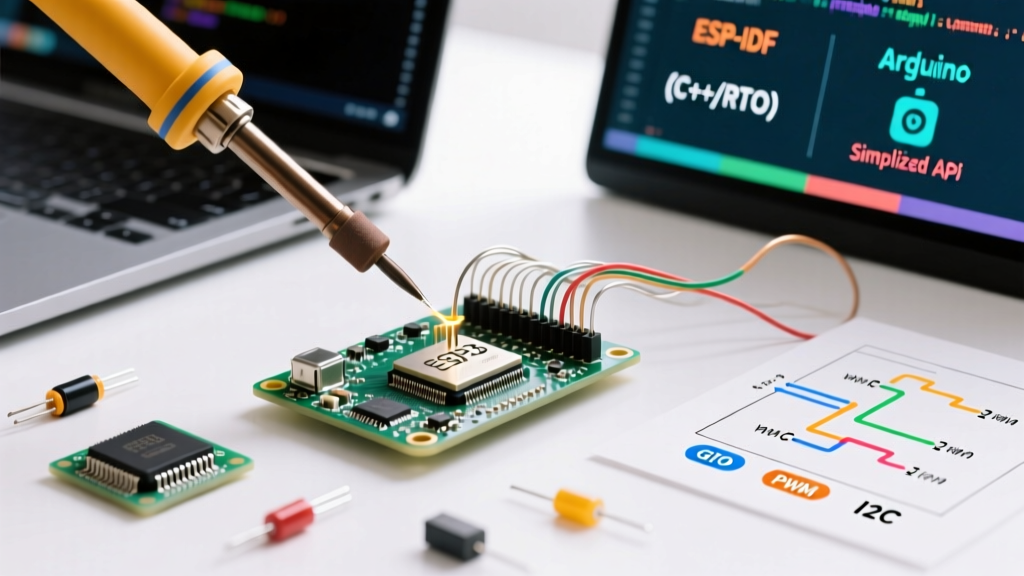
The most common misconception is that Arduino and ESP-IDF are entirely separate entities. In reality, the Arduino core for ESP32 (arduino-esp32) is built on top of ESP-IDF. Arduino functions as a C++ abstraction layer and an ESP-IDF component. When you call WiFi.begin() in Arduino, it translates down into ESP-IDF's esp_wifi_start() and FreeRTOS event groups. The difference lies in control versus convenience. Arduino hides the RTOS task management, partition tables, and hardware abstraction layer (HAL) configurations behind simple classes, whereas ESP-IDF exposes every register, clock gate, and memory allocation directly to the developer.
2. How does memory and binary overhead compare on ESP32-S3?
For resource-constrained applications, the overhead of the Arduino wrapper is significant. The Arduino core automatically initializes peripherals, mounts the SPIFFS/LittleFS filesystems, and starts background RTOS tasks for WiFi and Bluetooth event handling during the setup() phase.
- IRAM/DRAM Usage: A standard Arduino sketch consumes roughly 45 KB of SRAM just to boot and initialize the WiFi stack. A bare-metal ESP-IDF application, stripped of unnecessary logging and with aggressive compiler optimization (
-Os), can boot and run a basic TCP server using under 18 KB of SRAM. - Flash Wear: Arduino's default partition table often allocates massive OTA (Over-The-Air) slots. ESP-IDF allows you to define custom CSV partition tables, squeezing a factory image, two OTA slots, and an NVS (Non-Volatile Storage) partition into a 4 MB flash chip with zero wasted space.
3. When MUST I use native ESP-IDF over Arduino?
While Arduino is phenomenal for rapid prototyping, you must migrate to native ESP-IDF in the following 2026 scenarios:
- ESP32-C6 / H2 Thread and Matter Support: If you are building smart home devices using the 802.15.4 Thread protocol or Matter, the Arduino core lacks robust, stable support for the OpenThread stack. Native ESP-IDF provides day-one integration with the Espressif Matter SDK.
- Ultra-Low Power Edge Devices: Achieving true micro-amp deep sleep requires precise RTC (Real-Time Clock) domain isolation. In ESP-IDF, you use
rtc_gpio_isolate()and configure themenuconfigto power down specific LDO regulators. Arduino'sesp_deep_sleep_start()often leaves peripheral regulators energized, draining batteries in remote IoT sensors. - Secure Boot and Flash Encryption: Implementing hardware-level RSA-3072 secure boot chains and AES-256 flash encryption requires direct manipulation of the eFuse registers and bootloader configurations, which the Arduino IDE completely abstracts away and hides from the user.
4. Can I use Arduino libraries inside an ESP-IDF project?
Yes. This hybrid approach is the industry standard for commercial IoT products in 2026. You can configure your ESP-IDF project to include the Arduino core as a managed component. This allows you to write your main application logic in C++ using familiar Arduino libraries (like FastLED or PubSubClient), while retaining access to menuconfig, custom FreeRTOS task pinning, and native ESP-IDF drivers for complex peripherals like the I2S audio bus or the RMT (Remote Control) peripheral.
Pro-Tip: When using Arduino as an ESP-IDF component, you bypass the Arduino IDE entirely. You compile usingidf.py buildand manage dependencies via theidf_component.ymlfile, giving you the best of both worlds.
5. How do CI/CD and Fleet Management differ?
If you are manufacturing more than 500 units, CI/CD (Continuous Integration/Continuous Deployment) is non-negotiable.
- Arduino: Headless compilation via the Arduino CLI is possible but brittle. Managing board definitions, library versions, and custom partition tables across a fleet of GitHub Actions runners is notoriously difficult.
- ESP-IDF / PlatformIO: Native ESP-IDF uses CMake and standard GCC toolchains. You can lock your toolchain version, SDK version, and component hashes in a single repository. For automated testing, ESP-IDF includes the
pytest-based Unity testing framework, allowing you to flash a test firmware to a hardware-in-the-loop (HIL) rig and validate GPIO states over serial automatically.
Deep Dive: Power Consumption Edge Cases
Let us look at a real-world edge case: an ESP32-S3-WROOM-1 module running on a 2000mAh LiPo battery, waking up every 10 minutes to read a BME280 sensor and transmit via WiFi.
In the Arduino framework, developers often call WiFi.disconnect(true) and esp_deep_sleep_start(). However, without explicitly disabling the ADC and isolating the I2C pins, the pull-up resistors and peripheral leakage will draw roughly 45 µA during sleep. Over a year, this parasitic drain will deplete the battery.
In ESP-IDF, the developer writes a dedicated power-management task that calls esp_pm_configure() to enable dynamic frequency scaling (DFS) and automatic light-sleep when the CPU is idle. Before deep sleep, the developer explicitly calls rtc_gpio_isolate(GPIO_NUM_4) on the I2C lines and powers down the external sensor's MOSFET. The resulting sleep current drops to 6 µA, extending the battery life by over 40%.
The Final Verdict: Which Should You Choose?
Your choice between ESP-IDF vs Arduino framework ultimately depends on your project lifecycle stage and hardware targets.
- Choose Arduino if: You are building a proof-of-concept, a hobby project, an educational tool, or a simple data-logger where time-to-market is measured in hours, and a 300 KB binary size is irrelevant.
- Choose ESP-IDF if: You are engineering a commercial product, require Thread/Matter support on the C6/H2, need to pass strict EMC/FCC certifications (which require precise RF PHY layer tuning via sdkconfig), or are deploying a fleet of OTA-updatable devices where binary size and boot speed are critical.
Authoritative Resources for Further Reading
To master either toolchain, rely on the official documentation rather than outdated forum posts. The ecosystem moves too fast for third-party tutorials to remain accurate.
- For native development, consult the Espressif ESP-IDF Programming Guide. Pay special attention to the 'API Reference' and 'Migration Guides' when moving between v5.x releases.
- To understand what the Arduino core is doing under the hood, review the official arduino-esp32 GitHub Repository. The 'tools' and 'cores' directories reveal exactly how the C++ wrappers map to the IDF HAL.
- For professional build environments that bridge the gap between both frameworks, the PlatformIO ESP32 Documentation is the gold standard for managing toolchains, custom board definitions, and CI/CD pipelines in VS Code.