
The Core Concept: What is the Arduino STM32 Ecosystem?
For over a decade, the 8-bit ATmega328P has been the undisputed workhorse of the maker community. However, as projects evolve from simple LED blinkers to complex motor control, digital signal processing (DSP), and high-speed data acquisition, the 16MHz clock and 2KB SRAM of the AVR architecture become severe bottlenecks. This is where the Arduino STM32 paradigm bridges the gap. By leveraging the official STM32duino core, developers can program 32-bit ARM Cortex-M microcontrollers using the familiar Arduino IDE and syntax, while accessing hardware performance that rivals professional embedded systems.
It is critical to distinguish between the legacy 'Maple' core (popularized around 2015 for the STM32F103) and the modern, officially supported STM32duino core maintained by STMicroelectronics. In 2026, the legacy core is effectively deprecated. The modern core utilizes ST's Hardware Abstraction Layer (HAL) and Low-Layer (LL) APIs, ensuring compatibility across the entire STMicroelectronics STM32 portfolio, from the entry-level Cortex-M0+ to the high-performance Cortex-M7.
The 2026 Hardware Landscape: Beyond the Blue Pill
If you search for STM32 maker boards, you will inevitably encounter the 'Blue Pill' (STM32F103C8T6). Do not buy it in 2026. The market is saturated with counterfeit CS32F103 clones that exhibit erratic ADC behavior and USB enumeration failures. Instead, the community has standardized on the 'Black Pill' and official Nucleo boards.
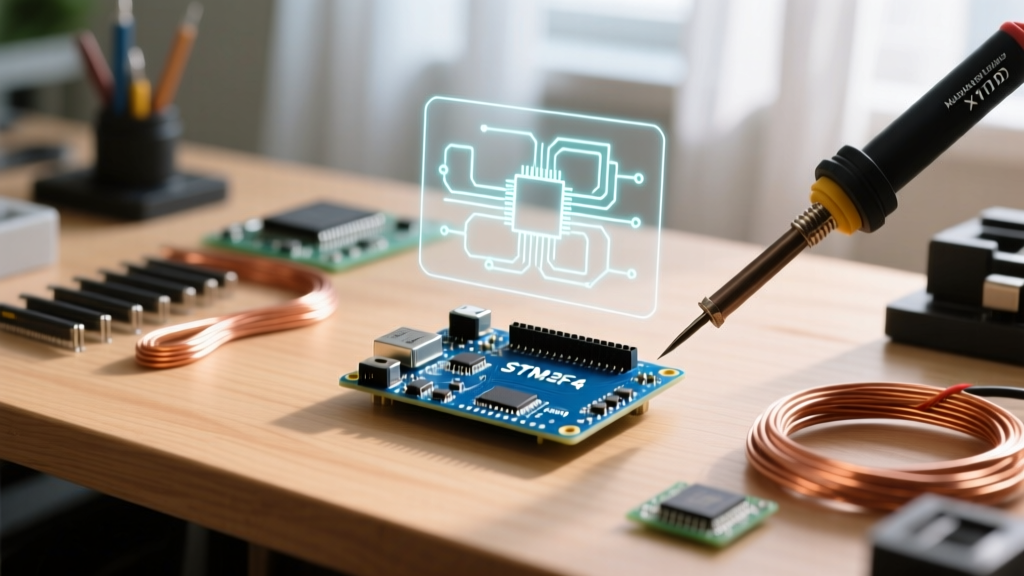
- WeAct Studio STM32F411CEU6 (Black Pill v2.0): Priced around $6.50, this board features a 100MHz Cortex-M4F with a hardware Floating Point Unit (FPU), 512KB Flash, and 128KB SRAM. It includes a native USB-C connector and an onboard QSPI flash footprint.
- ST Nucleo-64 (e.g., NUCLEO-F446RE or NUCLEO-G474RE): Priced between $18.00 and $22.00, these official ST evaluation boards include an integrated ST-Link V2-1 debugger. This allows for hardware breakpoints, single-stepping, and real-time variable monitoring directly within the Arduino IDE or STM32CubeIDE.
- DevEBox STM32H750VBT6: For roughly $14.00, makers can access a 480MHz Cortex-M7 powerhouse, ideal for real-time audio processing and camera interfaces.
Technical Comparison Matrix: AVR vs. ARM Cortex-M
| Microcontroller | Architecture | Clock Speed | Flash / SRAM | FPU / DSP | Typical Price (2026) |
|---|---|---|---|---|---|
| ATmega328P (Uno) | 8-bit AVR | 16 MHz | 32KB / 2KB | No | $27.00 (Official) |
| STM32F103C8T6 (Blue Pill) | 32-bit Cortex-M3 | 72 MHz | 64KB / 20KB | No | $3.00 (Clone) |
| STM32F411CEU6 (Black Pill) | 32-bit Cortex-M4F | 100 MHz | 512KB / 128KB | Single Precision | $6.50 |
| STM32G474RET6 (Nucleo) | 32-bit Cortex-M4F | 170 MHz | 512KB / 128KB | Single Precision + Math Accelerator | $21.00 |
The Software Bridge: Abstraction vs. Performance
The primary appeal of using STM32 hardware with the Arduino IDE is the abstraction of complex clock trees and peripheral initialization. However, this abstraction carries a performance tax. When you call digitalWrite(PA5, HIGH) on an STM32, the Arduino core routes this through the HAL layer, which checks pin validity, maps the port, and executes the write. This takes approximately 40 to 60 clock cycles.
For high-frequency applications like software-defined PWM or bit-banging WS2812B LEDs, this latency is unacceptable. Expert developers bypass the HAL by accessing the ARM memory-mapped registers directly. Using the Bit Set/Reset Register (BSRR), you can toggle a pin in a single clock cycle:
Expert Code Snippet:
GPIOA->BSRR = GPIO_PIN_5; // Set PA5 HIGH atomically
GPIOA->BSRR = GPIO_PIN_5 << 16; // Set PA5 LOW atomically
By mixing standard Arduino functions for setup and I2C/SPI communication with direct register manipulation for time-critical loops, you achieve the best of both worlds: rapid development and bare-metal execution speed.
Real-World Failure Modes and Edge Cases
Migrating to 32-bit ARM introduces hardware complexities that do not exist on 8-bit AVRs. Understanding these failure modes is essential for debugging.
1. The HSE Crystal Mismatch (System Clock Bricking)
STM32 microcontrollers rely on an external high-speed oscillator (HSE) for precise timing. The Arduino board variant file defines a macro, typically HSE_VALUE, which tells the HAL what frequency the physical crystal is (e.g., 8MHz or 25MHz). If you buy a generic clone board with a 25MHz crystal but flash it using a board profile configured for 8MHz, the Phase-Locked Loop (PLL) will calculate an invalid system clock. The MCU will hard-fault immediately upon boot, and USB CDC serial will fail to enumerate. Fix: Always verify the physical crystal frequency on your board's silkscreen and match it in the IDE's 'Tools > Board Part Number' menu.
2. SWD Lockout via GPIO Pin Mapping
Unlike AVRs, STM32 debugging pins (PA13 for SWDIO, PA14 for SWCLK) are shared with standard GPIOs. If your sketch configures these pins as standard outputs or inputs and uploads successfully, the ST-Link debugger will lose communication on the next flash attempt. Fix: You do not need to throw the board away. Press and hold the physical RESET button on the board. Click 'Upload' in the Arduino IDE. Watch the console, and release the RESET button the exact millisecond the IDE outputs 'Connecting to target via SWD'. This forces the MCU into its system memory bootloader before your sketch can hijack the SWD pins.
3. USB CDC vs. Hardware UART Confusion
On an Arduino Uno, Serial.print() transmits over hardware UART pins 0 and 1. On most STM32 boards, Serial defaults to the internal USB CDC (Communications Device Class) peripheral. If you are trying to communicate with a PC via a physical USB cable, this is correct. However, if you are trying to transmit data to a GPS module or secondary MCU via physical wires, you must use HardwareSerial Serial1(PA10, PA9); (RX, TX) to map the hardware UART to specific pins.
Decision Framework: When to Choose STM32
Should you use an ESP32 or an STM32? The ESP32 dominates in IoT, WiFi, and Bluetooth applications, and its dual-core 240MHz architecture is formidable. However, the Arduino STM32 ecosystem is the superior choice in the following scenarios:
- Precision Analog and Motor Control: STM32G4 series chips feature hardware operational amplifiers, 12-bit ADCs sampling at 4.27 MSPS, and advanced timers with dead-time insertion for Field Oriented Control (FOC) of BLDC motors.
- Deterministic Timing: The ESP32's WiFi stack runs on an RTOS that can introduce microsecond-level jitter in interrupt service routines (ISRs). STM32 offers bare-metal deterministic execution, critical for high-speed encoders and protocol decoding.
- Industrial Interfaces: Native support for CAN-FD, FDCAN, and hardware CRC calculation makes STM32 the default for automotive and industrial robotics prototyping.
By mastering the Arduino STM32 workflow, makers unlock a professional-grade silicon ecosystem without abandoning the rapid-prototyping tools they already know.