
The Cognitive Tax of Context-Switching at the Workbench
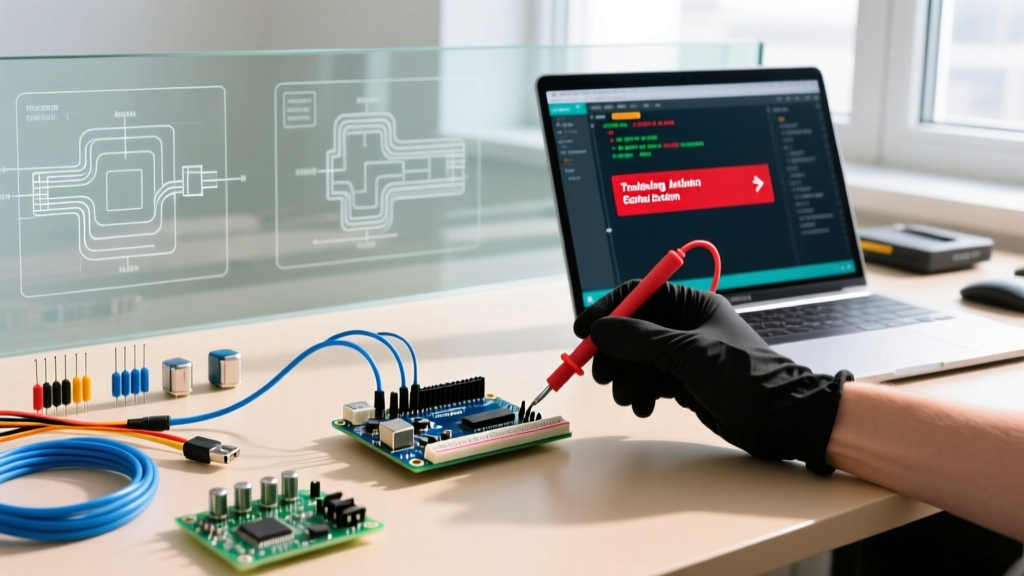
In embedded systems development, flow state is your most valuable resource. When you are debugging a complex I2C bus collision or tracing a floating ground on a breadboard, shifting your attention to a web browser to verify an ATmega328P-PU pinout or check C++ syntax introduces a severe cognitive tax. According to research on human-computer interaction by the Nielsen Norman Group, context-switching between physical hardware manipulation and digital documentation can increase task completion time by up to 40% while simultaneously elevating error rates.
For multilingual engineering labs, global maker spaces, and bilingual educational environments, this problem is compounded by language barriers. Relying on browser-based auto-translation plugins to read technical documentation often results in mangled C++ syntax, incorrectly translated variable types (such as translating the data type 'float' into a non-technical verb), and corrupted code snippets. This is where integrating a dedicated, professionally formatted arduino pdf libro—a comprehensive, localized Spanish-language Arduino PDF manual or textbook—into your physical bench workflow becomes a critical optimization strategy.
Why a Localized Offline PDF Outperforms Browser Tabs
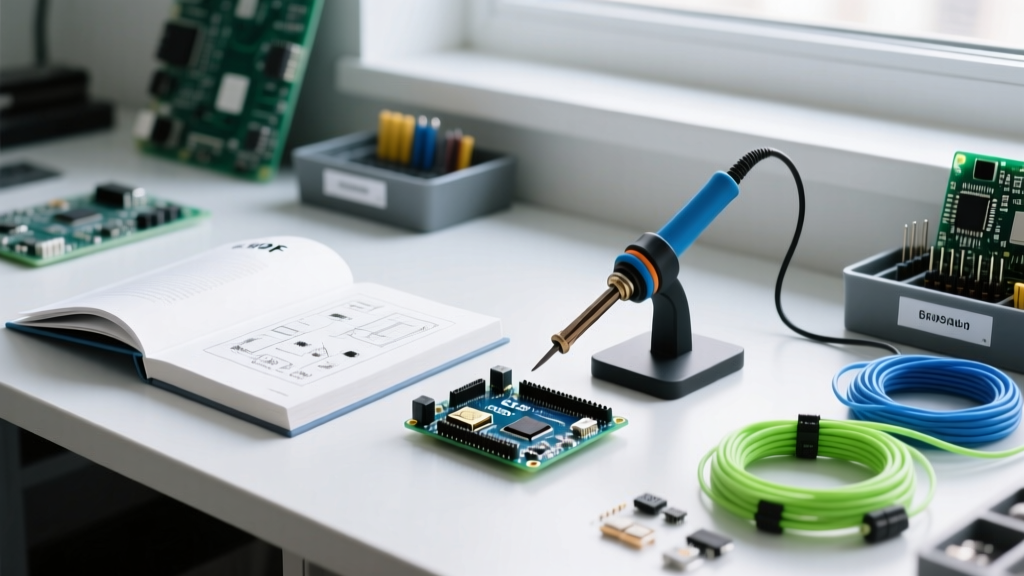
An optimized workbench requires documentation to be immutable, instantly accessible, and free from the formatting inconsistencies of responsive web design. A high-quality arduino pdf libro provides a fixed-layout reference that preserves code blocks, wiring diagrams, and timing charts exactly as the author intended.
| Medium | Code Integrity | Glare / Eye Strain | Offline Availability | Auto-Translate Risk |
|---|---|---|---|---|
| Browser Tabs (Wiki/Docs) | High (but responsive wrapping breaks long lines) | High (Backlit LCD/OLED) | Poor (Requires stable Wi-Fi) | High (Plugins corrupt syntax) |
| Physical Printed Book | Perfect | None (Reflective paper) | Perfect | None |
| Dedicated E-Ink PDF Node | Perfect (Fixed layout) | Minimal (E-Paper technology) | Perfect (Local storage) | None (Pre-translated) |
By sourcing a reliable arduino pdf libro and hosting it on a dedicated local device, you eliminate the risk of a CMS update breaking the layout of a crucial SPI timing diagram. Furthermore, having the documentation in your native or preferred working language ensures that complex concepts—like pointer arithmetic or interrupt service routines (ISRs)—are understood without the friction of mental translation.
Hardware Integration: Building a Dedicated Reference Node
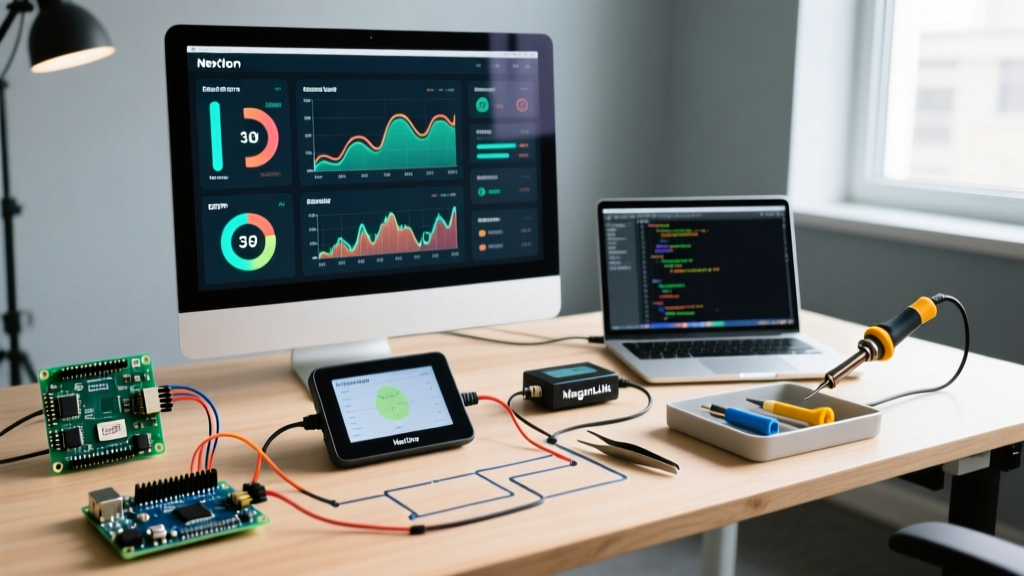
To truly optimize your workflow, the PDF should not live on the same machine running your Arduino IDE. Compiling, serial monitoring, and schematic capture require your primary display. Your reference documentation should live on a secondary, dedicated 'node' positioned directly above your breadboard. Here are two highly specific, field-tested hardware configurations for 2026.
Option A: The Waveshare E-Ink Dashboard (Budget & Low Glare)
E-ink displays are the ultimate bench companion because they emit zero backlight, reducing eye strain during late-night debugging sessions. The Waveshare 7.5inch e-Paper HAT (Resolution 800x480) is an ideal candidate.
- Cost: ~$38 USD (Display + HAT) + $15 (Raspberry Pi Zero 2 W).
- Wiring: Connects via SPI. MOSI to GPIO 10, SCK to GPIO 11, CS to GPIO 8, DC to GPIO 25, RST to GPIO 17, BUSY to GPIO 24.
- Workflow Execution: Write a lightweight Python script using the
Pillowlibrary to render specific pages of your arduino pdf libro as static images. Because e-ink only draws power during a screen refresh, you can map a physical rotary encoder to turn the pages of the PDF. The screen retains the image (e.g., an I2C address table for the SSD1306 OLED) even if the Pi loses power. - Limitation: Standard e-ink has a 15-second full refresh rate. This setup is strictly for static reference pages, not for scrolling through text dynamically.
Option B: Ruggedized Tablet Mount (High Interactivity)
If your workflow requires searching through a 600-page arduino pdf libro, copying hex codes, or zooming into complex EagleCAD schematic exports embedded in the PDF, an e-ink display is too slow. Instead, utilize a ruggedized tablet mounted on an articulated arm (like the Ergotron LX).
- Hardware: Samsung Galaxy Tab Active3 (SM-T570) or equivalent 2026 rugged enterprise tablet.
- Cost: ~$349 USD.
- Key Feature: The Active3 features 'Glove Mode' and physical navigation buttons. When your hands are covered in flux residue or you are wearing ESD gloves, you can physically click the side buttons to scroll through your PDF libro without smearing a capacitive touchscreen.
- Software Stack: Use PDF-XChange Editor or Xodo with OCR (Optical Character Recognition) enabled. This allows you to highlight a specific memory address in the PDF and instantly copy it to a shared local clipboard accessible by your main IDE machine via KDE Connect or similar local-network tools.
Optimizing the PDF for Rapid Bench Retrieval
Simply having the file is not enough; the document must be engineered for rapid retrieval. When dealing with a massive arduino pdf libro, implement the following structural optimizations before loading it onto your bench node:
- Inject Hyperlinked Bookmarks: Use Adobe Acrobat or Foxit PhantomPDF to create a nested bookmark tree. Top-level nodes should be categorized by workflow phase: 1. IDE & Compilation Errors, 2. Core Syntax & Pointers, 3. AVR/ARM Pinouts, 4. Communication Protocols (I2C/SPI/UART).
- Flatten Vector Graphics: Many community-translated PDF books suffer from bloated file sizes due to unoptimized CAD exports. Run the PDF through a Ghostscript compression pipeline (
gs -sDEVICE=pdfwrite -dCompatibilityLevel=1.4 -dNOPAUSE -dQUIET -dBATCH -sOutputFile=optimized.pdf original.pdf) to reduce file size and eliminate rendering lag on low-power bench tablets. - Create a 'Cheat Sheet' Appendix: Manually append a 5-page high-contrast summary at the end of the document containing the most frequently referenced data: the standard Arduino Uno R3 / ATmega328P pin mapping, common I2C pull-up resistor calculations, and standard baud rate divisors.
Edge Cases and Troubleshooting
When integrating localized PDF documentation into a professional lab environment, you will encounter specific edge cases that disrupt workflow if not anticipated.
Code Block Formatting Loss
The Issue: In many community-driven translations of an arduino pdf libro, the original formatting of C++ code blocks is lost, causing indentation to collapse. In Python (MicroPython/CircuitPython) or complex C++ macros, this makes the code unreadable.
The Fix: Always cross-reference critical code structures with the official Arduino Language Reference. Use the PDF libro for conceptual understanding, architectural explanations, and wiring theory, but rely on the IDE's auto-formatter (Ctrl+T) to fix syntax indentation before compiling.
Outdated Library References
The Issue: A PDF book published or translated in 2022 may reference deprecated library functions (e.g., using the legacy Wire.send() instead of the modern Wire.write()).
The Fix: Maintain a physical 'Errata' sticky note on the bezel of your reference monitor. Whenever you encounter a deprecated function in the libro, log it on the errata sheet. This builds a localized, lab-specific knowledge base that prevents junior engineers from falling into the same compilation traps.
Conclusion: Reclaiming Your Flow State
Optimizing your microcontroller workflow is rarely about writing code faster; it is about removing the friction between thought and execution. By integrating a dedicated, localized arduino pdf libro into a secondary, purpose-built bench node, you insulate your development process from internet outages, auto-translation errors, and the cognitive drain of alt-tabbing. Whether you choose a low-glare Waveshare e-ink dashboard or a ruggedized tablet with physical buttons, treating your documentation as a physical, immutable tool rather than a fleeting browser tab will yield measurable improvements in your prototyping speed and debugging accuracy.