
The Paradigm Shift: From 8-Bit AVR to 32-Bit ARM
For years, the 5V ATmega328P-powered Arduino Uno was the undisputed king of the maker bench. However, the rise of the Internet of Things (IoT) and the demand for ultra-low-power, battery-operated edge devices exposed the limitations of 8-bit AVR architecture. Enter the Arduino MKR family. Launched to bridge the gap between hobbyist accessibility and professional industrial IoT deployment, the MKR series represents a fundamental shift to 32-bit ARM Cortex-M0+ silicon.
At the heart of almost every MKR board is the Microchip ATSAMD21G18A microcontroller. Running at 48 MHz, it boasts 256 KB of Flash memory and 32 KB of SRAM—a massive leap over the Uno’s 16 MHz clock, 32 KB Flash, and 2 KB SRAM. This architectural leap allows MKR boards to handle TLS encryption, complex JSON parsing, and multithreaded sensor polling without the memory bottlenecks that plague legacy AVR boards.
Arduino MKR Board Comparison Matrix (2026 Lineup)
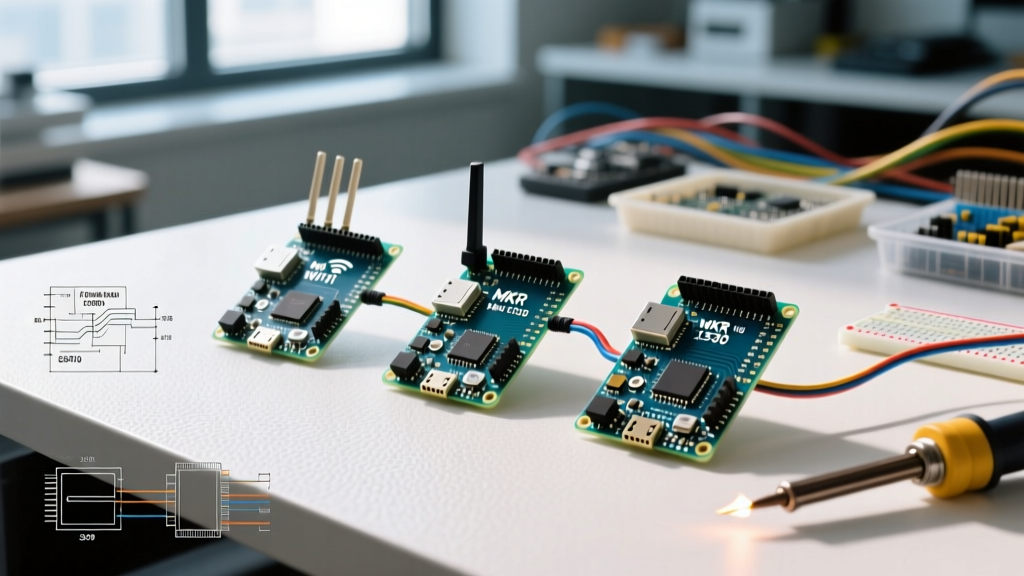
The MKR form factor is standardized, measuring just 61.5 mm x 25 mm, making it ideal for custom PCB integration or breadboarding. Below is a technical comparison of the core MKR IoT models available in 2026, including estimated retail pricing and primary use cases.
| Board Model | Connectivity Module | Best Use Case | Approx. Price (2026) |
|---|---|---|---|
| MKR WiFi 1010 | u-blox NINA-W102 (ESP32-based) | Smart home nodes, high-bandwidth local IoT, Arduino IoT Cloud | $35.00 - $38.00 |
| MKR WAN 1310 | Murata CMWX1ZZABZ (LoRa/Sigfox) | Agricultural sensors, remote telemetry, off-grid asset tracking | $48.00 - $52.00 |
| MKR NB 1500 | u-blox SARA-R410M (LTE Cat M1/NB-IoT) | Cellular IoT, fleet tracking, municipal infrastructure monitoring | $60.00 - $68.00 |
| MKR GSM 1400 | u-blox SARA-U201 (2G/3G) | Legacy cellular fallback regions (Phasing out in many markets) | $55.00 - $60.00 |
| MKR Zero | None (Base SAMD21 board) | Audio processing, custom carrier boards, low-power data logging | $28.00 - $32.00 |
Crucial Concept: The 3.3V Logic Constraint
The most common point of failure for engineers migrating from the Uno/Nano ecosystem to the Arduino MKR family is ignoring the logic level voltage. Every MKR board operates strictly at 3.3V logic. The SAMD21 GPIO pins are not 5V tolerant.
⚠️ CRITICAL WARNING: Connecting a standard 5V HC-SR04 ultrasonic sensor, a 5V I2C OLED display, or a 5V relay module directly to an MKR GPIO pin will permanently destroy the SAMD21 silicon. The absolute maximum voltage rating on any I/O pin is 3.6V.
The Solution: When interfacing with 5V legacy sensors, you must use a bidirectional logic level shifter. The Texas Instruments TXS0108E or the BSS138-based MOSFET level shifters are standard, low-cost ($2–$4) solutions. For I2C devices, ensure you use level shifters specifically designed for I2C pull-up capacitance to avoid bus locking.
Integrated Power Management and Li-Po Charging
Unlike the Uno, which requires a bulky external power supply or constant USB tethering, the MKR family was engineered for autonomous, battery-powered deployment. Every MKR board features an integrated MCP73831 Li-Po charge management controller.
- Charging Rate: The onboard circuit charges a connected 3.7V Lithium-Polymer battery at a safe 350 mA when the board is powered via USB.
- Automatic Switchover: If USB power is disconnected, the board seamlessly transitions to battery power without resetting the microcontroller or dropping the network connection.
- Deep Sleep Capabilities: By utilizing the
ArduinoLowPowerlibrary and putting the SAMD21 into standby mode, an MKR board can reduce its quiescent current draw to roughly 10 µA to 40 µA (excluding external sensor leakage). This allows a standard 2000 mAh Li-Po battery to power a sleeping node for several years, waking only via RTC (Real-Time Clock) alarms or external pin interrupts.
Hardware Security: The ECC608 CryptoAuthentication Chip
In modern IoT deployments, software-based encryption is vulnerable to memory scraping and key extraction. To solve this, Arduino integrated the Microchip ATECC608A (specifically the Trust&GO pre-provisioned variant) onto boards like the MKR WiFi 1010 and MKR WAN 1310.
This dedicated cryptographic co-processor handles TLS handshakes, SHA-256 hashing, and ECDSA signature generation in isolated hardware. Crucially, it stores your private X.509 certificates in a tamper-resistant EEPROM. When connecting to AWS IoT Core, Azure IoT Hub, or the Arduino IoT Cloud, the private key never leaves the ECC608 chip, ensuring that even if the SAMD21 firmware is compromised, the device's cryptographic identity remains secure.
Real-World Failure Modes and Troubleshooting
Working with the MKR family requires an understanding of its specific hardware quirks. Below are three common edge cases and their engineering solutions.
1. The Native USB Port Crash and Bootloader Rescue
The SAMD21 uses a "Native USB" architecture, meaning the USB CDC (Communication Device Class) serial stack runs in user firmware, not in a separate hardware UART chip like the ATmega16U2 on the Uno. If your sketch contains a bug that crashes the MCU or halts the USB stack before initialization, the board will disappear from your OS device manager, making it impossible to upload a fixed sketch.
The Fix: You must manually trigger the ROM bootloader. Locate the small RST (Reset) button on the MKR PCB. Double-tap the reset button quickly. The onboard LED will pulse slowly, indicating the bootloader is active and the board has mounted as a new COM port. Select this new port in the Arduino IDE and upload your corrected code.
2. U.FL Antenna Connector Delamination
Boards like the MKR WAN 1310 and MKR NB 1500 utilize surface-mount U.FL (IPX) connectors for external cellular or LoRa antennas. These connectors are notoriously fragile and are typically rated for only 30 mating cycles.
The Fix: Never pull the antenna cable by the wire. Use a specialized U.FL removal tool or a small flathead jeweler's screwdriver to gently pry the metal collar upward. If you are designing a custom enclosure, secure the U.FL pigtail with a dab of hot glue or RTV silicone on the cable jacket (never on the connector itself) to prevent mechanical stress from ripping the SMD pads off the PCB.
3. Deep Sleep Current Leakage via I/O Pins
Makers frequently report that their MKR board draws 2 mA instead of the expected 15 µA during deep sleep. This is almost always caused by external peripherals.
The Fix: If a GPIO pin is configured as an INPUT and is connected to a circuit that drops to 0V during sleep, the SAMD21's internal protection diodes may forward-bias, or the pin may float, causing the internal logic gates to oscillate and draw current. Before entering sleep mode, use pinMode(pin, INPUT_PULLUP) or pinMode(pin, OUTPUT) (driving LOW) on all unused or external pins to eliminate floating states and parasitic leakage paths.
Summary
The Arduino MKR family is not merely a smaller Arduino; it is a professional-grade IoT platform wrapped in a maker-friendly ecosystem. By respecting the 3.3V logic boundaries, leveraging the integrated Li-Po charging circuit, and utilizing the onboard ECC608 hardware security, engineers can deploy robust, secure, and ultra-low-power edge nodes that rival custom-designed industrial hardware. For complete pinout diagrams and schematic reviews, always refer to the official Arduino hardware documentation before finalizing your PCB designs.