
The Deceptive Simplicity of Conditional Logic
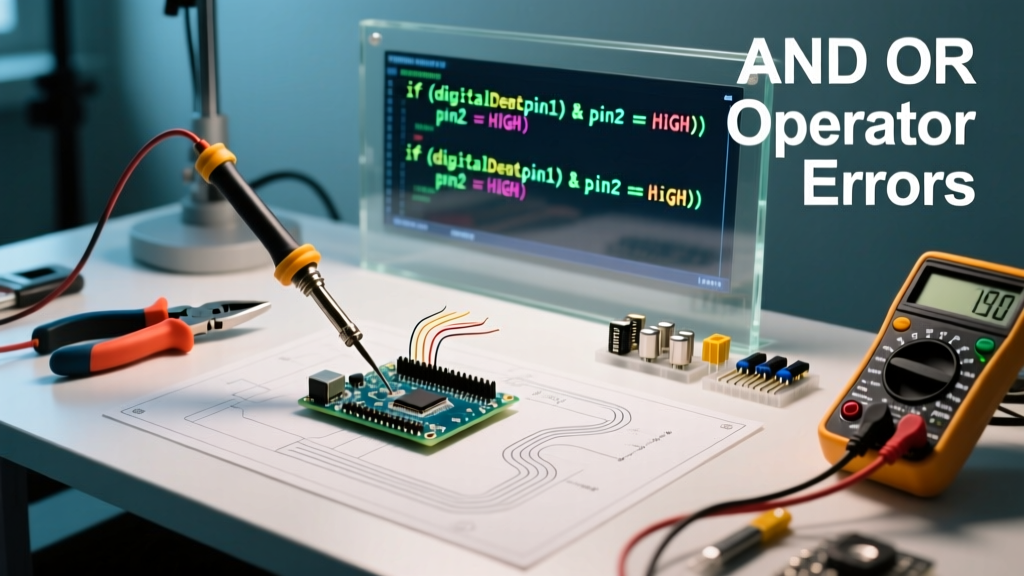
When your sketch compiles flawlessly but your relays chatter unpredictably, or your I2C sensors return ghost data, the culprit is rarely a hardware failure. More often than not, the root cause lies in a fundamental misunderstanding of conditional logic. Specifically, mastering the Arduino AND OR operators is a rite of passage for every embedded systems engineer. While the concepts of logical conjunction and disjunction seem trivial, the underlying C++ implementation on microcontrollers introduces severe edge cases that can silently corrupt your program's state.
In 2026, with the Arduino IDE 2.3.x enforcing stricter type-checking and modern boards like the Uno R4 Minima and Nano ESP32 running complex RTOS-backed cores, writing sloppy conditional statements will result in immediate compilation halts or catastrophic runtime logic failures. This diagnostic guide dissects the most common syntax and logic errors surrounding AND/OR operations and provides actionable protocols to fix them.
Compilation Errors: The 'English Word' Syntax Trap
A frequent error among makers transitioning from Python or JavaScript to C++ is attempting to use English words for logical operators. You might write:
if (digitalRead(2) == HIGH and digitalRead(3) == LOW) {
  // Trigger alarm
}
Depending on your specific board core and compiler flags, the AVR-GCC or ARM-GCC compiler will throw an error such as error: 'and' was not declared in this scope or stray 'and' in program.
The C++ Alternative Token Nuance
Technically, the C++ standard defines and, or, and not as alternative tokens for &&, ||, and ! via the <iso646.h> header (or natively in modern C++). However, the Arduino environment does not include these headers by default in standard sketch inclusions to save flash memory on legacy ATmega328P chips.
Diagnostic Fix: Never rely on alternative tokens in embedded C++. Always use the standard symbolic operators&&(Logical AND) and||(Logical OR). This ensures cross-compatibility across all Arduino cores, from the legacy AVR to the ESP32-S3.
The Silent Killer: Bitwise vs. Logical Operators
The most dangerous Arduino AND OR error does not trigger a compiler warning. It compiles perfectly, uploads successfully, and then causes intermittent hardware failures. This occurs when a developer accidentally uses bitwise operators (&, |) instead of logical operators (&&, ||).
The Binary Math Behind the Bug
Consider a scenario where a sensor returns a status code, and you want to check if the status is non-zero alongside another condition:
int sensorStatus = 5; // Binary: 0101
int errorCode = 2;    // Binary: 0010

// FLAWED LOGIC (Bitwise AND)
if (sensorStatus & errorCode) {
  Serial.println("System Active");
}
Why does this fail? The bitwise AND (&) compares the numbers bit-by-bit. 0101 & 0010 results in 0000 (Decimal 0). In C++, 0 evaluates to FALSE. The if block is skipped, even though both variables hold non-zero, 'true' values.
If you use the logical AND (&&), the compiler evaluates the truthiness of the variables: TRUE && TRUE results in TRUE.
| Expression | Operator Type | Evaluation Method | Result (5, 2) | Boolean Outcome |
|---|---|---|---|---|
A && B |
Logical AND | Truthiness of whole values | True && True | TRUE (1) |
A & B |
Bitwise AND | Bit-by-bit comparison | 0101 & 0010 = 0000 | FALSE (0) |
A || B |
Logical OR | Truthiness of whole values | True || True | TRUE (1) |
A | B |
Bitwise OR | Bit-by-bit combination | 0101 | 0010 = 0111 | TRUE (7) |
For a deeper understanding of how the Arduino core handles these boolean structures, refer to the official Arduino Logical AND Reference and the Logical OR Documentation.
Short-Circuit Evaluation and I2C Bus Crashes
Logical operators (&&, ||) utilize short-circuit evaluation. This means the compiler stops evaluating the expression the moment the final boolean outcome is guaranteed. Bitwise operators (&, |) do not; they forcefully evaluate both sides of the equation.
This distinction is critical when interacting with hardware buses like I2C or SPI, where function calls have side effects.
// DANGEROUS: Using Bitwise AND
if (Wire.requestFrom(0x68, 1) & Wire.available()) {
  byte data = Wire.read();
}
The Failure Mode: If Wire.requestFrom() fails (returns 0 bytes), the logical AND (&&) would immediately abort, skipping Wire.available(). However, the bitwise AND (&) forces Wire.available() to execute anyway. It will check the I2C buffer, potentially find stale data left over from a previous successful transaction, and return TRUE. Your code then reads garbage data, leading to erratic motor behavior or corrupted SD card logs.
Operator Precedence: Why Compound Logic Fails
When combining multiple Arduino AND OR conditions, developers often omit parentheses, relying on assumed left-to-right reading. C++ operator precedence dictates otherwise. According to the C++ Operator Precedence Standard, logical AND (&&) binds tighter than logical OR (||).
The Precedence Trap
if (sensorA == HIGH || sensorB == HIGH && safetySwitch == CLOSED) {
  activateMotor();
}
Intended Logic: Turn on the motor if EITHER sensor is triggered AND the safety switch is closed.
Actual Compiled Logic: Turn on the motor if sensorA is HIGH, OR if (sensorB is HIGH AND safetySwitch is CLOSED). If sensorA trips, the motor activates even if the safety switch is open, creating a severe physical hazard.
Diagnostic Fix: Always use explicit parentheses to enforce execution order, regardless of your memory of the precedence table.
if ((sensorA == HIGH || sensorB == HIGH) && safetySwitch == CLOSED) {
  activateMotor();
}
Diagnostic Protocol: Isolating the Fault
When you suspect an AND/OR logic error is causing a sketch failure, follow this strict isolation protocol using the Serial Monitor (baud 115200):
- Extract and Print: Remove the variables from the
if()statement. Print their raw values to the Serial Monitor immediately before the conditional check.Serial.print("ValA: "); Serial.print(valA); Serial.print(" | ValB: "); Serial.println(valB); - Verify Types: Ensure you are not comparing a
boolto auint16_tusing bitwise operators. Cast variables explicitly if interacting with raw sensor registers. - Test Short-Circuiting: Insert a
Serial.println("Right side evaluated");inside the right-hand function of your conditional. If it prints when the left-hand side is demonstrably false, you are illegally using a bitwise&instead of a logical&&. - Parenthetical Bracketing: Wrap every individual comparison in its own set of parentheses.
((A == B) && (C != D)). Recompile and test. If the behavior corrects itself, you have identified a precedence error.
Summary of Best Practices for 2026
As microcontrollers become faster and codebases more complex, relying on implicit compiler behaviors is a liability. Always default to && and || for control flow logic. Reserve & and | exclusively for bitmasking hardware registers (e.g., PORTB |= (1 << PB5)). By treating the Arduino AND OR syntax with the rigorous respect that embedded C++ demands, you eliminate an entire category of ghost bugs, ensuring your hardware responds predictably every single time.