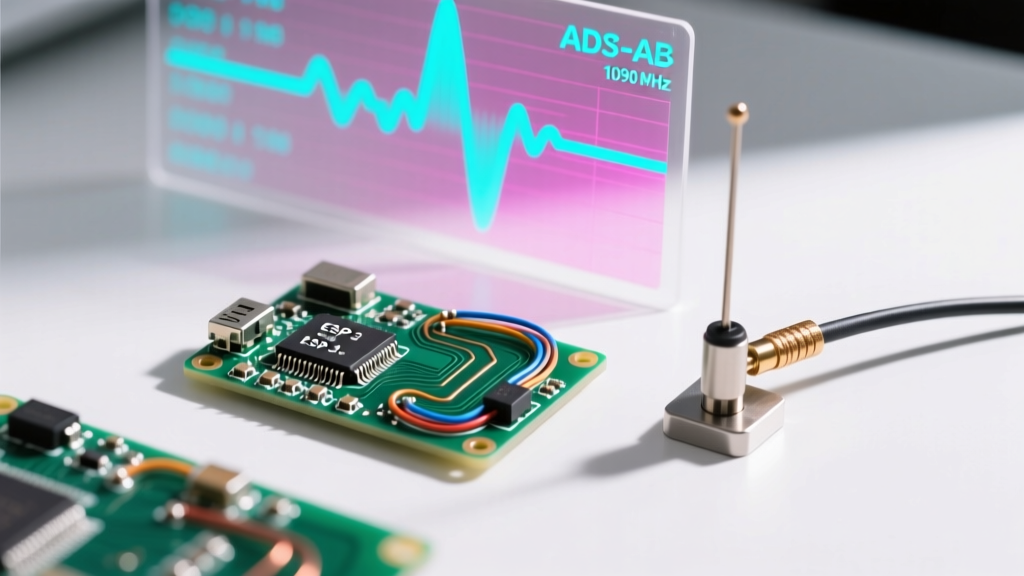

The Core Question: Can an Arduino Directly Decode ADS-B?
When makers search for an ADS-B receiver Arduino project, they are usually met with a harsh technical reality: standard AVR-based Arduino boards (like the Uno, Nano, or Mega) cannot natively demodulate or decode ADS-B signals. Automatic Dependent Surveillance-Broadcast (ADS-B) operates at 1090 MHz and utilizes Pulse Position Modulation (PPM) at a data rate of 1 Megabit per second (Mbps). According to the Nyquist-Shannon sampling theorem, capturing this signal requires an Analog-to-Digital Converter (ADC) sampling at a minimum of 2.4 Mega-samples per second (MSPS). The ATmega328P on an Arduino Uno maxes out at roughly 15 kilo-samples per second (kSPS)—a deficit of two orders of magnitude.
However, the maker community frequently uses 'Arduino' as a catch-all term for microcontroller development. By pivoting to modern, high-speed microcontrollers like the ESP32-S3 or utilizing an Arduino as a secondary display controller paired with a dedicated RF frontend, you can successfully build a DIY ADS-B tracking station. This quick-reference guide details the exact hardware architectures, wiring schemes, and parsing logic required to make microcontroller-based ADS-B receivers a reality in 2026.
Hardware Realities: Microcontroller ADS-B Capability Matrix
Before purchasing components, it is critical to select the right silicon. Below is a comparison of common development boards and their viability for 1090 MHz aviation tracking.
| Microcontroller | ADC / Sampling Rate | USB OTG Support | Role in ADS-B Receiver | Verdict |
|---|---|---|---|---|
| Arduino Uno (ATmega328P) | ~15 kSPS | No | Secondary UART Display | ❌ Cannot decode RF |
| Arduino Mega 2560 | ~15 kSPS | No | Multi-Sensor Data Aggregator | ❌ Cannot decode RF |
| ESP32-S3 DevKit | N/A (Relies on external USB) | Yes (Native USB) | Primary RTL-SDR Bridge | ✅ Highly Recommended |
| Raspberry Pi 4 / 5 | N/A (Linux Host) | Yes (Host) | Primary Decoder (dump1090) | ✅ Industry Standard |
The Working Architecture: ESP32-S3 as an RTL-SDR Bridge
To build a true microcontroller-based ADS-B receiver without a full Linux single-board computer, the ESP32-S3 is your best option in 2026. Unlike older ESP32 variants, the S3 features native USB On-The-Go (OTG) capabilities, allowing it to act as a USB host and communicate directly with an RTL-SDR dongle.
Required Bill of Materials (BOM)
- RTL-SDR Blog V4 Dongle: ~$35. Features the R820T2 tuner and a 1 PPM TCXO for frequency stability, which is critical for narrow-band aviation signals.
- ESP32-S3-DevKitC-1: ~$9. Ensure it has native USB pins (GPIO 19 and 20) broken out.
- 1090 MHz ADS-B Optimized Antenna: ~$25. A 5.5 dBi omnidirectional vertical dipole.
- 5V 3A USB-C Power Supply: Mandatory to prevent brownouts when the SDR spins up its internal LNA.
Power Delivery & Brownout Prevention
The most common failure mode in ESP32-to-RTL-SDR projects is a USB brownout. The RTL-SDR V4 can draw up to 320mA during heavy signal acquisition. The onboard 5V-to-3.3V LDO on most cheap ESP32-S3 dev boards will overheat and drop voltage if you route power through the board's internal regulator.
Expert Tip: Bypass the ESP32's internal 5V rail for the SDR. Use a dedicated 5V buck converter (like the Pololu D24V50F5) wired directly to the RTL-SDR's USB VBUS pin, sharing only the Ground and USB D+/D- data lines with the ESP32-S3.
Parsing the Beast Format via UART (AVR & ESP32)
If you are using a Raspberry Pi running dump1090-fa as your backend, you can use an Arduino Mega or ESP32 to read the decoded data and drive local physical displays (like OLEDs or servo-driven radar sweeps). The standard output format is the Beast binary format.
As detailed in Junzi Sun's authoritative text, The 1090MHz Riddle, the Beast format encapsulates Mode S and ADS-B messages with timestamps and signal strength metrics. A standard AVR Arduino can parse this via a hardware serial port (Serial1).
Beast Frame Structure Quick Reference
- Escape Character:
0x1A(Start of frame) - Message Type:
0x31(Mode-AC),0x32(Mode-S Short),0x33(Mode-S Long/ADS-B) - Timestamp: 6 bytes (MLAT timestamp)
- Signal Level: 1 byte
- Message Payload: 2, 7, or 14 bytes depending on type
- Byte Stuffing Rule: If
0x1Aappears in the payload, it is duplicated (0x1A 0x1A).
When writing your C++ sketch, you must implement a state machine that looks for the 0x1A escape byte, reads the type byte to determine the payload length, and handles the byte-stuffing edge cases. Failing to handle byte-stuffing will result in CRC checksum failures on roughly 4% of all received aircraft packets.
Antenna Tuning & SWR Targets for 1090 MHz
According to the RTL-SDR ADS-B Guide, antenna placement and tuning dictate your receiver's range more than any software filter. The speed of light divided by 1090 MHz yields a wavelength of exactly 27.52 cm.
- Quarter-Wave Monopole: 6.88 cm. Ideal for ground planes.
- Half-Wave Dipole: 13.76 cm per element.
- Target SWR: Below 1.5:1 at 1090 MHz. If your SWR exceeds 2.0:1, you are losing over 10% of your signal to coaxial reflection before it reaches the LNA.
- Placement: Elevation is king. A 1090 MHz antenna placed at 10 meters (33 feet) above ground level with a clear horizon will reliably track commercial airliners (flying at 35,000 ft) up to 250 nautical miles away due to line-of-sight RF propagation.
Frequently Asked Questions (FAQ)
Can I use an ESP8266 (NodeMCU) instead of an ESP32 for ADS-B?
No. The ESP8266 lacks native USB host capabilities and has insufficient RAM (typically 80KB usable) to buffer the TCP streams from FlightAware or a local PiAware instance while simultaneously driving a web server or display. The ESP32's dual-core architecture and 520KB SRAM make it the minimum viable microcontroller for network-bridged ADS-B data.
Why am I seeing 'ghost' aircraft or corrupted ICAO hex codes?
This is almost always caused by a poor SMA connection or an unshielded RTL-SDR dongle picking up local 1090 MHz noise from switching power supplies. Ensure your SMA pigtail is crimped (not soldered, which can melt the dielectric) and wrap your RTL-SDR in copper foil tape connected to the USB ground shield.
Do I need a 1090 MHz bandpass filter?
If you live within 5 miles of a cellular tower or FM broadcast antenna, yes. A 1090 MHz Surface Acoustic Wave (SAW) bandpass filter (typically costing around $15-$20) placed between the antenna and the RTL-SDR LNA will prevent strong out-of-band signals from desensitizing the R820T2 tuner's automatic gain control (AGC) loop.
Troubleshooting Matrix: ESP32 USB OTG Edge Cases
| Symptom | Probable Cause | Engineering Solution |
|---|---|---|
| ESP32-S3 boots, but RTL-SDR not enumerated | Insufficient 5V current on USB OTG VBUS | Inject 5V 2A+ externally to the SDR's VBUS pin; tie grounds together. |
| USB disconnects randomly every 10-15 mins | Thermal throttling of the SDR's internal LDO | Attach a 14x14mm aluminum heatsink to the RTL-SDR metal casing. |
| Garbage data on UART Serial output | Baud rate mismatch on Beast format stream | Verify dump1090 is outputting at 115200 baud, not the default 3000000 baud. |
| ESP32-S3 Watchdog Timer (WDT) resets | USB polling blocking the main loop | Move USB host tasks to Core 0, reserve Core 1 for display/network logic. |
Final Thoughts on Microcontroller Aviation Tracking
Building an ADS-B receiver with an Arduino-compatible microcontroller is a highly rewarding exercise in RF engineering, serial parsing, and power management. While you cannot bypass the laws of physics to make an ATmega328P sample at 2.4 MSPS, leveraging the ESP32-S3's USB host capabilities or using an AVR as a dedicated Beast-format display driver provides a robust, low-power alternative to leaving a Raspberry Pi running 24/7. Always prioritize antenna elevation and proper power delivery over software tweaks; in the world of 1090 MHz aviation tracking, RF is king.