
Beyond Classic Serial: The Shift to BLE GATT
When engineers and makers first explore bluetooth arduino to arduino communication, they almost universally start with the HC-05 or HC-06 modules using the classic Serial Port Profile (SPP). While SPP is easy to implement via standard Serial.println() commands, it is fundamentally unsuited for modern, low-power, or high-throughput embedded systems in 2026. Classic Bluetooth draws upwards of 40mA during active transmission and suffers from high-latency connection establishments.
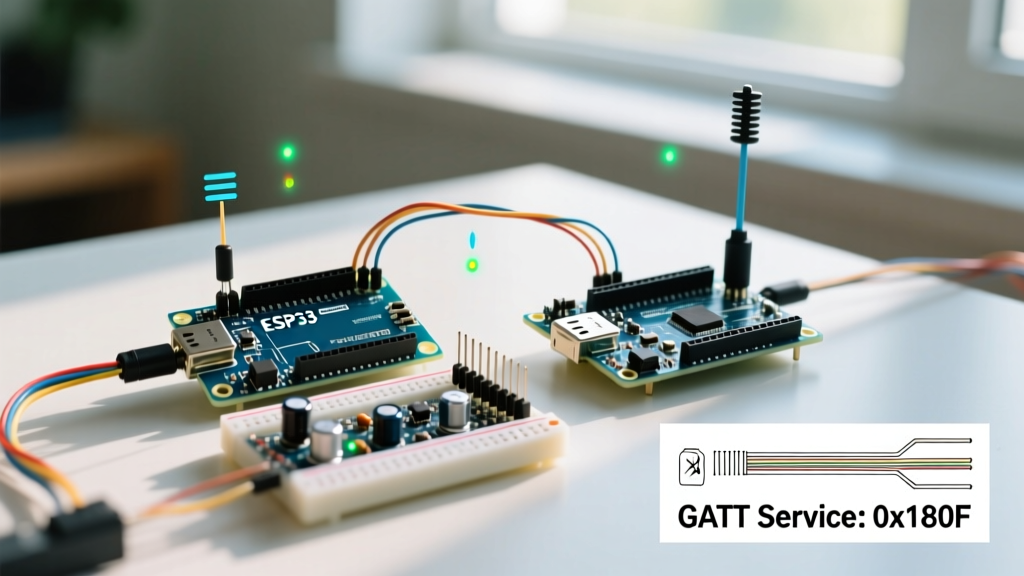
To achieve true advanced telemetry, encrypted links, and sub-20ms latency between microcontrollers, you must transition to Bluetooth Low Energy (BLE) utilizing the Generic Attribute Profile (GATT). This guide dissects the architecture of robust BLE GATT communication between an Arduino Nano 33 BLE Sense Rev2 (acting as the sensor node) and an ESP32-S3 DevKitC-1 (acting as the central aggregator), moving far beyond basic tutorials into MTU negotiation, connection interval tuning, and stack-level failure mitigation.
Hardware Matrix and Cost Analysis (2026)
Selecting the right silicon is critical for BLE performance. The table below compares the standard legacy approach with modern, advanced BLE-capable microcontrollers readily available in the Arduino ecosystem.
| Microcontroller / Module | Core / BLE Stack | Approx. Cost (2026) | Advanced BLE Capabilities |
|---|---|---|---|
| HC-05 Module (Legacy) | CSR8645 / Classic SPP | $6.50 | None. High latency, 5V logic, no GATT support. |
| Arduino Nano 33 BLE Sense Rev2 | nRF52840 / ArduinoBLE | $48.00 | Native BLE 5.0, hardware crypto, low sleep current (1.5µA). |
| ESP32-S3 DevKitC-1 | Xtensa LX7 / NimBLE | $13.50 | BLE 5.0 Mesh, massive RAM (512KB SRAM), dual-core processing. |
For this advanced architecture, we utilize the Arduino Nano 33 BLE Sense Rev2 as the GATT Server (Peripheral) due to its integrated environmental sensors and ultra-low power profile, and the ESP32-S3 as the GATT Client (Central) leveraging the highly optimized NimBLE-Arduino stack for rapid data ingestion.
Architecting the GATT Server and Client
Unlike classic serial, BLE does not stream raw bytes blindly. It relies on a structured hierarchy of Services and Characteristics. A Service acts as a container (e.g., a "Telemetry Service"), while Characteristics are the actual data points (e.g., "Temperature", "Vibration FFT Data").
Custom 128-bit UUID Generation
Never use the standard 16-bit SIG-adopted UUIDs (like 0x180F for Battery Service) for proprietary telemetry data, as mobile OS background-scanning algorithms and central stacks often filter or mishandle custom payloads mapped to standard UUIDs. Generate a custom 128-bit UUID. According to the Bluetooth SIG Assigned Numbers specification, you must use the base UUID format and replace the 'x' segments: xxxxxxxx-0000-1000-8000-00805F9B34FB.
Example custom service UUID: 19B10000-E8F2-537E-4F6C-D104768A1214.
Advanced Throughput Tuning: MTU Negotiation
The most common point of failure in advanced bluetooth arduino to arduino projects is silent data truncation due to Maximum Transmission Unit (MTU) mismatches. By default, the BLE ATT_MTU is 23 bytes. Because the ATT protocol requires a 3-byte header for the Handle and Opcode, your actual usable payload per packet is only 20 bytes.
If your sensor node attempts to send a 64-byte JSON string or a raw FFT array via characteristic.writeValue() without MTU negotiation, the stack will either fragment the packet (introducing massive latency overhead) or drop it entirely.
Implementing MTU Requests
On the ESP32-S3 (Client) using the NimBLE library, you must explicitly request an MTU bump immediately upon connection. On the Nano 33 BLE (Server) using the ArduinoBLE library, you must configure the stack to accept it.
- Server Side (Nano 33 BLE): Call
BLE.setMTU(128);inside yoursetup()block before callingBLE.advertise(). This tells the nRF52840 stack it is permitted to negotiate up to 128 bytes. - Client Side (ESP32-S3): After a successful
BLEClient::connect(), executeclient->setMTU(128);. The underlying NimBLE stack will send an Exchange MTU Request PDU. - Payload Verification: Always verify the negotiated MTU before transmitting large arrays using
client->getMTU() - 3to calculate the exact safe payload boundary.
Latency Optimization: Connection Intervals
Connection intervals dictate how often the Central device polls the Peripheral for data. The default interval on many generic BLE stacks is 50ms to 100ms, which is unacceptable for high-speed vibration or audio telemetry.
The BLE specification defines connection intervals in units of 1.25ms. To achieve a 15ms polling rate (ideal for real-time PID control loops between Arduinos), you must request an interval of 12 (15ms) to 24 (30ms).
Expert Note: The Central device (ESP32) ultimately dictates the connection interval. The Peripheral (Nano 33 BLE) can only request an update via the L2CAP Connection Parameter Update Request. If the ESP32's NimBLE stack is configured to reject intervals below 30ms to save power, your low-latency request will be silently ignored by the host controller.
To enforce high-speed polling on the ESP32-S3 NimBLE stack, modify the connection parameters immediately after linking: client->updateConnParams(12, 24, 0, 400);. This sets the min interval to 15ms, max to 30ms, latency to 0 (no skipped events), and supervision timeout to 4 seconds.
Reliable Data Transfer: Notify vs. Indicate
When pushing data from the Server to the Client, you have two primary mechanisms:
- Notify: The server sends the data without requiring an acknowledgment from the client. It is faster but unreliable in high-RF-noise environments.
- Indicate: The server sends the data and waits for an ATT Handle Value Confirmation from the client. If the ACK is not received within the supervision timeout, the link is dropped.
For advanced telemetry where packet loss is unacceptable but link drops are costly, use Notify combined with a custom application-layer sequence number. Embed a 1-byte rolling counter (0-255) in the first byte of your payload. The ESP32 client tracks this counter; if a gap is detected, it sends a lightweight write command back to the Nano 33 BLE requesting a re-transmission of the missing sequence block from a local ring buffer.
Real-World Failure Modes and Debugging
Working deeply with BLE stacks exposes several edge cases that generic tutorials fail to address. Below are the most critical failure modes encountered in production bluetooth arduino to arduino deployments.
1. The "Error 133" (GATT_CONN_TERMINATE_LOCAL_HOST)
If your ESP32 Serial monitor spits out Error 133 during connection or service discovery, it rarely means the remote device is offline. In the NimBLE and ESP-IDF stacks, Error 133 typically indicates that the local host controller terminated the connection due to a stack timeout or resource exhaustion. Solution: Ensure you are not blocking the main loop with delay() during the service discovery phase. The BLE RTOS task requires CPU cycles to process L2CAP signaling. Use non-blocking state machines for connection handshakes.
2. Flash Wear from Bonding Cache Overflow
During development, repeatedly flashing the Nano 33 BLE while the ESP32 holds cached bonding keys will result in immediate encryption failures (SMP Pairing Failed). The nRF52840's flash sector dedicated to bonding becomes corrupted or mismatched. Solution: Implement a "clear bonds" hardware trigger. Map a specific GPIO pin on boot; if pulled LOW, execute the stack-specific command to wipe the bonding table in flash before initializing the BLE advertisement.
3. Supervision Timeout Mismatches
If your Arduinos are mounted on moving robotics (e.g., a drone and a ground station), brief RF occlusions will drop the link if the supervision timeout is too low. The Espressif BLE API documentation recommends setting the supervision timeout to at least 6x the maximum connection interval to survive transient 2.4GHz Wi-Fi interference.
Summary Checklist for Production Deployment
- UUIDs: Verified custom 128-bit UUIDs for all proprietary telemetry characteristics.
- MTU: Explicitly negotiated to 128+ bytes; payload sizes dynamically calculated via
getMTU() - 3. - Intervals: Connection parameters updated to 15ms-30ms for low-latency control loops.
- Reliability: Application-layer sequence counters implemented over BLE Notify for lossless streaming.
- Error Handling: Non-blocking state machines utilized to prevent RTOS watchdog resets and Error 133 terminations.
By abandoning legacy serial emulation and embracing the granular control of GATT, MTU negotiation, and connection parameter tuning, your bluetooth arduino to arduino architecture will achieve the reliability, speed, and power efficiency required for professional-grade embedded systems in 2026 and beyond.